Rahile Dawut Wall
on March 12, 2019
Wall mural of Rahile Dawut at the exhibition of ‘I Can’t Sleep: Homage to a Uyghur Homeland’ at the Miyako Yoshinaga gallery in New York, January 2019.

Wall mural of Rahile Dawut at the exhibition of ‘I Can’t Sleep: Homage to a Uyghur Homeland’ at the Miyako Yoshinaga gallery in New York, January 2019.
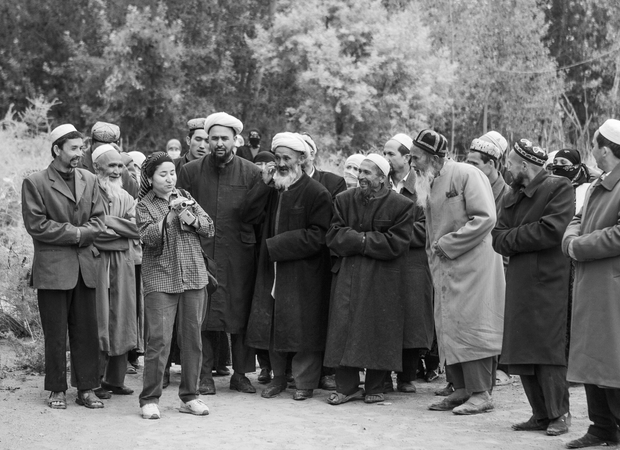
Rahile Dawut shares her field work with a group visiting a pilgrimage site south of the Taklamakan desert, 2005.
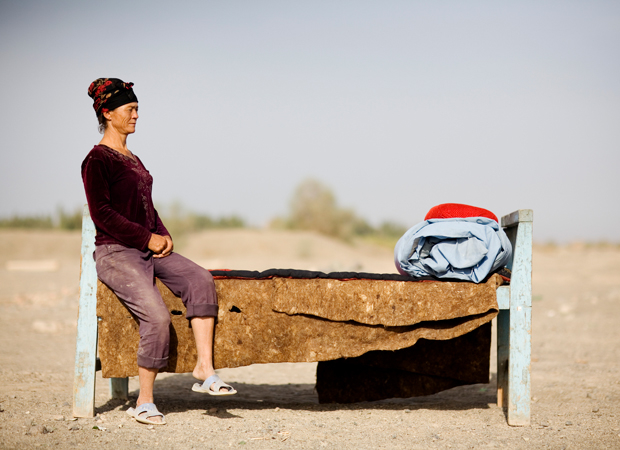
In the 2000s, New York-based artist Lisa Ross traveled to the city of Turpan in China’s Xinjiang Uighur Autonomous Region and photographed local people on the beds that they keep in their fields. The portraits in that series are currently on exhibit at the Miyako Yoshinaga gallery in New York through March 16, 2019.
Lisa Ross is an artist and photographer from New York, currently living and working in the Bronx.
Ross has traveled extensively for her work. She had her first museum exhibition at the Rubin Museum of Art, and a book titled Living Shrines was published by The Monacelli Press in 2013. Her work has also been exhibited at Fotografiska Museum, Sweden; Les Rencontres d’Arles, France; Brunei gallery, London; University of California, Berkeley; Harvard University; and La Viélle Charité in Marseilles, France. Ross was commissioned by the Center of Conservation, Restoration and Preservation in Marseilles to create new work in Azerbaijan.
Ross was an Artist-in-Residence at The Watermill Center, NY; Salzburg Fine Arts Academy, Hallein Austria; and View Art Gallery, Lanzhou, China. Ross was a grantee of the Asian Cultural Council of New York and received a travel grant for the Xinjiang Uighur Autonomous Region, China.
Ross’ work has received reviews in The New York Times, The New Yorker, New York Magazine, Artforum, The Wall Street Journal, and many other print and online journals. Her book has received enthusiastic responses in The New York Review of Books, The Los Angeles Review of Books, and London Review of Books. Ross received a B.A. from Sarah Lawrence College and an M.F.A. from Columbia University. She has taught at Columbia University and Parsons School of Design and created a Photography and Video Program for LGBT youth at the Harvey Milk High School which she ran for a decade.
In February 2017, the United States and China began renegotiating the five-year film pact that had limited the annual number of foreign film exports to China to 34 and the share of revenue payable to foreign-rights holders to 25 percent of gross box office. Hollywood wanted an increase in revenue-sharing films, a higher share of box-office receipts, and more access to key viewing windows in China’s ever-expanding film market. In January 2018, Beijing agreed to discuss “policies and practices that may impede the U.S. film industry’s access to China’s market,” and in April Chinese negotiators reportedly offered to raise annual quotas. But then the talks stalled amidst the contentious U.S.-China trade negotiations. And now, the same trade dynamics affecting products as diverse as soybeans and auto parts have hit Hollywood.

Li Chen is an Assistant Professor and International Security and Strategy Program Director at the School of International Studies at Renmin University. He teaches courses on international history, Asia-Pacific security, and strategic studies. His research interests include strategic and diplomatic history, modern Chinese military strategy, and China-U.S. security relations, on which he has published scholarly articles in leading journals such as The Journal of Strategic Studies, China Military Science, and various policy briefings. He is also a fellow of the National Academy of Development and Strategy at Renmin University, focusing on policy-relevant studies of traditional security and military strategy. Li received his Ph.D. from the University of Cambridge in 2013.
The U.S.-China military relationship has been relatively stable over the past few years. Both sides’ leaders recognize that effective relations between the two militaries help prevent crises and stabilize the broader bilateral relationship. Events in late 2018, however, demonstrated how easily the military relationship could get off track. How much cooperation can be expected throughout 2019? What should the agenda be for U.S.-China military relations, and what obstacles will need to be overcome?