Chinese Cinemas Cancel Propaganda Film Screenings
on March 8, 2013
Theater operators in several cities called off showings of government-backed “Young Lei Feng” after the film failed to sell a single ticket during its premiere on Monday.
Theater operators in several cities called off showings of government-backed “Young Lei Feng” after the film failed to sell a single ticket during its premiere on Monday.
A look at the recent high volume of unruly behavior from flight passengers, and how it reflects on the “national character" of the Chinese people.
China has been trying to slow its runaway growth and morph itself from an export-driven economy to one more like America, with no evidence of success.


From their website:
Celebrating 10 years in 2015, The Huffington Post is a Pulitzer Prize-winning source of breaking news, commentary, entertainment, features and lifestyle content, as well as a platform for a highly engaged community of opinion and conversation.
Learn how to be a selfless good Samaritan like Lei Feng through Zhang Leping's Sanmao comics.
From their website:
I first moved to China in 2005 to study Mandarin in Beijing. Fascinated by an ever-changing country, I spent most of the following decade bouncing back and forth between China and the United States. During those years, I spent the majority of my time in graduate school and eventually earned a Ph.D. in Chinese history at the University of California, Irvine in 2014. I also pursued my love of writing and travel, combining the two as frequently as I could. I’ve contributed to a number of publications, including the Wall Street Journal‘s China Real Time blog, the Los Angeles Review of Books, the Ms. Magazine blog, and The TLS. Additionally, I possess extensive editorial experience, having worked at The China Beat, ChinaFile, the Journal of Asian Studies, Twentieth-Century China, and GradHacker. I currently co-edit the LA Review of Books China Blog with Jeff Wasserstrom.
As an academic, my research examines Chinese social and cultural history from the beginning of the 19th century through today, and I tend to emphasize the links between China’s past and present in both my scholarly and general-audience writing. I’m also deeply engaged in discussions about being an “alternative academic,” as someone who appreciates her graduate training but has never envisioned a life on the tenure track.
Now based in New York, I am a program officer at the National Committee on U.S.-China Relations, an organization that promotes constructive relations between the United States and China.
Zong Qinhou's sentiment speaks volumes, highlighting the monumental obstacles investors face in China as they look for places to park their money in hopes of a return.
The United States and China introduced a resolution that would tighten inspections of suspect ship and air cargo and subject the country’s diplomats to invasive scrutiny and increased risk of expulsion.
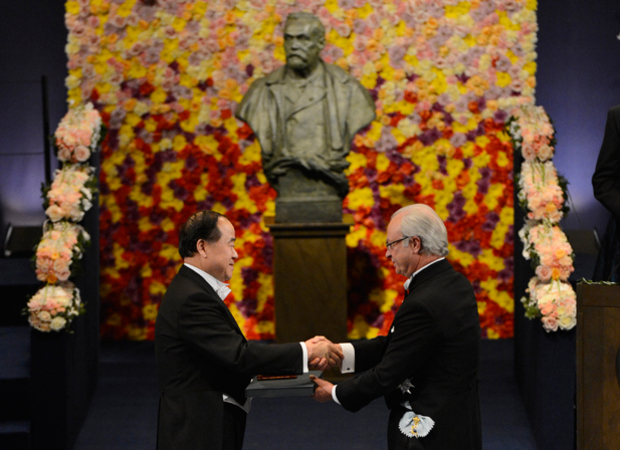
When Chinese author Mo Yan won the Nobel Prize for literature last year, many critics were fast to pounce on his selection, accusing the committee of making a political choice that glossed over what many consider to be pervasive self-censorship in the writer’s prose. But how much of this is true?
Dorinda Elliott: