


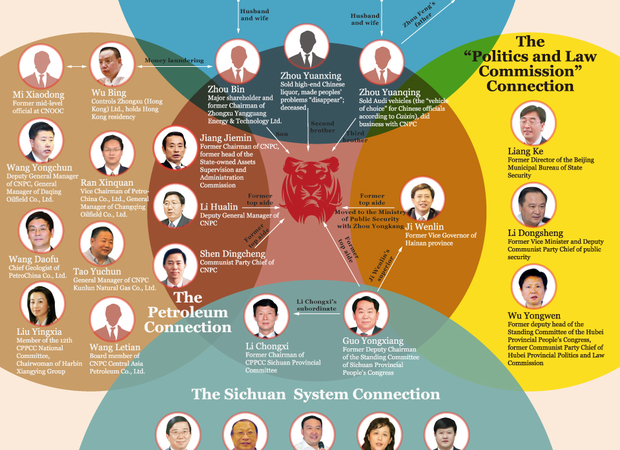
Tiger, Tiger, Burning Bright [Graphic]
on March 20, 2014
Isaac Stone Fish is the founder and CEO of Strategy Risks. Founded in 2021, Strategy Risks helps clients manage geopolitical risks, with a focus on China. Stone Fish is the author of America Second: How America’s Elites are Making China Stronger (Knopf), a book about American political and business leadership’s deep ties to China, and how this impacts the United States.
Stone Fish also serves as a contributor to CBSN, an adjunct at NYU’s Center for Global Affairs, a Visiting Fellow at the Atlantic Council, and a columnist on China risk at Barron’s. He is a term member at the Council on Foreign Relations, a Truman National Security Project Fellow, and a Senior Advisor to the Korea Society. He previously served as a Senior Fellow at the Asia Society’s Center on United States-China Relations, and the German Marshall Fund, and as the Asia Editor at Foreign Policy Magazine.
A fluent Mandarin speaker and formerly a Beijing correspondent for Newsweek, Stone Fish spent seven years living in China, and has visited every province, municipality, and special administrative region. He is an experienced speaker on United States-China business, economics, and politics, and his views on international affairs are widely quoted on CBS, CNN, NPR, Bloomberg, The Guardian, The New York Times, and other major news media. He lives in New York City.
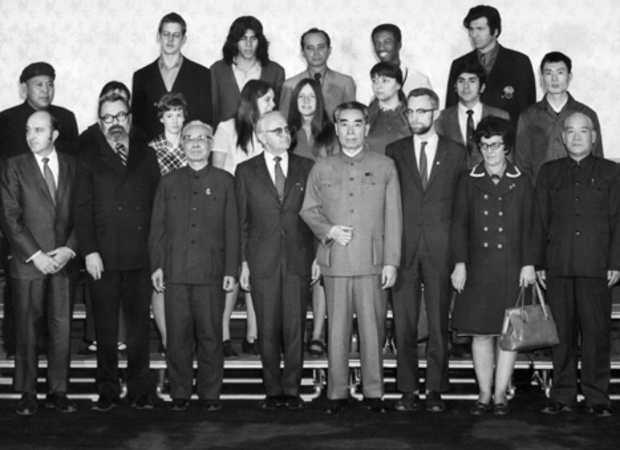
For Richard Nixon’s foreign policy, 1971 was the best of years and the worst of years. He revealed his opening to China, but he connived at genocide in East Pakistan. Fortunately for him, the world marveled at the one, but was largely ignorant of the other.
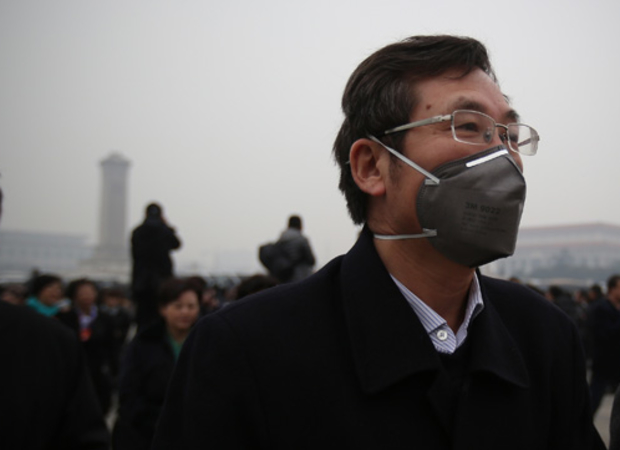
China’s environmental spending showed a year-on-year drop of almost ten percent in 2013, according to the budget report delivered at China’s annual parliamentary gathering.
The Chinese and U.S. economies have been locked in an uncomfortable embrace since the late 1970s. Although the relationship initially arose out of mutual benefits, in recent years it has taken on the trappings of an unstable codependence, with the two largest economies in the world losing their sense of self, increasing the risk of their turning on one another in a destructive fashion.
In Unbalanced: The Codependency of America and China Stephen Roach lays bare the pitfalls of the current China-U.S. economic relationship. He highlights the conflicts at the center of current tensions, including disputes over trade policies and intellectual property rights, sharp contrasts in leadership styles, the role of the Internet, the recent dispute over cyberhacking, and more.
A firsthand witness to the Asian financial crisis of the late 1990s, Roach likely knows more about the U.S.-China economic relationship than any other Westerner. Here he discusses:
In the wake of the 2008 crisis, both unbalanced economies face urgent and mutually beneficial rebalancings. Unbalanced concludes with a recipe for resolving the escalating tensions of codependence. Roach argues that the Next China offers much for the Next America—and vice versa.—Yale University Press
Fred Andrews, The New York Times (February 15, 2014)
Glenn C. Altshuler, Huffington Post (January 21, 2014)

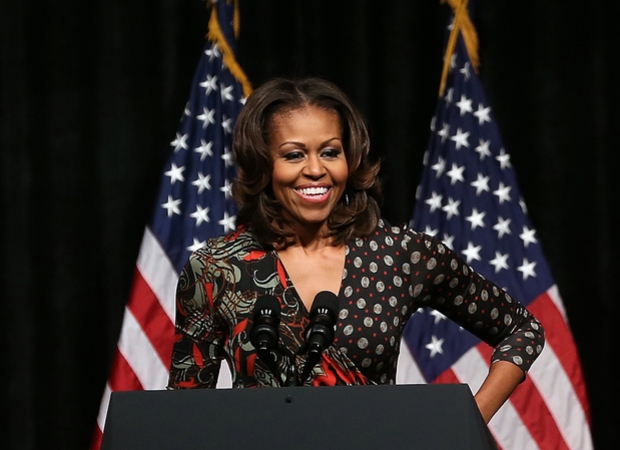
Orville Schell: Looking at the challenges of rectifying U.S.-China relations and building some semblance of the "new kind of a big power relationship" alluded to by presidents Obama and Xi at Sunnylands last year, will most certainly require a multi-stage ongoing effort. Michelle Obama's trip to China with her mother and her two daughters this week could prove to be a very constructive next step.
Police nabbed property developer Zhao Xingru and detained her for more than thirty days in late 2012 and early 2013 based on fraud allegations filed by executives at one of the country's largest developers, Hangzhou-based Greentown China Group.
But the detention ended abruptly and in the end Zhao was cleared of several serious charges leveled by Greentown, including contract forgery and faking transaction documents.

People in China cannot breathe, and they are getting tired of trying to mask it. One newlywed couple, in an act of protest, took their wedding portraits outdoors.




From their website:
Mic’s approach to news is as unique as our generation. Young people will define the future and we deserve a news outlet that offers quality coverage tailored to us. We are hungry for news that keeps us informed and helps us make sense of the world.
Mic was founded in 2011 by Chris Altchek and Jake Horowitz under the shared belief that millennials are inquisitive, have a healthy skepticism for conventional wisdom, and crave substantive news to spark interesting conversations. This sensibility informs everything we do.




Founded in 2004, EG365 is a professional design service provider. It was the first to introduce the concept of information visualization into mainland China. EG365 provides information graphics, video, interactive, and many other information visualization services to corporate and institutional clients.