


Hong Kong—Now What?
A ChinaFile Conversation
on September 2, 2014
David Schlesinger:
Hong Kong’s tragedy is that its political consciousness began to awaken precisely at the time when its leverage with China was at its lowest ebb.
Hong Kong’s tragedy is that its political consciousness began to awaken precisely at the time when its leverage with China was at its lowest ebb.
Harry W.S. Lee is a journalist based in East Asia. He has written for World Policy Journal and Korea Joongang Daily. His coverage of the Occupy Wall Street protests and New York Police Department's surveillance of Muslim communities at New York University have also been featured in The Nation.
Lee completed an M.Phil. in Modern Chinese Studies at the University of Oxford and holds a B.A. in Political Science and Economics from New York University. Having lived in the U.K., the U.S., and South Korea, Lee will be working as a freelance journalist in Beijing.
China's management of urbanization is an under-appreciated factor in the regime's longevity. The Chinese Communist Party fears "Latin Americanization"—the emergence of highly unequal megacities with their attendant slums and social unrest. Such cities threaten the survival of nondemocratic regimes. To combat the threat, many regimes, including China's, favor cities in policymaking. Cities and Stability shows this "urban bias" to be a Faustian Bargain: cities may be stabilized for a time, but the massive in-migration from the countryside that results can generate the conditions for political upheaval. Through its hukou system of internal migration restrictions, China has avoided this dilemma, simultaneously aiding urbanites and keeping farmers in the countryside. The system helped prevent social upheaval even during the Great Recession, when tens of millions of laid-off migrant workers dispersed from coastal cities. Jeremy Wallace's powerful account forces us to rethink the relationship between cities and political stability throughout the developing world. —Oxford University Press

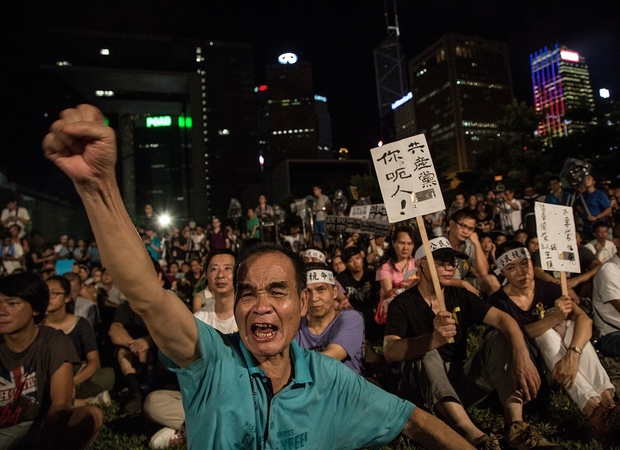
In a huge rally on Sunday in Hong Kong, democratic groups already were declaring a new era of civil disobedience.
Rosneft is proposing that China take a stake in one of its largest oilfields—a deal that would deepen energy ties between Moscow and Beijing at a time when the future of western companies in Russia is uncertain.
EU proposed sanctions against Russia over accusations Moscow was sending troops into Ukrainian territory, saying the European Union's push to draw up more measures would only complicate the crisis.
The Chinese authorities have accused British MPs of interfering in Hong Kong's affairs.
China is targeting foreign companies with opaque laws and rules, according to a group representing U.S. businesses there, contributing to a deteriorating environment for investment in the nation.
In a bid to boost its ailing economy, Mongolia is refocusing its foreign policy on its traditional partners Russia and China. But experts warn Ulan Bator runs the risk of becoming increasingly dependent.
The Beijing government has rejected demands for free, open elections for Hong Kong’s next chief executive, in 2017, enraging protesters who had called for broad rights to nominate candidates.