


Caixin magazine reported that Guo Guangchang, the billionaire chairman of Fosun International Ltd. couldn’t be contacted.
Polluted Skies Heighten Challenge for Chinese Government
on December 11, 2015
Red has been considered the color of prosperity and good fortune in China for centuries, and it is also the color of the Communist Party.
Tiananmen Police Don Smog Masks, Wind Makes or Breaks the Blue Sky | PM25.info
on December 11, 2015
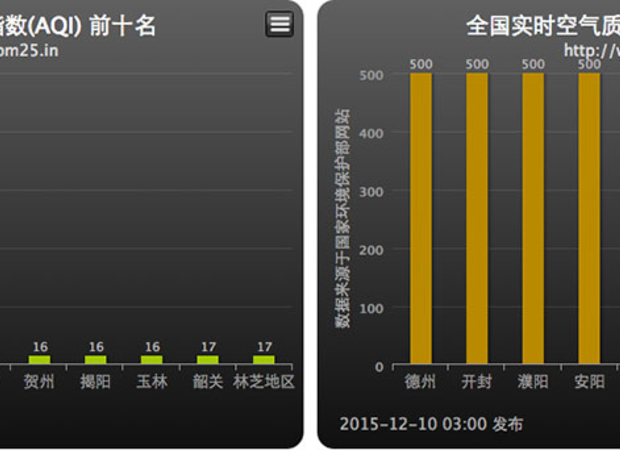
A screenshot of the air pollution ratings of Chinese cities on the early morning of December 10, 2015. Smog was expected to be clearer later that day. Beijing didn’t even make the top ten most polluted cities, which included Dezhou, Kaifeng, Puyang, Anyang, Baoding, Xingtai, Zhengzhou, Liaocheng, Handan, and Hefei.
China’s Anti-Corruption Cases Have Quadrupled Since 2013
on December 11, 2015
In Chinese business and political circles, conversations frequently return to a familiar question: When will President Xi Jinping’s anti-corruption campaign end?
Tiananmen Police Don Smog Masks, Wind Makes or Breaks the Blue Sky | Beijing Dec 5, 2015
on December 10, 2015
NASA satellite images of northern China from December 5-10, 2015 illustrate how wind cleared the air pollution in Beijing and other cities.

Amid China’s Smog Worries, One More: Counterfeit Masks
on December 10, 2015
The customs authorities in Shanghai have seized nearly 120,000 counterfeit surgical masks.
Pacific
on December 10, 2015
Following his acclaimed Atlantic and The Men Who United the States, New York Times bestselling author Simon Winchester offers an enthralling biography of the Pacific Ocean and its role in the modern world, exploring our relationship with this imposing force of nature.
As the Mediterranean shaped the classical world, and the Atlantic connected Europe to the New World, the Pacific Ocean defines our tomorrow. With China on the rise, so, too, are the American cities of the West coast, including Seattle, San Francisco, and the long cluster of towns down the Silicon Valley.
Today, the Pacific is ascendant. Its geological history has long transformed us—tremendous earthquakes, volcanoes, and tsunamis—but its human history, from a Western perspective, is quite young, beginning with Magellan’s sixteenth-century circumnavigation. It is a natural wonder whose most fascinating history is currently being made.
In telling the story of the Pacific, Simon Winchester takes us from the Bering Strait to Cape Horn, the Yangtze River to the Panama Canal, and to the many small islands and archipelagos that lie in between. He observes the fall of a dictator in Manila, visits aboriginals in northern Queensland, and is jailed in Tierra del Fuego, the land at the end of the world. His journey encompasses a trip down the Alaska Highway, a stop at the isolated Pitcairn Islands, and a trek across South Korea and a glimpse of its mysterious northern neighbor.
Winchester’s personal experience is vast and his storytelling second to none. And his historical understanding of the region is formidable, making Pacific a paean to this magnificent sea of beauty, myth, and imagination that is transforming our lives. —HarperCollins
Book Review:
Andrew Lycett, The Telegraph (November 2, 2015)
Philip Hoare, The Guardian (November 1, 2015)
Jennifer Senior, The New York Times (November 1, 2015)
Nina Maclaughlin, The Boston Globe (October 24, 2015)
Global Carbon Emissions May Stall in 2015
China's Efforts to Curb Coal Contributes to Slowdown in Global Emissions
on December 10, 2015
Global carbon dioxide emissions from burning coal, oil, and gas as well as from industrial activities grew by just 0.6 percent in 2014, according to researchers from the Global Carbon Project of the organization Future Earth.
The researchers say emissions have grown even more slowly this year, and may even show a small decrease of 0.6 percent by the end of this year.
Mission Improbable—Jack Ma, China’s Biggest E-Commerce Tycoon, Wants To Be a Media Mogul Too
on December 10, 2015
As U.S. and Europe Pass the Hat at Climate Talks, China Clings to Developing-Nation Status
on December 10, 2015
This week, China is crying poverty.