breadcrumb

A Comparison of China’s and America’s Richest People

CNPolitics, a Chinese-language news website, recently released this infographic examining the differences between China and America’s wealthiest individuals as reported by Forbes Magazine. As the site notes, China’s relatively recent economic rise means its wealthy tend to be younger. Perhaps surprisingly for a country where all land legally belongs to the state, China’s rich are more likely than their American counterparts to have made their money in real estate. While the data may exclude individuals with undeclared assets—and thus potentially a number of contenders from both countries—it does reveal some unique differences between the world’s top two economic powerhouses. ChinaFile partner site Tea Leaf Nation translates.

America’s wealthy have more money

Total GDP (in 1 billion USD increments)
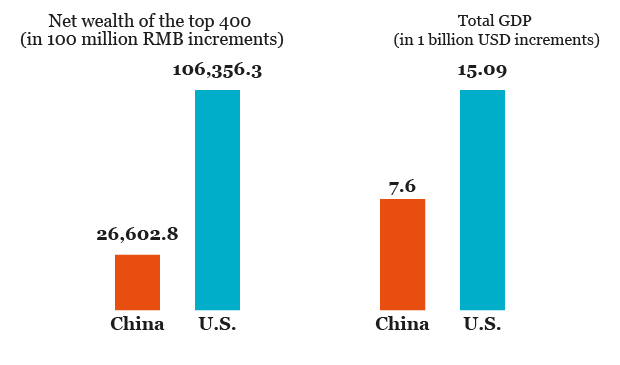
Net wealth and GDP

America’s wealth is distributed more evenly across the country

Entrepreneurs in China’s coastal regions have benefited from policies promoting development, and have climbed more quickly into the ranks of the wealthy. The top nine people on Forbes’ list of the wealthiest Chinese are from those provinces. In contrast, America’s wealthy are spread more evenly throughout the country. Excepting California and New York, there are not very significant geographical differences.
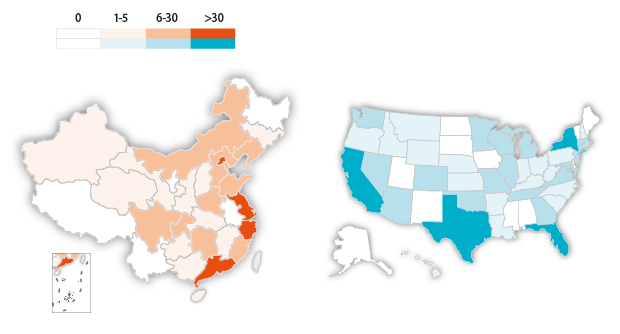
Map of Wealth Dirstribution

China’s wealthy are younger

Since 1992, China’s market economy has grown rapidly, and many of today’s wealthy began to get rich then. People around age fifty make up the largest group; they were around thirty years old and in their golden entrepreneurial years in 1992.
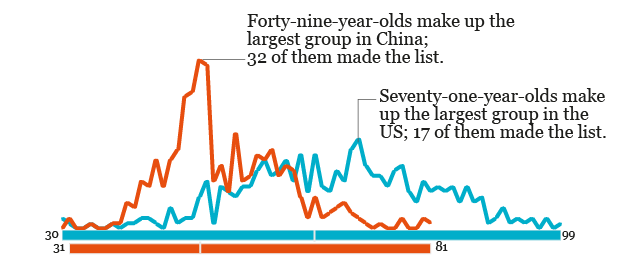
Wealth by Age

The average age of China’s richest 400 is forty-nine years old, the average for the U.S. is sixty-five.

China’s wealthy are hooked on real estate. There are more wealthy in the Information Technology industry in the U.S..

America’s wealthy work in a greater variety of fields: sports, the media, self-storage, express delivery services, airplane rental … these industries do not make one wealthy enough to make the Forbes list in China. The ability of the Internet to create wealth and innovate is strong in the U.S. as always, while some of China’s wealthy IT moguls got rich through income from the online gaming industry.

Of China’s wealthy, 129 had operations related to real estate; their total worth makes up approximately 35 percent of the total for all 400.

Of America’s wealthy, thirty-six people had operations related to real estate; their total worth makes up approximately 6.8 percent of the total for all 400.

Thirty of America’s wealthiest 400 have operations related to IT, software, and the Internet, while for China is was only eighteen.

Representatives of the next generation of Chinese and American wealth
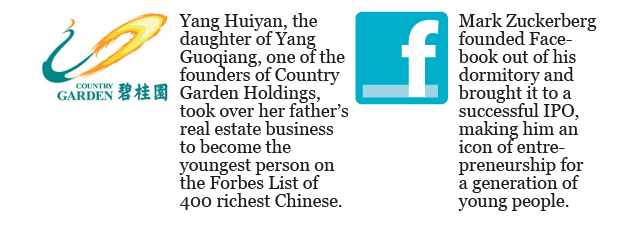
Next Generation of Wealth

What are the real differences between the U.S. and China? Perhaps they are embodied in the differences in the wealthy in each country.

CNPolitics is an independent group blog committed to introducing academic studies on Chinese politics to the Chinese public. Through short articles, infographics, and first-hand...

More

Tea Leaf Nation is an e-magazine founded in 2011 whose editors aspire to make it a must-read source for China experts of all stripes—journalists, diplomats, academics, analysts...

More

Statistical analysis by Zhang Rengang
Graphic design by Lü Yan
Translated by Liz Carter for Tea Leaf Nation, with permission from CNPolitics.org
Adapted by David M. Barreda

Interactive

04.09.13

China, North Korea, and Nuclear Arms

OUYANG BIN, DAVID M. BARREDA, ZHANG XIAORAN (& authors)

As tensions again escalate on the Korean Peninsula, ChinaFile examines more than a decade of developments in North Korea’s nuclear armaments program. We begin our timeline in late 2002, when China first joined diplomatic discussions, paving the way for what would become...

Interactive

02.14.13

Who Supplies Apple? (It’s Not Just China): An...

DAVID M. BARREDA, DAVID WERTIME, TEA LEAF NATION

Last month, Apple Inc. released its updated list of suppliers. This report says it includes “the major manufacturing locations of suppliers who provide raw materials and components or perform final assembly on Apple.” ChinaFile used this data to construct the interactive map...

Interactive

01.10.13

What Does China Think?

CNPOLITICS, TEA LEAF NATION

Are Chinese citizens happy with the direction their country is taking? Do they believe in a market economy? Do they believe that hard work brings success? Each year, the American think tank Pew Research Center asks questions like these to over 300,000 interviewees across...

DISCUSSION

Making It Big in China

JONATHAN MIRSKY

Jianying Zha describes China as “way too big a cow for anyone to tackle in full.” Therefore, Ms. Zha says, she omits “the rural life, the small-town stories, the migrants working in huge manufacturing plants…continued poverty in parts of interior rural China, surging...

Caixin Media

03.19.12

Fair Trade

CAIXIN

A typically opaque investigation can begin with a tip from a Shanghai Stock Exchange official and end with a ten-year jail term for a businessman convicted of insider trading. What happens in between is a carefully guarded secret. Likewise hidden from the public eye are the...

Caixin Media

04.09.12

Dalian Businessman Who Built an Empire Vanishes

CAIXIN

(Dalian)—The sudden disappearance of a self-made billionaire in the coastal city of Dalian has unnerved not only bank executives concerned about loans they made to his companies, but also government officials who have lent generous support to the expansion of his business...