


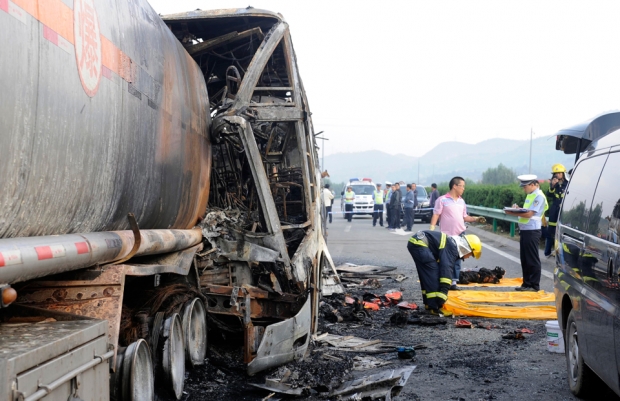
Thirty-six people died recently on a Shaanxi province highway when a double-decker bus slammed into a fuel tanker.
The crash underscored ongoing demands for beefing up traffic law enforcement and improving the design of these often-crowded overnight buses, which transport nearly 180 million passengers in China every year.
Only three passengers emerged alive from the sleeper bus early August 26, when the long-distance bus collided with a truck methanol in Yan’an and burst into flames.
Authorities said a preliminary investigation found each of the bus’ two drivers were negligent. A GPS tracking service had sent them a fatigue warning just before the accident. Investigators say the driver behind the wheel was too tired.
On August 27, Shaanxi province Governor Zhao Zhengyong announced all sleeper buses would be banned from provincial roads at night for the next week while investigators probed the wreck.
Meanwhile, new questions have been raised about alleged manufacturing and design flaws in sleeper buses. Some are said to have too few emergency exits. Others are made with highly flammable materials in seat upholstery and curtains.
Migrant worker Wang Xianze, 50, was a survivor of the Yan’an crash. He planned to take the bus from Inner Mongolia to Xi’an, and then transfer to another sleeper to reach his destination, Chongqing.
When the accident occurred, Wang opened and climbed out of one of only two safety windows.
The dead included nine students, ten migrant laborers, thirteen employees of various companies, a self-employed person, and an unidentified person died, Yan’an authorities said. Both drivers perished as well.
Driving in Circles
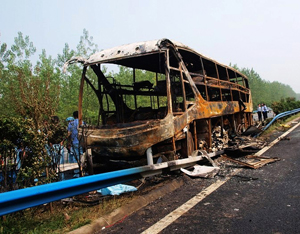
Between 2004 and 2010, 20 percent of all major traffic accidents nationwide in which more ten people died involved sleeper buses, according to the Ministry of Transportation.
Critics say regulators are quick to issue violation notices after such tragedies, but remain excruciatingly slow about enforcing safety laws.
The ministry released a notice in July 2011 that said every sleeper bus driver was required to stop driving after pulling over at a highway rest stop any day between 2 and 5 a.m. But only Jiangsu province authorities have taken clear steps toward making sure these central government safety regulations are being been followed, said a report in the Oriental Morning Post.
In March, the Ministry of Industry and Information and Technology and the Ministry of Public Security released a notice banning all production and sales of sleeper buses. They said sleeper buses would have to be taken off all roads in China within six years.
Meanwhile, though, this cheap and simple means of intercity travel remains highly popular for low-wage workers and others on a budget. A survey conducted last year by several government agencies found 60 percent of sleeper bus passengers were farmers and migrant laborers.
Currently more than 30,000 sleeper buses roll down China’s highways following more than 5,000 scheduled routes, the China Road Transport Association said.
After surviving the latest big crash, Wang was asked whether he would ever again ride a sleeper bus. “It depends,” he said.
Ren Zhongyuan, Luo Jieqi, and Liang Dongmei are Caixin staff reporters.