breadcrumb

Tibetans Fight Tourism on Holy Lakes

Mining, dam construction, sand excavation, poaching, and grassland degradation are seriously damaging the Qinghai-Tibet plateau, the world’s most fragile ecosystem. But without a second thought, the tourism industry has joined their ranks. The only difference is that tourism, rather than acting covertly, has swaggered in and brazenly harmed this beautiful and sacred place.

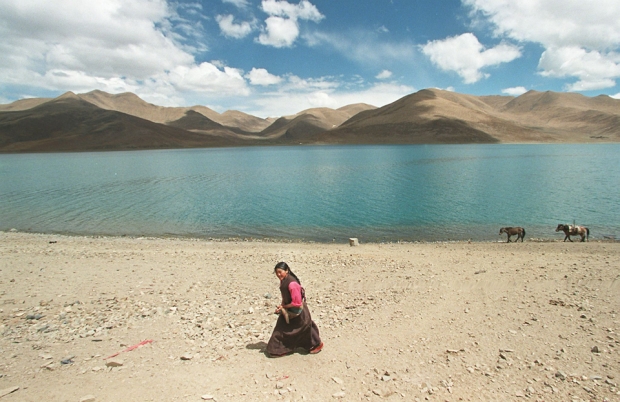
On June 15, local media announced that Tibet will launch boating tours on Yamdrok Lake, one of the largest sacred lakes in the Tibet Autonomous Region. This news sparked an immediate public outcry. Yamdrok Lake is less than 100 kilometers from Lhasa and, along with Namtso and Manasarovar, is one of Tibet’s three holy lakes. It is the largest inland lake in the northern Himalayas—a beautiful natural landscape of mountains and water, a rare sight in this world.

Actually, the lake has always been a popular destination, but this announcement aimed to raise its profile. Dawa, chairman of the Tibet Qomolangma Tourism Development Company, said the firm had bought a sightseeing boat called “the Qomolangma I,” two ferries, and several small-sized speedboats from inland China, according to media reports. “We will put all our effort into attracting tourists to come and experience for themselves what it’s like to tour the lake,” he said.

But Yamdrok Lake is more than just a beautiful landscape, it has a special cultural significance for Tibetans. When important “Living Buddhas” pass away, such as the Dalai Lama and the Panchen Lama, senior monks visit Yamdrok Lake to chant mantras and pray. They watch for a sign in the lake, to show them in which child the reincarnated spirit has been reborn.

Most Tibetans could not even imagine motorized tourist boats shuttling about in a place like this, with tourists making a commotion on the peaceful lake. But now this sacred lake of theirs was to become the money-making playground for the local government and tourism companies.

At noon on the same day in June, two environmental activists, one Tibetan and one Han Chinese, held an emergency meeting at the Matchstick Man Café in Xining, the capital of Qinghai province. They decided to launch a campaign to “Save Yamdrok Lake” on Weibo (“Chinese Twitter”). Very early the next morning, Sun Mian, the founder of New Weekly magazine, posted a message on Weibo to his 270,000 followers, demanding that the Yamdrok Lake development should stop. Shortly afterward, the filmstar Chen Kun rallied his 17 million-plus followers: “Let’s leave something for the later generations! Don’t be blinded by short-term interests!”

Public attention on Yamdrok Lake grew dramatically, as celebrities like actress Yao Chen and singer Han Hong joined the campaign. Overnight, the lake grew from a local news story into a national issue. But because of the remote location of the lake, and because the local government and the tourism company refused all interviews, information about the situation could only be spread on Weibo.

A young Tibetan writer called Ying Sa posted an official news piece from five years ago on Weibo which said that the local government had given the tourism company permission to develop Yamdrok Lake: “Nagarze County, Lhoka, Tibet and the Tibet Qomolangma Tourism Development Company will collaborate to transform Yamdrok Lake into a top quality tourism site and work hard to create a good investment environment for Yamdrok Lake.”

Online, environmentalists questioned the actions of the local government; had this project passed an Environmental Impact Assessment? Some internet users urged people to file a complaint on the local government’s official website

The public outcry soon caught the attention of the local government. On June 18, @SaveYamrokLake received a private message from @Tibet Daily: “We are reporting in our morning paper that this project has already been suspended.”

Tourism has been destroying Tibet’s sacred mountains and holy lakes for a long time. Qinghai Lake is a top-grade national scenic spot in Qinghai province and China’s biggest saltwater lake. But it is being over-exploited.

Back in May 2004, a local tourism company announced it would launch a luxury cruise boat called the “Qinghai Pearl” on Qinghai Lake. The boat would have food, sleeping berths and entertainment for tourists. It would be a floating “four-star hotel.” But several academics spoke out against the project. Qinghai Lake is an inland lake; water can flow in, but it cannot flow out. And so all the waste oil, waste water, and litter produced by the cruise ship would permanently pollute the lake. The polluted water would be impossible to clean up, causing irreversible damage to the lake’s ecosystem.

Academic Sun Honglie pointed out that there would be no way to deal with pollution using existing technology, unless pollution was “ladled out, spoonful by spoonful, and clean water poured in.”

Opposition from academics and questions raised by the media forced the Qinghai provincial government to suspend the cruise boat project on Qinghai Lake in the end. By then, about 70% of the so-called luxury cruiser had been built at a construction site on the shores of the lake.

Founder of the “Qinghai-Tibet Plateau Ecological Protection website” Tashi Nyima also joined the campaign to oppose the development of Yamdrok Lake. He said that the environment of Qinghai Lake was being damaged by a heavy load of tourists and boats. Of course, this is not only an environmental issue; it is also about respecting local culture. In an article by Tashi Nyima, he wrote that, even if the activities on Qinghai Lake are environmentally friendly, they do not respect local people’s religious beliefs concerning sacred lakes. Local beliefs in “holy mountains and sacred lakes” play an important role in conserving the Tibetan plateau’s natural resources; their “environmental ethics” have provided a kind of invisible protection.

But time after time, foreign tourists and explorers fail to respect local culture and break religious taboos. In 2004, when a sports teacher from Beijing called Zhang Jian announced that he would swim across the holy Namtso Lake, it sparked great outrage. Namtso, which means “heavenly lake” in Tibetan, is the world’s highest saltwater lake and a sacred site for Tibetans. Many Buddhists meditate in the caves in the cliffs along the edge of the lake.

The year before, Zhang Jian swam across Qinghai Lake, upsetting local Tibetans there. In his quest to conquer Namtso Lake, he again aroused strong opposition. The very popular Tibetcul website published an open letter: “Don’t rush recklessly to every blade of grass and every tree, every hill and every stream. Over the course of history, local people and nature have created a special ecosystem. It should be treasured, and more importantly, it should be respected.”

Zhang Jian canceled his plans to swim across the lake.

The open letter said: “The reason why people call the Qinghai-Tibet plateau the ‘world’s last pure land’ is not just because of its geographical features, but also because of its profound cultural significance. These ‘sacred sites’ are scattered across the plateau: sacred lakes such as Namtso Lake and Qinghai Lake, holy mountains such as Mount Kailash and Khawakarpo Mountain; and revered buildings like the Potala Palace.”

Unfortunately, not a single one of these sacred sites has escaped desecration. Khawakarpo Mountain, which stands over 6,000 meters high, is the world’s highest unclimbed peak. In 1991, a team of Chinese and Japanese climbers attempted to scale the summit. The local people strongly opposed their mission. They prostrated and burnt incense for the mountain, entreating the mountain spirits to stop these outsiders from disrespecting the holy mountain. The climbers were caught in a sudden blizzard and seventeen of them died.

In 1996, the Japanese climbing team tried again, but local people blocked their way on a bridge over the Lancang River. Again, the climbing expedition ended in failure. Later, the local government honored the local people’s wishes and prohibited mountaineering in the Meili Snow Mountains, after gaining the central government’s approval.

But while mountain climbing is now prohibited, the tourist industry has developed in leaps and bounds. Last year, when I was at Khawakarpo Mountain, I saw that the excessive number of visitors had already damaged this holy mountain. The village road that heads deep into the mountains was covered in rubbish. Forests had been cut down to make way for places for tourists to stay. People butchered livestock at the foot of the sacred mountain to cater to travelers’ needs. This would have been unimaginable in the past.

On top of this, official tourism companies and local people now scramble for profit. Revenue from ticket sales is not shared with local people. One local person said: “The infrastructure has grown old, no one looks after it. No one is repairing the wooden roadways on the cliffs; no one is looking after the power; no one is looking after the water; no one is looking out for mudslides! These problems have been created by the government because they handed the Meili Snow Mountains over to companies to manage. Companies put their profits first. They take the money and leave all the bad things behind, such as rubbish.”

In my book called Heavenly Beads, I interviewed Zha Duo, the executive director of the Snowland Great Rivers Environmental Protection Association. He said: “The Qinghai-Tibet Plateau is like a famous painting. This painting is serene, peaceful, like the ideal Shangri-La. But people defile her at will: tourism, mining, blasting holy mountains, cutting down forests and damming rivers. The Qinghai-Tibet plateau is deteriorating at such a rate that it’s as if she doesn’t even have the strength to take a breath. People in the east make money so that they come to the west. But all they think about is money. Who will come and value this famous painting? Who has both the ability and the compassion to protect her?”

Luckily, more and more people are realizing the true value of the Qinghai-Tibet plateau. And more and more people are willing to protect her, like those members of the public who expressed their opposition to the exploitation of Yamdrok Lake on Weibo.

The public are still skeptical about whether or not the local government has really put a stop to the boat project. chinadialogue gave Nagarze’s local government a phone call. An official who asked to remain anonymous said: “This project really has been suspended. The cruise ship has already been towed away under the direct supervision of the head of the county.” Some internet users say they have heard that that boat has been sent to Lhasa. But you can imagine how the company that owns the boat must be looking forward to the time when they can take it back to Yamdrok Lake or use it on another lake, jam-packed with tourists.

chinadialogue is a bilingual source of high-quality news, analysis, and discussion on all environmental issues, with a special focus on China.Founded by international journalist...

More

Liu Jianqiang is chinadialogue’s Beijing-based deputy editor. Read this article at chinadialogue.

Topics: 
Keywords: 

Environment

05.17.13

China Tops Table for Disaster-Induced Displacement of...

CHINADIALOGUE

More than a third of all people forced from their homes by disasters such as floods, storms, and earthquakes in the past five years were in China, says a new report from the leading international body on displacement.Around 49.8 million Chinese people were displaced by natural...

Environment

05.16.13

Singapore’s Growth Story Holds Lessons for Water-...

CHINADIALOGUE

When the tiny city-state of Singapore gained independence in 1965, its social, economic, political, and environmental constraints appeared so formidable that many of those looking in from outside predicted a future of dismal dimensions.Forty years on, the reality looks very...

Environment

05.03.13

Time to End Secrecy Over Chinese Overseas Fishing

CHINADIALOGUE

It is well-known that overseas fishing fleets are more cavalier in terms of respect for laws and regulations than their domestic counterparts. There are innumerable examples from all over the world of fishing with gears that are not part of agreements, or catching amounts of fish...

Environment

04.30.13

Why Has Water-rich Yunnan Become A Drought Hotspot?

CHINADIALOGUE

Yunnan’s drought continues. During China’s annual parliamentary session in March, the deputy party secretary of the southwest Chinese province, Qiu He, blamed spring floodwaters that flow through Yunnan and on into other countries for the water shortages. He proposed a...

Environment

04.22.13

Why It’s Time to End China-bashing on the Environment

CHINADIALOGUE

The major impact that international summits and treaties have had on China’s environmental governance is often overlooked. Environmental protection first emerged as an issue in China in 1972, after the country dispatched a delegation to the U.N. Conference on the Human...

Environment

04.16.13

Morococha: The Peruvian Town the Chinese Relocated

CHINADIALOGUE

The headlines have been stark: a Chinese mining company moves an entire Peruvian town of 5,000 people five miles down the road to make way for its new mine.It sounds like another story about an extractive corporation riding roughshod over local lives. But the reality is more...

Environment

04.10.13

Writing Yunnan a Rubber Check

CHRIS HORTON

Our van stopped at a scenic vista on the contour road where verdant mountains undulated southward toward China’s border with Laos. Stepping out to take some photos, I was overcome by an acrid, unpleasant odor. I asked my local travel partner, Xiao Guan, what the stink was.“...

Environment

03.22.13

Public Fury After Chinese Environment Minister Keeps...

CHINADIALOGUE

In his eight years as China’s environmental protection minister, Zhou Shengxian has failed to keep almost a single promise. I say “almost”: he has kept his word at least when it comes to his own career—as promised, he has not quit.When the new leadership’s ministerial...

Environment

03.18.13

Baby Milk Restrictions Cause Outrage in Mainland China

CHINADIALOGUE

The Hong Kong government’s recent listing of baby formula as a “reserved commodity” and a 1.8kg per person per day export limit has sparked widespread criticism—as well as becoming a hot topic at China’s annual session of parliament [the Lianghui, or “Two Meetings...

Environment

03.13.13

Chinese Fracking Plans Prompt “Water-Grabbing”...

CHINADIALOGUE

China has become one of Asia’s leaders in expanding unconventional shale-gas extraction in the name of energy self-sufficiency and national autonomy. Experiences of “fracking” worldwide, however, suggest the costs to China of joining this revolution will be loss of control...

Environment

03.06.13

Environmentalists Unconvinced by Wen Jiabao’s Green...

CHINADIALOGUE

China’s outgoing premier Wen Jiabao vowed that the government would solve the country’s ever-worsening pollution in his final work report yesterday as he opened the annual session of parliament.But coming amid rising public concern about China’s air, water, and soil quality...

Environment

03.02.13

China Criticized over Tiger Farms and Illegal Ivory

CHINADIALOGUE

China is under pressure to regulate its rampant trade in illegal ivory and tiger parts ahead of the Convention on International Trade in Endangered Species (CITES), opening this weekend in Bangkok.It has also been accused of quietly stimulating domestic markets for tiger skins...

Environment

02.28.13

Drought and Earthquakes Pose “Enormous Risk” to...

CHINADIALOGUE

When the Fukushima nuclear disaster struck, China was building new nuclear power capacity at a rate unprecedented in world history: 40 percent of all reactors planned or under construction were in China. Targets for installed nuclear generation capacity by 2020 were raised...

Environment

02.22.13

Could Smartphones Help Clear China’s Congested Roads?

CHINADIALOGUE

The extraordinary growth of China’s cities is well-known. Today, 160 Chinese metropolises have over one million inhabitants and more than half the population lives in urban areas, which are growing at two to three times the rate of Western cities.One sector feeling the weight...

Environment

02.20.13

Air Quality in China: A Snapshot

TEA LEAF NATION

Nearly five weeks ago, Beijing experienced its worst day of air quality on record: Levels of PM2.5—small particulates that can cause lung, cardiovascular, and respiratory disease—soared to more than thirty times the level considered safe by the World Health Organization.View...

Environment

02.20.13

China Air Daily

MICHAEL ZHAO

Beijing’s air pollution regularly makes international headlines. But exactly how bad is the air in the Chinese capital, home to 20 million people? That’s the question China Air Daily strives to answer—in pictures we take every single day from the same spot.Air pollution...

Environment

02.19.13

China’s Disappointing Absence from U.N. Water Summit

CHINADIALOGUE

After recent heated debate over China’s mega-dam plans, any visitor to the launch on February 11 of the U.N.’s much-vaunted International Year of Water Cooperation would have been disappointed.As well as a notable absence of any representatives from China, there was...

Environment

02.14.13

A Progress Report on U.S.-China Energy & Climate Change...

LEAH THOMPSON

In his second inaugural address, President Barack Obama committed to confronting climate change, stating, “The path towards sustainable energy sources will be long and sometimes difficult. But America cannot resist this transition; we must lead it.” These were welcome words...

Environment

02.13.13

Nuclear Fusion: An Answer to China’s Energy Problems?

CHINADIALOGUE

The global nuclear sector has been through something of an apocalyptic patch since the disaster at Fukushima—from power station shutdowns in Japan and Germany to waste-plan chaos in the U.K. to doubts about China’s ability to showcase new reactor designs.But not everything is...

Environment

02.07.13

Xi Jinping Must Tackle Corruption and Boost Innovation...

CHINADIALOGUE

In January 2013, Australia’s biggest supermarket chain Woolworths began restricting sales of baby formula to four tins per customer after a massive increase in demand stripped shelves bare of popular brands such as Karicare.The buyers were not Australian mothers suddenly...

Environment

02.03.13

Where Does Beijing’s Pollution Come From?

SOHU BUSINESS, TEA LEAF NATION, DAVID WERTIME

In January alone, a stifling and noxious haze twice enveloped the Chinese capital of Beijing, pushing air quality indexes literally off the charts and inciting widespread outrage both on-line and off. Pollution—and the outcry surrounding it—has gotten so severe that,...

Environment

01.25.13

Climate Change, Not Grazing, Destroying the Tibetan...

CHINADIALOGUE

Sanjiangyuan—which literally translates as the “three river source area”—feeds China’s mightiest rivers. The 300,000-square kilometer region, high on western China’s Qinghai-Tibetan plateau, provides a quarter of the Yangtze’s water, almost half of the Yellow River...

Environment

01.15.13

We’re Winning the Air Pollution Data Battle—So What...

CHINADIALOGUE

Last year, China made a breakthrough in the publication of air quality data, as more than sixty cities started to monitor and publish levels of the dangerous air pollutant PM2.5. But the figures themselves were depressing. With PM2.5—fine particulates—and ozone now included...

Environment

01.07.13

Taxi Drivers in China Have Highest PM2.5 Air Pollutant...

CHINADIALOGUE

A study conducted by Greenpeace has revealed that taxi drivers suffer the greatest levels of exposure to PM2.5 air pollution: three times that of the average person, and five times the world standard.The study, carried out by Greenpeace in partnership with the Beijing University...

Environment

01.07.13

Car-driving Officials in China Urged to Get on a Bus

CHINADIALOGUE

China’s new leadership has asked government officials to travel simply and, in normal circumstances, not to close roads to ease their journeys. In a recent visit to the Qianhai area of Shenzhen, south China, incoming president Xi Jinping made sure to follow the new rules.As a...

Environment

01.02.13

China’s New “Middle Class” Environmental Protests

CHINADIALOGUE

China’s urban residents (or the new “middle class”) protest on the streets only very rarely. Discontent is expressed almost exclusively online, via angry typing. But this has changed over the last five years—protests have come offline and on to the streets.2012 saw...

Environment

12.21.12

China’s Environment in 2012

CHINADIALOGUE

From mass protests to trade wars, shale-gas drilling to hazardous cosmetics, it’s been a topsy turvy twelve months for China’s environment. Here’s a quick refresher of the year that was.JanuaryThe year got off to a bang – literally. The customary fireworks set off for...

Environment

11.28.12

Russia’s Siberian Dams Power “Electric Boilers”...

CHINADIALOGUE

The underdeveloped, sparsely populated Eastern Siberia region that shares a 4,000-kilometer border with China has vast resources to offer its heavily populated and fast-developing neighbor. Hydroelectricity is key among them.A major new hydroelectric plant commissioned on October...

Environment

11.27.12

Millions Await News of Test-tube Panda Taotao’s “...

CHINADIALOGUE

On October 11, at the age of two years and two months, giant panda Taotao went home.This was China’s second attempt to introduce a giant panda born through artificial insemination into the wild. Unlike last time, however, Taotao was born and raised in an environment designed to...

Environment

11.15.12

China’s Low-carbon Zones Lack Motivation, Guidance,...

CHINADIALOGUE

None of China’s so-called low-carbon industrial zones currently live up to the name. That’s the conclusion to draw from the work of the U.S. Institute for Sustainable Communities (ISC), which this year released a guide for the development of green industrial parks in China....

Environment

10.19.12

Overfishing Pushes 80% of Chinese Fishermen Towards...

CHINADIALOGUE

In mid-September, the fishing season got under way as usual in Ningbo, on China’s east coast, after the three-month season when fishing is forbidden. Over 2,000 steel-hulled boats headed out to sea. But, on board, there was little cause for optimism.“For the last two years...

Environment

10.16.12

Chinese Boycott Airline China Southern After Mysterious...

CHINADIALOGUE

On the morning of October 10, a high-profile lawsuit against China Southern, one of China’s “big three” airlines, opened at Chaoyang People’s Court in Beijing. The plaintiffs? Zhao Nan and Chen Lei, a couple from Tianjin, north China, who blame the airline for the death...

Environment

10.11.12

China’s New Leaders Must Respect Environmental Rights

CHINADIALOGUE

China has achieved remarkable economic successes over the last three decades. For years, it has led the world in GDP growth. But widespread industrialization and urbanization, along with growth based on increased use of resources, mean the nation also leads the world in energy...

Environment

10.09.12

Top Clothing Brands Linked to Water Pollution Scandal...

CHINADIALOGUE

China is the major hub of the international textile industry, exporting US$200 billion worth of textile and apparel products in 2010—accounting for 34 percent of global exports.It’s provided cheap T-shirts and other clothes to people around the world but at a huge...

Environment

09.20.12

Desertification in Tibet’s Wetlands Threatens the...

CHINADIALOGUE

The “kidneys” of the Tibetan plateau are failing.The Zoige Wetland National Nature Reserve, which sits on the northeastern fringe of western China’s Qinghai-Tibet plateau, contains the largest alpine peat wetlands in the world. It is also the catchment area for the Yangtze...

Environment

09.06.12

Sinking Shanghai “Not Prepared to Admit” Climate...

CHINADIALOGUE

It’s been a brutal summer for much of urban China. From the once-in-sixty-years storm that lashed Beijing in July, killing seventy-nine people and costing US$1.6 million, to the typhoon floods that triggered mass evacuations in Jingdezhen city, the heavens have been parading...

Environment

08.30.12

Milk Price War Puts Squeeze on China’s Dairy Farmers

CHINADIALOGUE

China’s dairy industry has been in a precarious state since 2008, the year of the Sanlu milk-powder scandal, when babies across the country were poisoned by melamine-tainted infant formula. This incident revealed to the world the flaws in China’s milk industry, including deep...

Environment

08.28.12

China’s South-North Water Transfer is “Irrational...

CHINADIALOGUE

Ruth Matthews, executive director of the Water Footprint Network, tells Tom Levitt how food has come to dominate our water use and why China may need to re-think its South-North water transfer project.Tom Levitt: What do you mean by our water footprint?Ruth Matthews: A water...

Environment

08.15.12

Can New Trials Boost Chinese Wind?

CHINADIALOGUE

For the last half year, the National Energy Administration (NEA) has been making its interest in Inner Mongolia’s western regions crystal clear. This part of north China, rich in wind-power potential, has hosted group after group of energy officials—one lot even spent the...

Environment

08.15.12

Official Shrugs Off Public Food “Panic”

CHINADIALOGUE

Wang Guowei heads up the policy and legislation department at the State Council Food Safety Commission. He spoke to Xu Nan and Zhou Wei about the nature of China’s food safety problems and the ongoing policy response.chinadialogue: Compared with other countries, what are the...

Environment

08.09.12

Data Gaps Hobble Carbon Trading

CHINADIALOGUE

Late last October, China’s top economic planning body—the National Development and Reform Commission—instructed the cities of Beijing, Tianjin, Shanghai, Chongqing, and Shenzhen, plus Hubei and Guangdong provinces, to get ready to run carbon-trading trials.{...

Environment

08.01.12

Protests Show Chinese Kids’ Fears

CHINADIALOGUE

The decision to cancel the metal refinery project in Shifang last month after protesters clashed with the police has been widely reported in the Chinese and global media. This is not the first time a project has been shelved due to public demonstrations. The same happened in...

Environment

07.18.12

Shifang: A Crisis of Local Rule

CHINADIALOGUE

China has been engrossed in the mass protests in Shifang, Sichuan province, where on the morning of July 2, locals and police clashed during demonstrations against a planned molybdenum and copper refinery. The next day, the government announced a halt to the project, restoring...

Environment

07.11.12

Why Big Dams Don’t Work

CHINADIALOGUE

The record of Africa’s large dams is one of widespread environmental destruction to the continent’s major river systems, upon which millions of people depend for their livelihoods; forcible resettlement and human rights abuses; corruption and cost overruns.Large dams across...

Environment

06.11.12

The Diplomacy of Air Pollution

CHINADIALOGUE

On June 5, World Environment Day, China’s environment ministry published its annual “state of the environment” report as normal. But this year, the launch attracted unusual levels of attention thanks to a statement from vice minister Wu Xiaoqing on who should, and...

Environment

06.08.12

In Ecuador, Home Truths for China

CHINADIALOGUE

“We need to make contact with the Chinese media as urgently as possible.” I was on my university campus in New York when I received this call for help from an Ecuadorean NGO on March 5.Some 4,000 kilometers south, in Quito, the Chinese embassy was already surrounded by...

Environment

06.07.12

What’s Coming Out of China’s Taps

CHINADIALOGUE

China’s urbanites use a lot of water. Every day, more than 4,000 water-treatment plants supply 60 million tons of water to 400 million people living in Chinese cities. Despite the impressive figures, the water industry is grappling with widespread criticism as concerns grow...

Environment

06.05.12

Hot Air?

MICHAEL ZHAO

It has been a busy season for U.S. diplomatic activity in China. Given the tensions aroused by U.S. involvement in the Bo Xilai scandal and the flight of the blind activist Chen Guangcheng, perhaps it should come as no surprise that even relatively indirect affronts to China’s...

Environment

06.02.12

A Fallacy of Steel and Glass

CHINADIALOGUE

Among its many environmental challenges, China faces an enormous increase in energy consumption by buildings over the coming decades. Bricks and mortar already account for 25% of China’s total primary energy consumption, but are currently consuming energy at a very low level...

Environment

05.30.12

We’re All Farmers Now

CHINADIALOGUE

At a monthly “friends of farming” dinner held by Green Heartland, an NGO based in Chengdu, west China, Chen Xia quietly reads an ode to the land against light background music. It’s a simple thanksgiving ceremony the hosts conduct before leaving the diners to tuck into a...

Environment

05.24.12

Unplugging from China

CHINADIALOGUE

Apparent preparations by US energy giant AES Corporation to withdraw from China have raised eyebrows lately. Earlier this year, it emerged that the firm—one of the world’s biggest independent power generators—had engaged an investment bank to sell all or part of its...

Environment

01.02.12

As China Grows Rich, Rainforests Fall

CRAIG SIMONS

An incredible forest lies on its side in this gritty industrial town in southeastern China. On the southern bank of the Yangtze River nine-foot-diameter kevazingo trees from Gabon rub against Cambodian rosewoods and Indonesian teaks. Nearby, rust-colored bark from Malaysian...

Environment

01.02.12

Chinese Demand Stokes U.S. Coal Battle

CRAIG SIMONS

TRINIDAD, Colorado—When the New Elk mine reopened amid windblown prairies last winter, it attracted little attention. But the mine—a long shaft boring through some of the world’s most valuable coal—strikes at the heart of a growing debate about the future of American coal...

Environment

01.01.12

China’s Rising Consumer Class Sparks Climate Change...

CRAIG SIMONS

TUOJIA VILLAGE, China—When you think about China’s growing greenhouse gas emissions, you probably don’t think of people like Zhang Chao or his father Zhang Dejun. Zhang Chao, a thirty-five-year-old middle school teacher living in small city in southwestern China, earns the...

Environment

11.14.11

China’s Rise Creates Clouds of U.S. Pollution

CRAIG SIMONS

At more than 9,000 feet along the crest of Oregon’s Cascade mountain range, the top of this snow-covered peak normally enjoys some of America’s cleanest air. So when sensitive scientific instruments picked up ozone—the chief component of smog—at levels higher than...

DISCUSSION

The Chinese Miracle?

JONATHAN D. SPENCE

Over the last few months the news and reportage about China have become almost incomprehensibly divided between two points of view. According to one set of reports, China is now confirmed as an economic “colossus,” shaking off all the trammels of the past, yearning to host...

Is There Enough Chinese Food?

VACLAV SMIL

1.Many Americans think they know something about Chinese food. But very few know anything about food in China, about the ways in which it is grown, stored, distributed, eaten, and wasted, about its effects on the country’s politics, and about its importance to the rest of the...

Room at the Top

PICO IYER

The last time I was in the Himalayas, I met a young, highly Westernized Tibetan who, misled perhaps by my Indian features (born in England, I’ve never lived in the subcontinent), started talking to me about the strange ways of the exotic foreigners he saw all around him. “...