A Growing Corner of China’s $2 Trillion Mortgage Market Looks a Lot Like the U.S. Subprime Bubble
on March 22, 2016
“If China allows high leverage in the housing market, it could lead to a financial disaster.”
“If China allows high leverage in the housing market, it could lead to a financial disaster.”
People posted photoshopped pictures of him jogging through other Tiananmen tableaus after his facebook update.
The accident was reported shortly after China came out in support of sanctions against its ally over its nuclear program.
People are questioning how almost $90 million of illegal vaccines were distributed across two-thirds of the country.
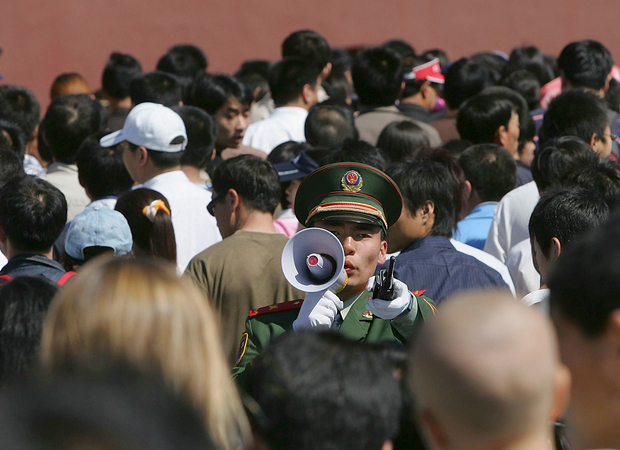
A policeman tries to control crowds in Tiananmen Square on May 1, 2007 in Beijing.
Dominic Meagher is a multi-disciplinary political economist focusing primarily on Australia’s economic relationship with China. He has a background in institutional economics and Chinese policy and economic analysis. Before joining China Matters, Dominic was based in Hong Kong researching China’s institutional evolution and reform process, as well as RMB internationalization.
Meagher holds a Ph.D. in Economics from the Australian National University, where he was a Rio Tinto China Scholar, and he holds a graduate diploma and Masters degree in International Development Economics from the ANU and an honors degree in Politics and International Relations with a major in History from the University of New South Wales.
Concurrent with his Ph.D., Meagher was Manager of the Crawford School of Public Policy’s China Economy Program, Project Officer at the East Asian Bureau of Economic Research, and consulting editor with the East Asia Forum, which he helped establish. He also interned with Citi in Hong Kong in 2007, where he advised against the prevailing belief that a repeat of the 1997 Asian financial crisis was impossible.
First arriving in China in 2003 without knowing a single word of Chinese, Meagher left after a year of evading SARS and becoming conversationally fluent in Mandarin. He has spent around a third of the time since then in greater China.
Meagher has analyzed China’s economic transformation, energy use, geopolitics, climate change, water management, international trade rules, rural poverty, Asian integration, and financial systems. He has written on U.S. and Chinese politics, China-Japan relations, food crises, international trade, and China’s oil, coal, and electricity industries and has been interviewed by international media on environmental sustainability, air quality, and Australia-China relations.
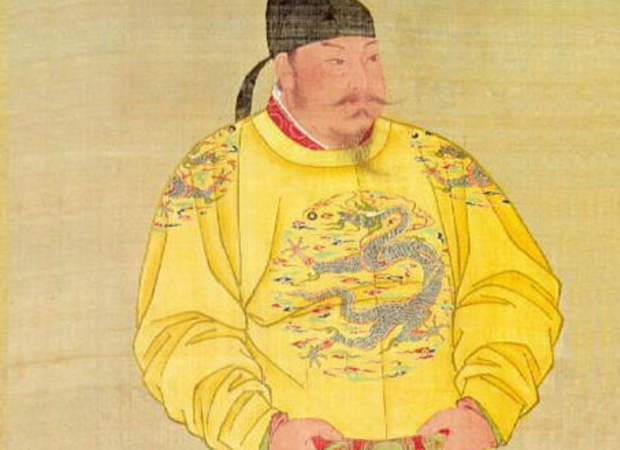
Emperor Taizong Tang, hanging silk scroll, National Palace Museum, Taipei.

Several cadre leaders have been punished for breaking the law, and nearly all of them have said: There isn’t enough internal supervision and no one warned me; if there’d been someone there whispering in my ear, I wouldn’t have committed such grave crimes. The lesser problem is that there is no one there to warn people; the greater problem, which no one seems to be discussing and which breeds even worse mistakes, is the old saying that “a thousand yes-men cannot equal one honest advisor.”
Two remarkable documents emerged from China last week—the essay “A Thousand Yes-Men Cannot Equal One Honest Advisor,” which appeared on the website of the Central Commission for Discipline Inspection, and an open letter calling for Xi Jinping’s resignation, penned by a group describing themselves as “loyal Party members.” What, if anything, do these documents suggest about the stability of Xi’s regime?