breadcrumb

U.S.-China Tensions: What Must Kerry Do?

A China File Conversation

Dorinda Elliott:

On a recent trip to China, I heard a lot of scary talk of potential war over the disputed Diaoyu Islands—this from both senior intellectual types and also just regular people, from an elderly calligraphy expert to a middle-aged history professor. People seemed to blame the U.S. for encouraging Japan in pushing its claims over the islands. (The assumption being that the U.S. wants to contain China, to keep China down.) So is war a real danger, and what should the U.S. do to defuse tensions?

Two weeks into John Kerry's tenure as Secretary of State, Nina Hachigian, a Senior Fellow at the Center for American Progress, who co-authored The Next American Century: How the U.S. Can Thrive as Other Powers Rise (Simon & Schuster, 2008), argues that there is much to be concerned about in U.S.-China relations.
iconAndy Wong/Getty Images
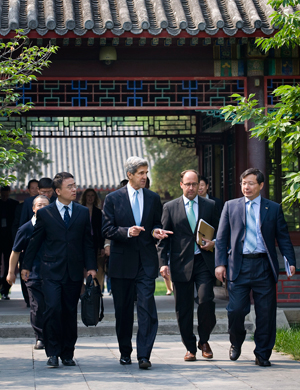
Then U.S. Senate Foreign Relations Committee Chairman John Kerry is followed by embassy staff members upon his arrival at Tsinghua University May 26, 2009 in Beijing.

An excerpt of her recent piece:

“Beyond the immediate issues, a broader aspect of U.S. policy toward China needs attention: The United States and China have no shared vision for what their future bilateral relationship could or should look like. They have not articulated a clear understanding of how they could continue to co-exist in peace a decade or two down the road, and they need to develop a shared, tangible idea for the future of the relationship.

Without a credible alternative, the default prediction for the interaction between a rising power such as China and an established power such as the United States is based on what has come before: inevitable violent conflict. As China grows, the uncertainty about what will come next in the relationship will only increase. With no positive vision, some Americans will picture a much stronger, more aggressive China that the United States will need to confront, and many Chinese will imagine that America will inevitably seek to preserve what they see as its waning hegemony by lashing out even more than it already does. These dark visions could become self-fulfilling prophecies. Because the United States and China do not know where they are headed, they cannot know what policy steps to take now.”

Responses

Elizabeth Economy

 I think Nina is right to identify a lack of shared vision as a serious challenge in the U.S.-China relationship. Unfortunately, I don’t think that at this point in time it is possible to have such a shared vision—beyond what we have always had, namely a stated commitment to peace and stability in the Asia Pacific and to free and open markets. I am fairly sure, for example, that part of our vision for the relationship includes a vastly reformed China (economically and politically)—probably in ways that the Chinese leadership is not interested in reforming, or at least not interested in reforming at the pace we would like. And China’s vision undoubtedly includes some changes in the U.S. role in the world that many here would find unpalatable.

In terms of what President Obama or the Secretary of State or Treasury could do within the very real constraints of our two countries’ differing visions and interests, I would suggest at a bare minimum laying out a plan for strengthening our economic relationship. It would be beneficial, for example, for both President Obama and soon-to-be-President Xi to lay out all the advantages that accrue from our bilateral trade to reinforce to people in both countries the benefits of working together. I don’t think either leader does even that much sufficiently. With that as a starting point, perhaps leaders in both countries could establish a two-three year time frame for completion of a bilateral investment treaty and a five to ten year negotiation period for a free trade agreement. We need to appreciate the benefits of the relationship and have concrete objectives for taking it to the next level.

To Dinda’s point about the growing talk of war and U.S. containment in China, it is really up to the Chinese leadership to manage this challenge. Frankly, to date, I don’t think that the Chinese leaders have seen it in their interest to dampen this type of rhetoric. In fact, at many points, the Chinese media have clearly stoked nationalism within the Chinese people. Belief within China that the United States is trying to contain China is not a function of the Diaoyu/Senkaku dispute, it is a long-standing, frequently articulated perspective by some segments of society. Even U.S. efforts to work with China on environmental protection have been labeled in the past as efforts to keep China from growing economically. So while I agree that the United States should try to avoid giving substance to the Chinese containment narrative, I don't see this as primarily a U.S. responsibility. 

Andrew J. Nathan

Talk is cheap, and in a paradoxical way I think the Obama pivot to Asia — or rebalancing, as the administration preferred to rename it—sends the right signal to Beijing. To be sure, it is hard for any observer — even us, much less policy makers in Beijing—to figure out what American strategy really is.  I sometimes even wonder whether it’s possible for a country with two parties that alternate in power, three branches of government, fifteen fairly independent executive departments, and 535 entrepreneurial legislators, to have a coherent strategy. For that very reason, the strategy has to be revealed in practice before can be understood. In practice, U.S. policy since Nixon has been to welcome and even assist in the rise of China. At the same time, U.S. policy has been to maintain and not diminish our longstanding strategic position in Asia—the alliances, the naval presence, the troop deployments, and all the rest.

All the talk of war exhaustion, the budget deficit, the fiscal cliff, and the sequester, and of the impact of these things on the U.S. military have understandably led to doubts both here and in Asia about whether the U.S. will continue to sustain its position in Asia. The pivot intended to signal that it would. Time will tell whether it actually does.

Either way, the Chinese need to know where the U.S. really stands. It’s understandable that they will test the U.S. in rhetoric and in action to find out where Washington’s bottom line lies. We American observers will find out the answer along with China.

Orville Schell

I’ve just arrived in Beijing to catch the waning fireworks of the Chinese New Year celebrations, smack in the middle of an interim time bracketed by the two big official congresses, the first held by the Party last November and the second scheduled for the government to make its leadership transition this March. There’s a feeling in the air that big policy issues have been left waiting. U.S.-China relations are among those challenges left hanging. Indeed, with the U.S. election, President Obama's cabinet shuffle, and the ongoing game of musical chairs churning the White House and the Department of State, the same can be said of the climate in Washington.

So, Nina Hachigian’s description of U.S.-China relations as lacking any new, clear vision remains true. At the same time, there are areas of worrisome tension growing, especially around maritime issues. Even though Party General Secretary Xi Jinping, China’s next president, has said that he would like to see U.S.-China relations have a fresh start, it is unlikely that there will be a major “re-set” any time soon. Both Beijing and Washington seem far too root-bound by their own issues and inner- and inter-party politics to step out boldly into any kind of new mutual foreign policy framework.


However, what can at least happen—and should happen—is an effort by both presidents Obama and Xi to make contact as soon as possible to affirm in a very public way their intentions to upgrade and then carefully cultivate a better bilateral relationship.


If President Obama’s charge is largely a symbolic one, the practical question of then managing the relationship should logically go to Vice President Biden, who has adequate rank, now knows Xi as well as any American official, is a voluble, good-hearted person who is perfectly matched to the task of thawing out the freeze of formality that often enshrouds U.S.-China exchanges. What the U.S. side has lacked these past few years is precisely a Hank Paulson-like, go-to, China person of sufficient stature with whom the Chinese feel comfortable. 

Of course, if such a scheme of things is going to be successful in establishing a more personal diplomatic synapse between the two countries, a person comparable in status must be levitated on the Chinese side. When Hillary Clinton tried to pinch hit in this role, she found herself pared with Dai Bingguo, which was not only a mismatch in terms of stature, but never really catalyzed itself into a truly “special relationship.” 


Simply put, if there are not going to be any big policy framework breakthroughs between the U.S. and China, the very least that we should have is two demonstrable custodians who have been specially designated on both sides to guide and oversee this crucial relationship.


Dorinda Elliott is Editor at Large at ChinaFile, where she helps curate the ChinaFile Conversation. In her “day job,” she is Global Affairs Editor at Condé Nast Traveler,...

More

Elizabeth Economy is the C.V. Starr senior fellow and director for Asia studies at the Council on Foreign Relations (CFR). The author of The River Runs Black: The Environmental...

More

Andrew J. Nathan is Class of 1919 Professor of Political Science at Columbia University. He is also chair of the steering committee of the Center for the Study of Human Rights and...

More

Orville Schell is the Arthur Ross Director of the Center on U.S.-China Relations at the Asia Society in New York. He is a former professor and Dean at the University of California...

More
Topics: 

Blog

05.21.13

U.S.-China Economic Relations—What Will the Next...

JONATHAN LANDRETH, ORVILLE SCHELL, PATRICK CHOVANEC

On Monday, within hours of the announcement that Chinese President Xi Jinping will meet U.S. President Barack Obama on a visit to California on June 7-8, Tung Chee-hwa, the former Chief Executive and President of the Executive Council of Hong Kong, introduced former U.S....

Blog

05.16.13

China: What’s Going Right?

MICHAEL ZHAO, JAMES FALLOWS, ORVILLE SCHELL (& authors)

Michael Zhao:On a recent trip to China, meeting mostly with former colleagues at the Chinese Academy of Sciences, I got a dose of optimism and hope for one aspect of the motherland. In terms of science, or laying down a solid foundation for better science to come, things are...

Blog

05.14.13

Why Can’t China Make Its Food Safe?—Or Can It?

ALEX WANG, JOHN C. BALZANO, ISABEL HILTON (& authors)

The month my wife and I moved to Beijing in 2004, I saw a bag of oatmeal at our local grocery store prominently labeled: “NOT POLLUTED!” How funny that this would be a selling point, we thought.But 7 years later as we prepared to return to the US, what was once a joke had...

Blog

05.10.13

What’s China’s Game in the Middle East?

RACHEL BEITARIE, MASSOUD HAYOUN, TAI MING CHEUNG

Rachel Beitarie:Xi Jinping’s four point proposal for a Palestinian-Israeli peace agreement is interesting not so much for its content, as for its source. While China has maintained the appearance of being involved in Middle East politics for years, its top leaders, so far,...

Blog

05.07.13

Why Is a 1995 Poisoning Case the Top Topic on Chinese...

RACHEL LU, ANDREW J. NATHAN, SUSAN JAKES (& authors)

With a population base of 1.3 billion people, China has no shortage of strange and gruesome crimes, but the attempted murder of Zhu Ling by thallium poisoning in 1995 is burning up China’s social media long after the trails have gone cold. Zhu, a brilliant and beautiful...

Blog

05.02.13

Does Promoting “Core Interests” Do China More Harm...

THE EDITORS, STEPHANIE T. KLEINE-AHLBRANDT, SUSAN SHIRK (& authors)

On April 30, as tensions around China’s claims to territories in the South- and East China Seas continued to simmer, we began what proved to be a popular ChinaFile Conversation, asking the question, What's Really at the Core of China’s ‘Core Interests’? The participants...

Blog

04.30.13

What’s Really at the Core of China’s “Core...

SHAI OSTER, ANDREW J. NATHAN, ORVILLE SCHELL (& authors)

Shai Oster:It’s Pilates diplomacy—work on your core. China’s diplomats keep talking about China’s core interests and it’s a growing list. In 2011, China included its political system and social stability as core interests. This year, it has added a vast chunk of the...

Blog

04.25.13

Hollywood in China—What’s the Price of Admission?

JONATHAN LANDRETH, YING ZHU, JEREMY GOLDKORN (& authors)

Last week, DreamWorks Animation (DWA), the Hollywood studio behind the worldwide blockbuster Kung Fu Panda films, announced that it will cooperate with the China Film Group (CFG) on an animated feature called Tibet Code, an adventure story based on a series of recent Chinese...

Blog

04.23.13

How Would You Spend (the Next) $300 Million on U.S.-...

ORVILLE SCHELL, MICHAEL KULMA

Orville Schell:When Stephen A. Schwarzman announced his new $300 million program aimed at sending foreign scholars to Tsinghua University in Beijing the way Rhodes Scholarship, set up by the businessman and statesman Cecil Rhodes in 1902 began sending American scholars to Oxford...

Blog

04.18.13

How Fast Is China’s Slowdown Coming, and What Should...

PATRICK CHOVANEC, BARRY NAUGHTON, DAMIEN MA

Slower Chinese GDP growth is not a bad thing if it’s happening for the right reasons. But it’s not happening for the right reasons.Instead of reining in credit to try to curb over-investment, Chinese authorities have allowed a renewed explosion in credit in an effort to fuel...

Blog

04.16.13

Why is China Still Messing with the Foreign Press?

ANDREW J. NATHAN, ISABEL HILTON, JONATHAN LANDRETH (& authors)

To those raised in the Marxist tradition, nothing in the media happens by accident.  In China, the flagship newspapers are still the “throat and tongue” of the ruling party, and their work is directed by the Party’s Propaganda Department.  That’s the first...

Blog

04.11.13

Why Is Chinese Soft Power Such a Hard Sell?

JEREMY GOLDKORN, DONALD CLARKE, SUSAN JAKES (& authors)

Jeremy Goldkorn:Chairman Mao Zedong said that power comes out of the barrel of a gun, and he knew a thing or two about power, both hard and soft. If you have enough guns, you have respect. Money is the same: if you have enough cash, you can buy guns, and respect.Israel and Saudi...

Blog

04.03.13

Bird Flu Fears: Should We Trust Beijing This Time?

DAVID WERTIME, YANZHONG HUANG, ISABEL HILTON (& authors)

David Wertime:A new strain of avian flu called H7N9 has infected at least seven humans and killed three in provinces near the Chinese metropolis of Shanghai, with the first death occurring on March 4. Meanwhile, in the last month, about 16,000 pigs, 1,000 ducks, and a few swans...

Blog

04.02.13

Why Did Apple Apologize to Chinese Consumers and What...

JEREMY GOLDKORN, ISABEL HILTON, DAVID WERTIME (& authors)

Jeremy Goldkorn:On March 22, before the foreign media or Apple themselves seemed to have grasped the seriousness of the CCTV attacks on the Californian behemoth, I wrote a post on Danwei.com that concluded:“The signs are clear that regulators and establishment media would both...

Blog

03.28.13

Will China’s Renminbi Replace the Dollar as the World...

PATRICK CHOVANEC, DAMIEN MA, DONALD CLARKE (& authors)

Patrick Chovanec:This week’s news that Brazil and China have signed a $30 billion currency swap agreement gave a renewed boost to excited chatter over the rising influence of China’s currency, the renminbi (RMB). The belief, in many quarters, is that the renminbi is well on...

Blog

03.26.13

Can China Transform Africa?

JEREMY GOLDKORN, ISABEL HILTON, DONALD CLARKE

Jeremy Goldkorn:The question is all wrong. China is already transforming Africa, the question is how China is transforming Africa, not whether it can. From the “China shops”—small stores selling cheap clothing, bags, and kitchenware—that have become ubiquitous in Southern...

Blog

03.19.13

China’s New Leaders Say They Want to Fight Corruption...

ANDREW J. NATHAN, OUYANG BIN

In his first press conference after taking office as China's new premier, Li Keqiang declared that one of his top priorities would be to fight corruption, because “Corruption and the reputation of our government are as incompatible as fire and water.” This put Li on message...

Blog

03.15.13

Is the One Child Policy Finished—And Was It a Failure...

DORINDA ELLIOTT, ALEXA OLESEN, ANDREW J. NATHAN (& authors)

Dorinda Elliott:China’s recent decision to phase out the agency that oversees the one-child policy has raised questions about whether the policy itself will be dropped—and whether it was a success or a failure.Aside from the burdens only children feel when it comes...

Blog

03.13.13

China’s Post 1980’s Generation—Are the Kids All...

SUN YUNFAN, ORVILLE SCHELL, DAMIEN MA

This week, the ChinaFile Conversation is a call for reactions to an article about China's current generation gap, written by James Palmer, a Beijing-based historian, author, and Global Times editor. The article, first published by Aeon in the U.K., “The Balinghou: Chinese...

Blog

03.08.13

Will China’s Property Market Crash, and So What If It...

DORINDA ELLIOTT, BILL BISHOP

Dorinda Elliott:At this week’s National People’s Congress, outgoing Premier Wen Jiabao proclaimed that the government kept housing prices from rising too fast. Really? I wonder what my 28-year-old Shanghainese friend Robert thinks about that. He and his fiancée could never...

Blog

03.06.13

Are Proposed Sanctions on North Korea a Hopeful Sign...

ORVILLE SCHELL, SUSAN SHIRK, SUZANNE DIMAGGIO (& authors)

Orville Schell:What may end up being most significant about the new draft resolution in the U.N. Security Council to impose stricter sanctions on North Korea, which China seems willing to sign, may not be what it amounts to in terms of denuclearizing the DPRK, but what it...

Blog

03.01.13

Is America’s Door Really Open to China’s Investment...

DANIEL H. ROSEN, ORVILLE SCHELL, JONATHAN LANDRETH

Daniel Rosen:There have not been many new topics in U.S.-China economic relations over the past decade: the trade balance, offshoring of jobs, Chinese holding of U.S. government debt, whether China’s currency is undervalued and intellectual property protection problems have...

Blog

02.27.13

How Long Can China Keep Pollution Data a State Secret?

ELIZABETH ECONOMY, ORVILLE SCHELL, DONALD CLARKE (& authors)

Elizabeth Economy:The environment is center stage once again in China. A Chinese lawyer has requested the findings of a national survey on soil pollution from the Ministry of Environmental Protection and been denied on the grounds that the information is a state secret. (The...

Blog

02.22.13

Will Investment in China Grow or Shrink?

DONALD CLARKE, JONATHAN LANDRETH

Donald Clarke:I don’t have the answer as to whether investment in China will grow or shrink, but I do have a few suggestions for how to think about the question. First, we have to clarify why we want to know the answer to this question: what do we think it will tell us? This...

Blog

02.20.13

Cyber Attacks—What’s the Best Response?

JONATHAN LANDRETH, JAMES FALLOWS, XIAO QIANG (& authors)

Jonathan Landreth:With regular ChinaFile Conversation contributor Elizabeth Economy on the road, I turned to her colleague Adam Segal, Maurice R. Greenberg Senior Fellow for China Studies at the Council on Foreign Relations in New York. Segal said that “the time for naming and...

Blog

02.13.13

North Korea: How Much More Will China Take and How...

WINSTON LORD, TAI MING CHEUNG, ELIZABETH ECONOMY (& authors)

China is increasingly frustrated with North Korea and may even see more clearly that its actions only serve to increase allied unity, stimulate Japanese militarism and accelerate missile defense. For all these reasons the U.S. should lean on Beijing to—at last—not only help...

Blog

02.08.13

Rich, Poor and Chinese—Does Anyone Trust Beijing to...

ANDREW J. NATHAN, SUSAN SHIRK, DONALD CLARKE (& authors)

Andrew Nathan:The new Chinese leadership under Xi Jinping seems to be making some bold opening moves with its attacks on corruption and the announcement on February 5 of plans to reduce the polarization of incomes.  Does this mean Xi is leading China in new directions? ...

Blog

02.06.13

Airpocalypse Now: China’s Tipping Point?

ALEX WANG, ORVILLE SCHELL, ELIZABETH ECONOMY (& authors)

The recent run of air pollution in China, we now know, has been worse than the air quality in airport smoking lounges. At its worst, Beijing air quality has approached levels only seen in the United States during wildfires.All of the comparisons to London, Los Angeles, and New...

Blog

02.01.13

China’s Cyberattacks — At What Cost?

JAMES FALLOWS, DONALD CLARKE, ORVILLE SCHELL (& authors)

James Fallows: Here are some initial reactions on the latest hacking news.We call this the “latest” news because I don’t think anyone, in China or outside, is actually surprised. In my own experience in China, which is limited compared with many of yours, I’ve seen the...

Blog

01.30.13

China, Japan and the Islands: What Do the Tensions Mean...

ORVILLE SCHELL, JOHN DELURY, SUSAN SHIRK (& authors)

How did the Diaoyu, Spratly, and Paracel islands come to replace Taiwan as the main source of tension for maritime Asia? And how are we to explain the fact that China’s foreign policy toward its Asian neighbors has now morphed from such slogans as: “Keep our heads down, and...

DISCUSSION

The Popularity of Chinese Patriotism

MARTIN BERNAL

Fundamentally China is a sellers’ market. The first half of this century, when there was a glut of books, seems to have been the exception. Since 1949 a veil has once more been drawn over the center of the mysterious east, and the situation has reverted to that of the...

Mao’s China

MARTIN BERNAL

To most Westerners China is not a part of the known world and Mao is not a figure of our time. The ignorant believe he is the leader of a host of martians whose sole occupation is plotting the destruction of civilization and the enslavement of mankind. The more sophisticated say...

Down There on a Visit

MARTIN BERNAL

In many ways this is the book that everybody interested in China has been waiting for, a book describing what it feels like to be a peasant living through the Chinese Revolution. In the summer of 1962 Jan Myrdal, the thirty-year-old son of the famous Swedish sociologist Gunnar...