


Is China Doing All It Can to Rein in Kim Jong-un?
A ChinaFile Conversation
on April 9, 2013
Winston Lord:
No.
Winston Lord:
No.
For much of the past century, U.S. relations with Tibet have been characterized by kowtowing to the Chinese and hollow good wishes for the Dalai Lama. As early as 1908, William Rockhill, a U.S. diplomat, advised the Thirteenth Dalai Lama that “close and friendly relations with China are absolutely necessary, for Tibet is and must remain a portion of the Ta Ts’ing [Manchu] Empire for its own good.” Not much has changed with the Fourteenth Dalai Lama one hundred years later.
After receiving his delayed wages, thirty-year-old Wang Jie decided to change professions.
On March 7, he pressed a fingerprint onto a receipt that read: “Today I have received settlement of the 12,000 yuan in wages owed to me by Mr. Shao.”
“Actually it was short by over 1,000 yuan,” said Wang, flipping through his notepad on which he had recorded the over forty trips he had made between Beijing and the southern province of Guangdong, including dates, addresses, and reimbursement details.
The world’s second and third largest economies are engaged in a standoff over the sovereignty of five islets and three rocks in the East China Sea, known as the Diaoyu in Chinese and the Senkaku in Japanese. Tensions erupted in September 2012 when Japan purchased three disputed islands from their private owner to keep them from the nationalist governor of Tokyo. In response, Beijing implemented a series of measures including the establishment of overlapping administration in the disputed waters. Both sides’ law enforcement agencies and militaries currently operate in close proximity in disputed naval and aerial space. Unlike foreign ministries, these actors have less institutional interest in containing crises and enjoy an information monopoly allowing them to shape domestic perceptions. The two countries lack the mutual trust and communication mechanisms to manage incidents, let alone to discuss intentions or operating protocols. In the event of a skirmish, heightened nationalism, especially in China, could constrict the room for diplomatic maneuvers to de-escalate the situation.
They are called rats, and they have become a symbol of Beijing’s red-hot real estate market. Because of soaring housing costs, there are at least a million people living underground, only able to afford a rented room in the basements of skyscrapers or converted bomb shelters in their nation’s capital. Obsessed with the possibility of a Soviet nuclear attack, in 1969 President Mao Zedong ordered the construction of underground shelters that would stretch for eighteen miles beneath the city, able to accommodate half of the population if war ever broke out.
Journalist Liu Jianfeng worked at the China Economic Times newspaper in Beijing for fifteen years. Eventually, frustration with the nation’s state-controlled media system and pressure from his colleagues prompted him to quit.
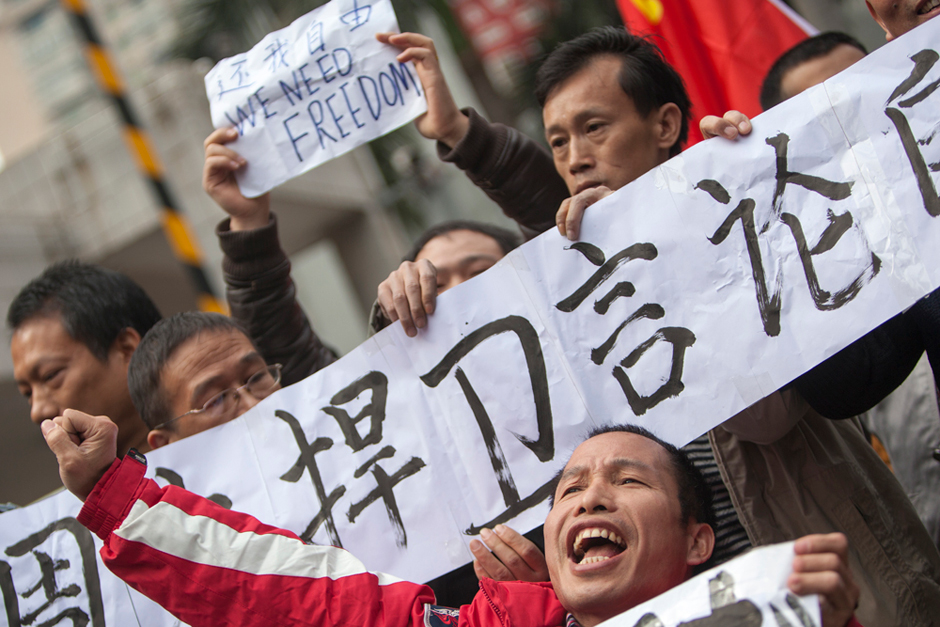
The first months of 2013 have seen a rapid intensification of combative rhetoric and action from North Korea. In the sixteen months since Kim Jong-un assumed leadership of the country, North Korea has run through the whole litany of provocations his father’s regime had deployed over a seventeen-year reign—including launching missiles, conducting nuclear tests, nullifying the armistice with South Korea, and threatening to restart its nuclear reactor and launch missile attacks on the U.S.
While foreign media coverage these last two weeks has focused on environmental disasters, over-fishing, and emerging forms of the avian flu, the Chinese state media has turned its gaze towards the transgressions of Apple Computer, which found itself excoriated by CCTV on World Consumer Rights Day for its warranty policy and for using refurbished parts in mainland phone repairs.

In China in the 1980s, the word renquan (“human rights”) was extremely “sensitive.” Few dared even to utter it in public, let alone to champion the concept. Now, nearly three decades later, a grassroots movement called weiquan (“supporting rights”) has spread widely, and it seems clear that China’s rulers are helpless to reverse it. Even people at the lowest levels of society demand their rights.

This Spring 2013 China is expected to finish the first phase of its gigantic South-North Water Transfer Project, though the project highlights the limits of engineering solutions to problems of basic environmental scarcity.