Why Is Chinese Soft Power Such a Hard Sell?

A ChinaFile Conversation

Jeremy Goldkorn:

Chairman Mao Zedong said that power comes out of the barrel of a gun, and he knew a thing or two about power, both hard and soft. If you have enough guns, you have respect. Money is the same: if you have enough cash, you can buy guns, and respect.

Israel and Saudi Arabia are examples of the limits of such respect. Both countries are rich and in some ways very powerful, but people in other countries with no cultural connections don't look at Israel, or Saudi Arabia and think: “Gee, I want to live like that and watch their movies!”

Writing Yunnan a Rubber Check

Is An Environmental Crisis Brewing in Southwest China?

Our van stopped at a scenic vista on the contour road where verdant mountains undulated southward toward China’s border with Laos. Stepping out to take some photos, I was overcome by an acrid, unpleasant odor. I asked my local travel partner, Xiao Guan, what the stink was.

“Money,” he said with a wry smile. “That’s the smell of money, my friend.”

He pointed to a small rubber plantation where latex was being processed. After I took some photos and boarded the van, I noticed rubber plantations everywhere we went.

China, North Korea, and Nuclear Arms

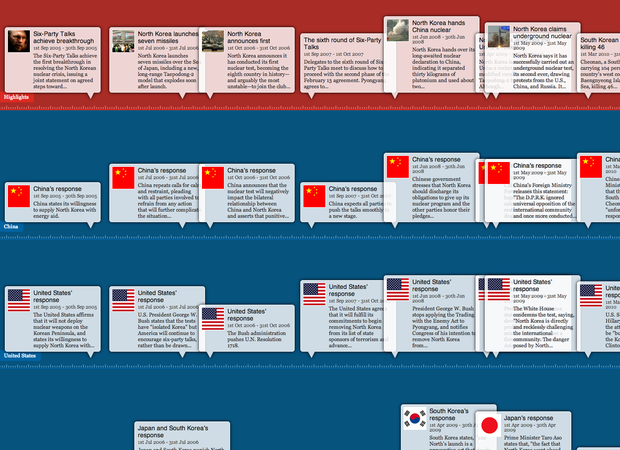
An Interactive Timeline

As tensions again escalate on the Korean Peninsula, ChinaFile examines more than a decade of developments in North Korea’s nuclear armaments program.

We begin our timeline in late 2002, when China first joined diplomatic discussions, paving the way for what would become known as the “Six-Party Talks” on denuclearizing North Korea—talks that for the first time included diplomats from both North and South Korea, China, Russia, Japan, and the United States.

Fully-searchable, the timeline links each development to news headlines from the day and is sortable by country.

Toward a New Phase of U.S.-China Museum Collaborations

The 2012 U.S.-China Museum Directors Forum, organized by Asia Society and the Chinese People's Association for Friendship with Foreign Countries, brought together 17 Chinese and 15 American museum leaders for a two-day dialogue to assess common needs and develop new processes for museum exchanges.

The museum leaders identified various benefits of museum exchanges. Such programs provide information and experiences to museum audiences; foster tolerance and understanding between nations; and enhance cultural competence in a globalized world. The directors also identified obstacles impeding museum collaborations, including disparities in resources and practices; cumbersome bureaucratic, legal, and regulatory systems; a lack of familiarity between museum professionals; and the absence of institutional and funding mechanisms to facilitate exchanges.

Going forward, the museum leaders pinpointed three key areas of need and opportunity for the evolution of U.S.-China museum collaborations: improving people-to-people contacts; fostering institutional relations; and greater coordination within the museum sector in both countries. Taken together, the recommendations offer a blueprint for improving institutional interactions.

The directors suggested specific programs that their institutions, coupled with other museums, government agencies, and private funders, can pursue going forward. The consensus view among them was that the expansion of museum collaborations will require new funding and organizational mechanisms to spur and conduct exchange activities. Some of the goals outlined by the Chinese and American museum directors will be pursued by the Asian Arts and Museum Network, established in 2012 by Asia Society Museum.

Embed Code: 
Orville Schell
Organization: 
Asia Society