


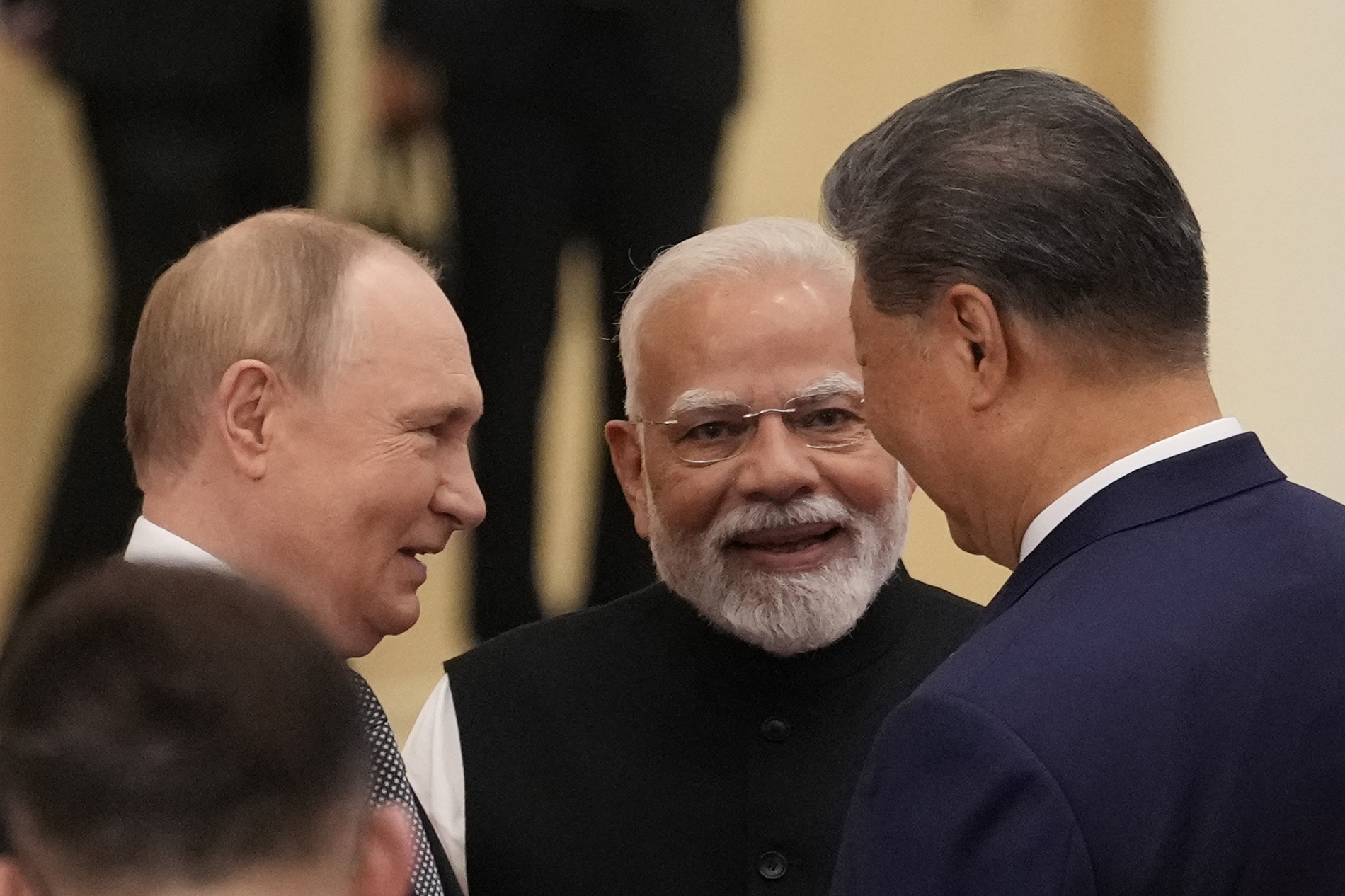
From August 31 to September 1, China hosted twenty foreign leaders in Tianjin for a Shanghai Cooperation Organization (SCO) summit, the biggest meeting since the formation of the security group in 2002. Group photos of all the attendees and video and photos of Xi Jinping enjoying moments of bonhomie with Russian President Vladimir Putin and Indian Prime Minister Narendra Modi “were not accidental but deliberate diplomatic theatre, a spectacle that will make Trump squirm” according to India’s Economic Times.
Then, on September 3, Putin, Kim Jong-un, and leaders from 24 other countries, mostly Asian, joined Xi Jinping to watch the 80th anniversary Victory Day parade commemorating the end of World War II, or what Beijing calls “the Victory in the Chinese People’s War of Resistance Against Japanese Aggression and the World Anti-Fascist War.” State media prominently featured footage of Xi, Putin, and Kim walking together and talking before the parade, but the stars of the show were perhaps the goose-stepping soldiers, military vehicles, arms, and technology on display, including hypersonic anti-ship missiles, intercontinental nuclear missiles, drones, tanks, and aircraft.
What was the significance of these encounters in Beijing and Tianjin? Was it mainly about optics, a reminder that China has friends and advanced weapons? Or did it signal a more substantive shift in geopolitical alignment or strategy? –The Editors
Comments
Farwa Aamer
The Shanghai Cooperation Organization summit in Tianjin, followed by Beijing’s military parade, was more than just diplomatic theater. Beijing’s aim was to send a carefully curated message about China’s regional influence and its ability to convene a diverse set of leaders, even amid intensifying geopolitical uncertainty. Yet for India, and particularly for Prime Minister Narendra Modi, the optics carried layered significance that extended beyond the Shanghai Cooperation Organization framework.
Modi’s participation, his first visit to China in seven years, inevitably drew attention, especially given the photos of him alongside Xi and Putin. These images played into Beijing’s desire to showcase itself as a hub of global multipolarity, but from New Delhi’s perspective, they also served another purpose: signaling to Washington that India retains strategic options and will not be boxed in, especially at a moment of strain in U.S.-India relations.
India faces steep U.S. tariffs, sharp rhetoric from U.S. officials accusing it of “profiteering” from the Ukraine war, and renewed American outreach to Pakistan (especially after the May India-Pakistan conflict), all of which have left the bilateral partnership at its most difficult juncture in decades. While there is no appetite yet in New Delhi for outright retaliation, there is evident disappointment as India has called out the additional tariff impositions as “unfair, unjustified, and unreasonable.” A course correction, through renewed Modi-Trump chemistry or a trade breakthrough, would serve both New Delhi’s and Washington’s interests, given the decades of investment that have gone into building this strategic partnership, but in the meantime, projecting strategic autonomy remains essential for India. Re-engagement with Beijing, if carefully managed, provides that space.
This is not to suggest that India is turning a new leaf with China. The images from Tianjin should be read with the same caution that India itself brings to the table. Efforts at stabilizing the fraught border relationship have been ongoing since the Modi-Xi meeting in Kazan last year, with subsequent high-level engagements, including Chinese Foreign Minister Wang Yi’s August visit to Delhi, aimed at keeping tensions under control. Both sides appear to recognize that unbridled competition will only sap resources at a time of regional flux. For India, a measure of stability with China helps ease pressure when U.S. ties are fragile/uncertain; for Beijing, this frees bandwidth to pursue its broader influence agenda at a time when U.S. foreign policy shifts are unsettling both allies and adversaries.
Still, the structural fault lines in the relationship remain. The border dispute continues to simmer, transboundary water feuds persist, and above all, China’s entrenched partnership with Pakistan casts a long shadow. Against this backdrop, the most realistic trajectory for India-China ties is one of cautious, incremental improvement rather than sweeping transformation.
Mounting pressure from Washington could push India to lean more actively into multilateral frameworks where it shares space with both Russia and China. This would not come at the expense of India’s commitments to the broader U.S.-India relationship for now (Modi did skip the parade), but it could gradually recalibrate India’s diplomacy, broaden its strategic options, and hedge against overdependence on any single partner.
Katie Stallard
If there is one clear conclusion to draw from this week’s events in China, it is that we can finally lay to rest the idea that the Trump administration is in the process of executing a sophisticated “reverse Kissinger” maneuver that will draw Russia away from China. As Vladimir Putin and Xi Jinping strolled together down the red carpet in Beijing, flanked by Kim Jong-un, they were plainly signaling that their relationship is as strong as ever, and that they remain aligned in their shared opposition to the United States.
Equally significant was the presence of Narendra Modi at the Shanghai Cooperation Organization summit in Tianjin two days earlier, where he was photographed clasping hands with Putin and Xi, evidently keen to signal that he has other options beyond the U.S. after being targeted with 50 percent tariffs over his country’s purchases of Russian oil. Trump’s erratic foreign policy seems to have succeeded in cementing the bonds between American adversaries and straining relations with major partners and allies.
This does not mean we are witnessing the emergence of a new world order. Real tensions and fault lines remain beneath the televised displays of camaraderie. Kim, for instance, has long resented his role as the junior partner in the relationship with China and no doubt savored the opportunity to meet Xi on a stronger footing after signing a defense and security pact with Putin last year and assuming an important role in Russia’s war against Ukraine through the provision of troops, missiles, and artillery shells.
Putin, similarly, will have been buoyed by the red carpet welcome he received during his recent summit with Trump in Alaska, signaling the end of U.S. attempts to isolate him at a time when the future of U.S. military aid to Ukraine is already in serious doubt. Xi will not welcome the prospect of an emboldened Kim making rapid advances to his weapons programs thanks to his new partnership with Putin, which could destabilize the region and complicate China’s calculus.
These leaders do not share a unified world view, but rather a set of shared grievances and an assessment that they share a common adversary in the U.S. This sustains their current alignment, but it does not yet amount to an alternative global order.
It is also worth remembering that for all the goose-stepping soldiers and impressive hardware parading through Beijing, Xi is currently overseeing a wide-ranging purge of his senior military officials, nominally over allegations of corruption. This suggests he has reason to doubt the loyalty and efficacy of the vast forces assembled before him in Tiananmen Square in the event of a near-term conflict. Similarly unconvincing was Xi’s appeal to learn the lessons of the Second World War and “cherish peace” when he was standing alongside the man who is currently waging the most devastating war in Europe since 1945. So while the symbolism of these events is powerful, the reality is considerably more complicated.
Tanvi Madan
Indian Prime Minister Narendra Modi’s trip to Tianjin for the Shanghai Cooperation Organization (SCO) summit involved both symbolism and substance. It was his first visit to China since the fatal 2020 border clash that led to a downward spiral in Sino-Indian ties. The substantive part was the bilateral meeting with Xi Jinping, a key step in the re-engagement path the two countries have been on since the Modi-Xi meeting on the sidelines of the BRICS summit in October 2024. For both Beijing and New Delhi, stabilizing the relationship could help prevent another crisis, enhance their decision-making space, and strengthen each country’s capacity to deal with other countries, especially the U.S.
During Modi’s visit, the leaders reinforced the understandings reached when Chinese Foreign Minister Wang Yi traveled to India in August. These involved recommitting to and updating boundary mechanisms and agreements and reviving civil society and connectivity links. They potentially open the door to further steps, including selective economic re-engagement, for instance, in sectors where New Delhi believes Chinese industrial inputs, technology, or expertise can help India’s manufacturing ambitions.
For both leaders, optics were an objective as well. Modi’s presence allowed Xi to show the West and the Global South that he could host not just Vladimir Putin but also the leader of the rival Asian giant that Washington has courted in the past. Modi, in turn, was signaling to both domestic and international audiences India’s continued independence of action (or strategic autonomy) and that, even in the face of pressure from Donald Trump, New Delhi still had options.
However, it is important to rightsize assessments of Modi’s trip. It did reflect some rebalancing but not an Indian pivot away from the U.S., or the formation of a new anti-West troika. Delhi indeed seems to have, for now, declined Beijing’s and Moscow’s pleas to revive the Russia-India-China trilateral summit. Modi also left China before Xi’s military parade—his attendance wouldn’t have gone down well either at home or with India’s crucial Western partners.
Bilaterally, there was no grand Sino-Indian reconciliation. Their many divergences persist, and some have even deepened in recent months. Their border troops have not gone back to peacetime deployments. During the recent India-Pakistan crisis, Beijing supported Pakistan with military equipment, intelligence, and information operations. India has also had concerns about China building a massive dam on the Yarlung Tsangpo river, and restricting exports of critical items and travel for technical experts to India.
Beijing, in turn, was vocally unhappy about Delhi rejecting its claim that Indian External Affairs Minister Subrahmanyam Jaishankar reiterated that “Taiwan is a part of China.” China’s leaders also can’t have been pleased with some of the defense and economic security outcomes of Modi’s visit to Japan just before his China trip.
China and India might come together for BRICS and SCO meetings, but they also continue to compete for influence in the Indian Ocean region, the Global South, and international institutions. Their leaders don’t see these groupings similarly: India wants them to be non-West rather than anti-West platforms, supplementary to the existing order and not a replacement for it. Beijing and Delhi both talk about multipolarity, but they mean different things. India emphasizes that it also wants to see a multipolar Asia—left unsaid publicly by policymakers is that they believe Beijing seeks a unipolar Asia.
Whatever the rhetoric, images, or memes emerging from Tianjin, in reality this remains a rivalry.
Maria Repnikova
The Shanghai Cooperation Organization (SCO) summit and the grand parade were true spectacles. We saw autocratic friendships on display, and China presented itself as a proud, glorious nation, carving out an alternative global vision and rewriting history on its own terms. The parade included immaculately choreographed patriotic performances primarily aimed at the Chinese public, sparking nationalism, pride, and a sense of belonging in a nation that’s on the rise, never to be defeated. Some of the songs also celebrated the Communist Party. “If there is no Communist Party, there is no new China,” passionately sang young soldiers.
The impressive event and Xi’s inspection of China’s military technologies also signaled to Chinese elites that he is irreplaceable. In fact, he plans to live to 150 years, according to a chat with Putin inadvertently livestreamed by state broadcaster CCTV.
Of course, the parade also implicitly addressed the West, and especially the United States. China is a peaceful nation but ready for war, was the message conveyed through the ceremony. China is not isolated; it attracts powerful leaders and is the pinnacle of the making of governance that eludes the West. The message was interpreted differently by Western countries. Politico referred to the blooming friendship between the world’s leading autocrats as the “axis of evil.”
And yet, there was limited action beyond the symbolism. Xi announced the launch of a new development bank run by the Shanghai Cooperation Organization and proposed the Global Governance Initiative at the summit, a project “to make the existing international system and international institutions better at . . . responding promptly and effectively to various global challenges, and serving the interests of all countries, particularly developing ones.”
Xi, along with his guests like Putin, also expressed support for multipolarity and creation of a “fairer” world order. This rhetoric is not new. Xi has advocated for more equality in global relations for years now, including through his Community of Shared Destiny initiative, as well as via bilateral diplomacy with developing countries. China itself has arguably offered more than rhetoric with trade deals, infrastructure projects, and other material opportunities for countries shunned by the West. The SCO summit and the parade comprised another symbolic step in this direction, but China and its friends didn’t lay out a clear plan or an alternative vision beyond signaling unity around “fairness” and frustration with the U.S. dominance in the international system. The theatrics of friendship should also be treated with caution. Xi and Modi likely see each other as much as competitors as friends or allies, and the same goes for Putin and Xi.
If the aim of the summit and the parade was to gauge attention and recognition from domestic and global publics, then it largely succeeded. Social media platform Weibo is flooded with patriotic content, and media in autocratic countries like Russia are celebrating the event. Even Western media organizations, despite much criticism, are devoting much energy to this coverage and commentary, which rhetorically elevates China as a nation worthy of fascination, along with discomfort and fear. I think the leaders in Beijing are likely proud of the outcome, and they can take the time to articulate their vision. With waning U.S. influence, time is on China’s side.
Sun Chenghao
The Shanghai Cooperation Organization (SCO) summit in Tianjin and China’s Victory Day parade in Beijing took place within the same week, and the overlap created greater international resonance. As a result, China’s diplomacy during this period attracted heightened global attention, with the two events’ reinforcing each other in terms of visibility and impact.
The SCO summit carried particular weight. Since its founding, the SCO has promoted what Beijing calls the “Shanghai Spirit,” a framework of mutual respect, inclusiveness, and cooperation. Against the backdrop of intensifying major power competition, the Tianjin summit underscored China’s emphasis on stability and multilateral cooperation. The presence of foreign leaders, including those from Central Asia, South Asia, and the Middle East, highlighted not only the continued appeal of the SCO but also the growing role of Global South countries in international affairs. In addition, one of the objectives of China’s Global Governance Initiative proposed this time is to leverage regional cooperation platforms, such as the SCO, to strengthen connections with Global South countries and enhance China’s international influence.
China’s Victory Day parade in Beijing projected a complementary message. The 80th anniversary of the World Anti-Fascist War allowed China to re-emphasize its identity as a nation committed to peace. From China’s perspective, the defeat of fascism was not only a Chinese victory but a collective victory of all peoples striving for peace. Xi Jinping has repeatedly stated that China will adhere to the path of peaceful development. The intention is not to threaten others, but to make clear that China will not be intimidated. Therefore, strengthening its military capacity is aligned with China’s broader commitment to peace and stability in an era of intensified major-power rivalry.
The diplomatic encounters at these events also attracted global attention, particularly Xi’s interactions with Russian President Vladimir Putin, Indian Prime Minister Narendra Modi, and Democratic People’s Republic of Korea (DPRK) leader Kim Jong-un. These should not be misinterpreted as signs of a new formal alliance. China’s dialogue with Russia reflects longstanding ties and the pragmatic need to take care of multiple common interests. Engagement with India, including Modi’s visit, hints at a cautious thaw after recent tensions, consistent with both countries’ interest in stabilizing relations between two neighboring great powers. Talks with the DPRK possibly remain focused on shared regional security concerns, particularly the situation on the Korean Peninsula.
Taken together, the SCO summit and Victory Day parade conveyed a twofold message: China is both a country of peace that values inclusive cooperation and a major power confident in its military modernization. The optics mattered, but the deeper significance lies in Beijing’s effort to position itself as a responsible actor navigating a turbulent global environment—not through rigid alliances, but through pragmatic partnerships and symbolic reminders of strength and restraint, as well as the call of peace and cooperation.