


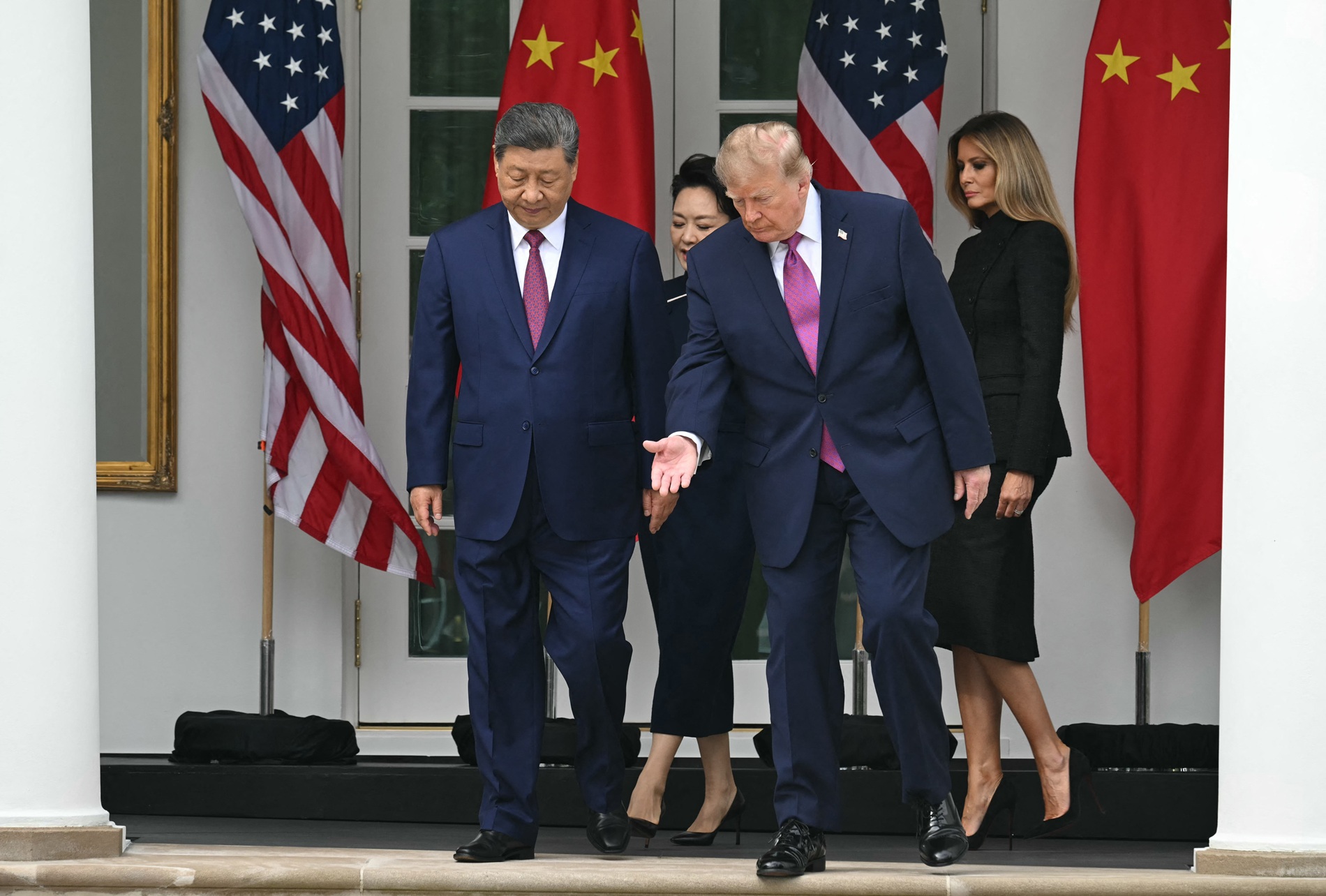
On September 24, U.S. President Donald Trump hosted Chinese leader Xi Jinping at the White House for their second summit of the year. The meeting advanced new mechanisms on trade and investment, and launched the U.S.-China bilateral dialogue on artificial intelligence, while leaving many of the relationship’s most difficult questions—from Taiwan to technology competition—unresolved.
We asked experts to assess what the summit actually changed, what remains unsettled, and what to watch next.
Comments
Neil Thomas
Was the Trump-Xi summit a success? Despite all the pomp and circumstance of the state visit, the deliverables announced by the two sides were partial and circumscribed. But how much that matters depends on what you think is the point of meetings between the two presidents.
Is it to maintain diplomatic stability between China and the United States? Beijing and Washington agreed to elevate their bilateral ambitions by building a “constructive relationship of strategic stability on the basis of respect, fairness, and reciprocity.” Both Trump and Xi confirmed their intention to attend November’s APEC summit in Shenzhen and December’s G20 summit in Miami, setting the stage for a record four presidential meetings this year. But the trade truce was extended only by two months, meaning that these meetings will likely focus on working out how to extend the status quo.
Is it to strengthen economic ties between the two countries? The two governments “operationalized” a Board of Trade, under which they agreed to pursue tariff reductions on $30 billion of imports in each direction. They also established a Board of Investment intended to identify investment opportunities and address investment between the two countries. The White House also said China would import at least 10 million tons of U.S. coal in both 2027 and 2028, but Beijing did not publicly confirm this commitment.
Is it to work together on global challenges? Trump and Xi agreed to establish a U.S.-China dialogue on what Trump now calls “super intelligence” and what Xi will almost certainly continue to call “artificial intelligence.” But the Chinese president’s proactive call to “jointly guard against artificial intelligence being misused or maliciously used” sits uneasily alongside Trump’s insistence that the United States should not “in any way hinder or stifle the growth” of the technology. The two leaders also discussed Iran, Russia, and North Korea, although what scant public comments emerged largely reiterated existing positions.
Is it to resolve bilateral tensions and reduce the risk of conflict over geopolitical flashpoints? White House statements that Trump “advocated for” arms-control talks and that the two sides “continue to work on” Chinese supplies of rare earths suggest limited progress on two longstanding disputes. Xi was unusually explicit in saying that he expected Washington to “oppose” Taiwan independence, but the absence of any Taiwan-related item from either side’s list of summit outcomes indicates that this pressure produced no publicly announced change in U.S. policy.
Optimists argue that Trump and Xi are developing a personal chemistry that could help underpin deeper working-level cooperation. That may prove especially useful in managing the profound uncertainties and acute risks surrounding AI and in advancing cooperation in relatively low-stakes areas such as educational exchanges and public health. But presidential pageantry will not alter Xi’s commitment to expanding China’s international leadership or his longstanding vision of China as a self-reliant industrial power with a commanding position in global manufacturing and critical supply chains. Any economic concessions Beijing offers are therefore likely to remain bounded by Xi’s overriding objective of strengthening China’s own technological capabilities and geoeconomic leverage.
Chinese state media reveled in the respect afforded their president during the state visit. People’s Daily framed the trip through the lens of “great changes unseen in a century,” a phrase Xi has used since the first Trump administration to describe a transformation in the international balance of power. The concept reflects his assessment that relative U.S. power is declining and the Western-led international order is fragmenting—a transformation that creates risks of geopolitical instability and external pressure on China, but also unique opportunities for Beijing to expand its international influence.
Trump and Xi may be getting better at managing U.S.-China competition precisely because both now recognize how little they can do to change the relationship’s underlying dynamics. Xi’s longstanding approach has been to bolster China’s power while avoiding conflict with the United States. The question now is how effectively Washington can mobilize America’s economy, society, and international partners to strengthen its own competitive advantages.
Lizzi C. Lee
Leadership summits play an outsized role in U.S.-China relations, and by that measure, the latest talks were substantive. Yes, much of what transpired was pageantry, and the deliverables were thin—more about setting up next steps than settling anything—but the process itself matters, especially on tough issues like AI safety, trade, and export controls. U.S. Treasury Secretary Scott Bessent and China’s Vice Premier He Lifeng agreed to build out an AI dialogue, with the next round expected in roughly two months in Shenzhen, while the United States proposed a notification mechanism for AI incidents that rise to the level of national-security threats. The two sides also moved toward operationalizing tariff reductions for non-sensitive goods. It is hard to tell how many of the mechanisms discussed are just big-picture ideas and how concrete the long-term thinking behind them is. The more concrete aspects of the deliverables on purchases and trade show where the low-hanging fruit lies: removing or lowering barriers around non-sensitive goods where both sides have obvious common interests.
The harder task starts immediately afterward, in the nitty-gritty of tech competition and strategic chokepoints at the intersection of economic and national security, with no easy solutions. AI is the clearest example. The U.S. compute advantage is real, and it constrains China. And China’s grievances over U.S. export controls are not merely rhetorical—its counter-leverage over rare-earths has imposed real costs on the United States and others, and those effects can be even more immediate. Both sides wield enormous leverage, and neither side is shy about flexing its muscles. Just before the summit, some Chinese suppliers reportedly refused to make shipments to U.S. customers; earlier disruptions had already forced auto factories and other key industrial outlets, globally, to halt production. Imagine if this happens repeatedly, for prolonged periods, and at a larger scale.
In the near term, China is getting several things it has wanted from this process: a blessing from U.S. leadership to stabilize relations, and greater predictability for at least the next few months.
The next step requires choices that are much harder, economically and politically. Domestic politics on both sides make those choices harder still. In China, the run-up to the 2027 Party Congress is already generating bureaucratic stalling: local and rank-and-file officials simply waiting out the leadership transition because they don’t know who will be in charge, and the Politburo’s intensifying focus on Party discipline and anti-corruption can make bureaucrats default to inaction—better to do nothing than to be wrong. In Washington, the November 3 midterm elections set their own near-term political clock. Both Xi and Trump therefore have strong incentives to bank small, visible wins now and defer the hardest structural bargains to later.
For China, the biggest unresolved issue is economic rebalancing. China’s own economy still needs a deeper shift toward domestic demand and consumption. The U.S.-China bilateral relationship needs a more sustainable rebalancing on trade and investment, especially on Chinese technology inputs, which are critical for accelerating the U.S.’ own reindustrialization and revitalization after years of hollowing out. Crafting that broader relationship in a way that is consistent with both sides’ self-interest would require serious and intense negotiation and coordination below the leadership level. It is precisely the kind of long-term work that can easily be swamped by short-term political goals.
That is why the two-month extension of the Busan trade truce, from November 10 to January 10, though very short, is good news. It carries the détente through APEC in Shenzhen and the G20 in Miami, effectively creating two natural leadership-level check-in points where Trump and Xi could potentially meet again and further extend the truce. Repeated leadership summits can generate the political momentum to propel some movement down the bureaucratic ladder that otherwise tends to stall.
Scott Shaw
Specific outcomes remain limited, but most analysts agree that the Board of Trade structure has made more progress than skeptics expected. Initial reports indicate that concrete agreements are now in place to introduce “managed trade” between the two countries. Certain product sectors, for example, are expected to receive zero or minimal tariffs. Given the current leadership-level structure of Board of Trade discussions, it remains unclear whether the framework can effectively incorporate the broad range of commercial disputes between the world’s two largest economies. Even so, the Board of Trade may prove to be one of the few institutional outcomes to endure beyond the current talks. As I have argued, a continuing, leadership-led trade framework fills an important gap.
The separate Board of Investment was announced as a new deliverable but produced no outcomes at this summit. Moreover, the Chinese statements continue to refer to the Board of Investment’s being under the “economic and trade consultation mechanism,” which would seem to indicate that the two sides have not yet agreed to a fully independent Board of Investment.
Despite the positive outcomes associated with the Board of Trade, its long-term success will depend on progress toward a broader approach to managing the trade relationship. Cabinet-level and vice premier-led discussions have produced important initial breakthroughs after a lengthy hiatus in high-level engagement. Going forward, rather than limiting progress to a small number of high-profile matters, sub-cabinet-level leadership will be necessary to address the multitude of detailed commercial issues facing both governments on an ongoing basis.
Nevertheless, the current high-level discussions play a vital role for the business community and for trade officials in both countries as they navigate an increasingly complex geopolitical landscape. The symbolism of the Board of Trade consensus, which designates $30 billion in managed-trade sectors for each side, fulfills an important objective by demonstrating that the two governments can still reach basic agreements and cooperate in areas of mutual interest. The Board of Investment, once fully authorized and commenced, will likely face a more difficult path toward a comparable outcome given the high degree of sensitivity around investment issues.
The Board of Trade should also include senior representatives from a wider range of relevant government agencies. This is because even after the most sensitive high-level issues begin to get resolved, numerous practical trade-related challenges will remain that hamper the bilateral commercial relationship. These issues can only be addressed through broader interagency participation and sustained engagement from both governments. Following years of limited staff-level connectivity, trust must be rebuilt by expanding the scope of discussions to include these concerns and by increasing staff-level engagement to work toward resolving the most difficult issues.
To support this effort, either the Board of Trade or an alternative mechanism should be clearly designated as the forum through which companies can raise concerns, with a well-defined scope of issues for consideration. In this regard, the U.S. Trade Representative appropriately sought stakeholder, including company, input on the Board of Trade structure. For the Board of Investment to succeed, both governments will need to provide similar support as they work to further develop a clearly defined mandate and interagency consensus around its objectives.
Alvin Wang Graylin
The most consequential line from this week’s summit sits near the bottom of the White House fact sheet: Washington and Beijing launched a U.S.-China Super Intelligence Dialogue, set the next exchange to take place by November 2026, and agreed to build a bilateral channel for AI incidents. The AI consultations discussed at the May summit in Beijing were never formalized, so a name, a deadline, and a line to call are real progress.
That follow-through is what separates this round from Lima in 2024, where Joe Biden and Xi Jinping agreed that humans must control nuclear launch decisions but let the AI dialogue they had started go dormant after a single meeting. With frontier capabilities compounding every few months, another quiet death would be expensive.
The talks survived a rough run-up: Beijing called Anthropic CEO Dario Amodei’s “We Must Pace the Frontier” essay “fearmongering,” and Senate Democrats used Xi’s arrival to push three bills tightening chip export controls. According to the Chinese readout, Xi said the two countries “may have competition, but they may cooperate even more,” urged both “to draw on each other’s strengths, not guard against each other,” and proposed dialogue to “jointly prevent the misuse and abuse of AI.” Trump praised a friendship “built on mutual respect” and, in the Chinese account, said AI “concerns the future of humanity.”
The rest of the package lowers the temperature AI cooperation depends on. The new Board of Trade agreed on better tariff treatment for $30 billion of goods in each direction, a Board of Investment now exists, and China tightened controls on fentanyl precursors.
The seating chart carried its own message. Nvidia’s Jensen Huang, AMD’s Lisa Su, Apple’s Tim Cook, and Elon Musk sat at the head table, Sam Altman wasn’t at the table, and Dario Amodei was absent all together. In part, this simply reflects who does business in China, but I also read it as the U.S. administration’s tilt toward chips and manufacturing, which generate durable jobs and returns, over frontier labs whose models are commoditizing. China has focused on hard goods and manufacturing for decades, and Washington may be reconverging on that priority.
The biggest gap is alignment. Trump has called fears about AI catastrophe a “hoax,” and the readouts center on misuse by bad actors, which is the right near-term priority because small, cheap models in non-state hands threaten both countries equally. The possibility that AI systems could slip beyond human control still needs its own expert track, and Beijing looks ready: China’s TC260 standards body released version 3.0 of its AI safety framework, covering the risk of systems’ pursuing goals their developers never intended or replicating themselves to avoid being shut down. That rebuts critics who claim China won’t regulate its labs or take AI safety seriously.
This summit delivered two of the proposals in my Quincy Institute brief: a standing dialogue with a date and an agreed incident channel. November, when both leaders are due at APEC in Shenzhen, should be used to fill in the missing pieces, including a shared format for reporting incidents with technical staff on both ends, common definitions of dangerous capabilities, the four redlines both capitals already accept (no AI-initiated nuclear launch, no uncontrolled self-replication, no AI attacks on civilian infrastructure, no bioweapons uplift), and third-party testing of major new models released by both sides.
Ping-pong gave two wary publics a shared story in the 1970s, and two pandas’ arrival at the Atlanta Zoo may do the same now. No single meeting solves AI safety, but this one built a much needed foundation of greater trust and respect between the two leaders and put a date on the calendar before the first serious crisis. I’ve seen some call the summit a “nothingburger,” but it gave me reason for hope.
Lyle J. Morris
Contrary to the low expectations heading into the Trump-Xi summit, the meeting actually produced an impressive set of working channels that breathed new life into the “constructive strategic stability” framework. The two governments created new economic working groups, launched a new AI technology dialogue, and, according to Beijing, committed to further military crisis management. While these mechanisms will not resolve the underlying disputes in U.S.-China relations, they give officials ways to manage them below the leader-level and provide positive momentum to iron out differences in the years ahead.
The clearest progress came in economic relations. The White House said the leaders “operationalized” the Boards of Trade and Investment chartered at their May summit in Beijing. The Board of Trade produced “recommendations” for more favorable tariff treatment covering $30 billion in nonsensitive goods in each direction and launched a working group on agricultural market access. The Board of Investment now offers a structured channel to discuss opportunities and impediments.
Beijing’s readout likewise endorsed the boards, the tariff arrangement, and implementation of the two economic teams’ consultations. This matters because the boards move trade disputes into standing institutions where officials can pursue specific decisions and litigate disputes between presidential meetings. The tariff recommendations still require follow-through, but the machinery for progress is now in place to alleviate a major irritant in the relationship.
The summit also opened a channel for managing emerging technology risks. Both readouts announced a bilateral dialogue on the risks and benefits of advanced AI, with another exchange planned to occur by November 2026, plus a communication channel for related incidents. Despite Donald Trump claiming that a consensus had been reached on terminology, Beijing called it an “AI Dialogue,” while Washington calls it a “Super Intelligence Dialogue” in their respective readouts. That discrepancy will need clarification, but agreement on a next meeting and an incident channel is more consequential than agreement on a label.
Finally, military-to-military channels also appear to have been agreed to. China’s readout said the two militaries agreed to “conclude” a memorandum of understanding on crisis communication and prevention “as soon as possible.” Curiously, the White House fact sheet does not mention the development. Washington, for its part, says Trump advocated for trilateral arms control talks with China and Russia, which the Chinese side did not mention. Neither readout described a new arrangement for Taiwan, the issue most likely to test the framework in a crisis.
Given all the pessimism that the United States and China could not operationalize their new framework, there is significant cause for optimism. The two leaders produced a patchwork of institutions with defined subjects, near-term deliverables, and crisis mitigation mechanisms in the economic, technology, and military domains. Of course, their success will be measured by whether these institutions yield results. But early returns suggest that the summit gave strategic stability meaningful structure.
Simona Grano
The September 24 Trump-Xi summit did not produce a new Taiwan arrangement, but that does not mean Taiwan was unaffected. The more consequential change is in how Taiwan is being incorporated into the management of U.S.-China relations: Beijing has increasingly succeeded in making Washington’s handling of Taiwan a foundation of what it calls “strategic stability” between the two powers—and Washington under Trump has allowed that connection to become more explicit.
The summit itself illustrates the point. In China’s readout, Xi urged Trump to “oppose” Taiwan independence and “handle the Taiwan question with caution,” maintaining that this would lay a “solid foundation” for strategic cooperation and bilateral relations. The White House has not issued a corresponding account indicating any change in U.S. Taiwan policy, and Trump did not answer reporters when asked whether Taiwan had been discussed. In other words, there was no new agreement, no new U.S. commitment to Beijing’s preferences, and no formal alteration of Washington’s longstanding policy. However, the difference in framing still matters since Beijing is explicitly presenting U.S. handling of Taiwan as part of the preconditions for stable U.S.-China relations.
The more important shift actually predates the summit. In May, Trump said he had discussed Taiwan arms sales with Xi and described the pending U.S. $14 billion package as “a very good negotiating chip.” This was more than unusual rhetoric given that previous U.S. administrations had long maintained a deliberate practice of not consulting Beijing on specific arms sales to Taiwan, reflected in the “Six Assurances” issued under President Reagan in 1982. Trump’s willingness to discuss the sales directly with Xi therefore departed from longstanding U.S. practice. The package continues to remain delayed, although U.S. officials have also cited weapons-production constraints as a reason, and Taiwan’s deputy foreign minister said after the summit that Taipei expects the sale to proceed.
For Taiwan, the main issue is therefore not simply whether one weapons package is approved but—much more importantly—whether Taiwanese security is rapidly becoming a bargaining variable in the broader U.S.-China relationship. That perception matters because deterrence depends not only on weapons but also on confidence in the political framework behind them. A survey released just before the summit found that 47 percent of Taiwanese respondents lacked confidence that the United States would continue military assistance and arms sales to Taiwan, compared with 44 percent who expressed confidence.
Beijing has not shown restraint since the summit: Taiwan’s defense ministry reported continued People’s Liberation Army aircraft and naval activity around the island on September 24-25. At the same time, Taiwan’s government has emphasized continued close communication with Washington and rejected Beijing’s claim that Taiwan’s future can be determined by China.
The summit therefore changed little in Taiwan’s formal status or in U.S. policy, but it reinforced a more important dynamic: Beijing is increasingly seeking to make U.S. handling of Taiwan a condition for broader U.S.-China stability. For Taipei, that may ultimately be significantly more important and consequential than what was—or was not—said in the room.
Joan Kaufman
Donald Trump and Xi Jinping’s summit in Washington was more pomp than substance, and with no further discussion of critical health issues of mutual concern.
The White House’s official fact sheet following the summit led with progress on the fentanyl issue, a welcome development. China’s exports of that narcotic drug’s precursors has been a thorn in the side of U.S.-China relations. Prior to the summit, China announced expanded export controls on those precursors and will now require permits for exporting them to North America. Controls now extend to the “scheduling of orphines, a class of deadly drugs,” such as cychlorphine, that have threatened recent declines in U.S. drug overdose deaths. Despite declining 14 percent from 2024, there were an estimated 70,000 drug overdoses in 2025. The U.S. “strongly encouraging the permanent scheduling of these and other substances and chemicals to help stem the flow of illicit precursors to dangerous narcoterrorists in North America.” The fact sheet also noted that China had arrested 21 Chinese citizens illegally manufacturing and distributing drug precursors, an indication, albeit a limited one, of China’s intention to demonstrate it takes this issue seriously.
However, an opportunity was missed to advance other areas of health cooperation, notably pandemic prevention and cancer collaboration.
Collaboration on pandemic preparedness for the next emerging pathogen—which in the cases of SARS and Covid-19 originated in China—was not mentioned despite the real threat of another zoonotic spillover. Controversy over Covid’s origins makes this urgent political hot potato difficult to pursue. Cuts to U.S. science funding and international aid further challenge previous efforts and new initiatives in this critical area of mutual concern. At the UN General Assembly meetings in New York last week, the United States rejected a declaration for international collaboration on pandemic preparedness.
China is advancing rapidly in the application of AI to health for drug discovery, already revolutionized by advances in genomics; in improving diagnostics and imaging; and in optimizing clinical trial research for new therapies. Its innovation ecosystem tolerates more financial risk than ours and has led to notable advances in health and biotechnology products and new drugs. It is in the U.S.’s interest to forge ways to benefit from these innovations so more lives can be saved from diseases like cancer, which will kill an estimated 626,140 Americans this year. China’s global dominance in production of active pharmaceutical ingredients and generics makes the U.S. dependent on China for cancer drugs that are no longer profitable to U.S. manufacturers. Some see this as a threat, a chokehold comparable to critical minerals, making it even more urgent to come to agreement on continuing two-way access for life-saving therapies.
There are two more opportunities this year to make progress: APEC in Shenzhen and the G20 in Miami. Xi and Trump are expected to meet again at both. For the sake of our two countries and others attending those summits, let’s hope real collaboration on pressing global health problems are on the agenda and no new pathogen emerges before then.