


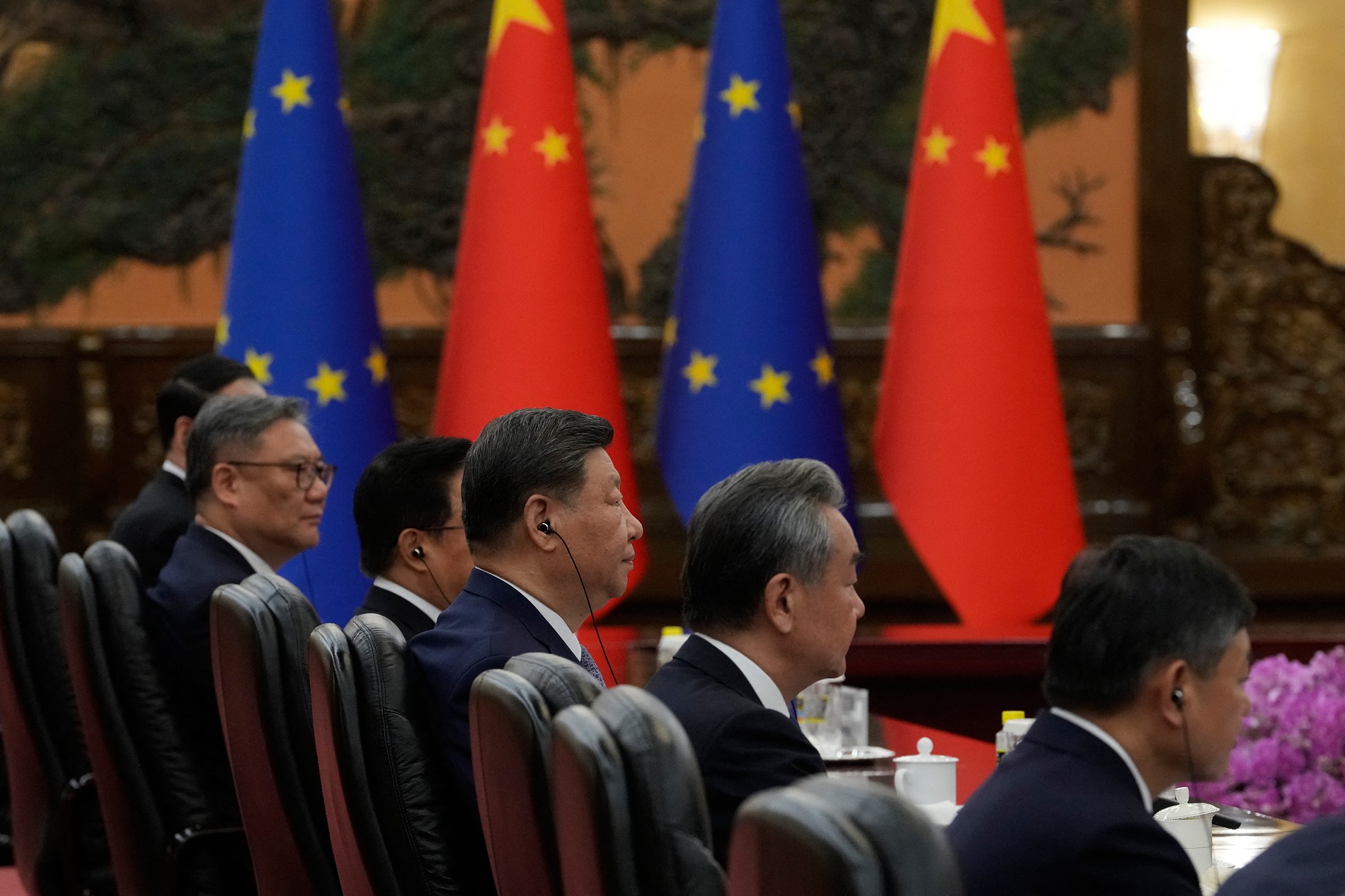
A European Union-China Summit took place in Beijing on July 24, 2025, marking the 50th anniversary of EU-China diplomatic relations. European Council President António Costa and European Commission President Ursula von der Leyen met with Chinese President Xi Jinping and Premier Li Qiang.
Amid escalating trade disputes, the EU has implemented tariffs of up to 45 percent on Chinese electric vehicles and in response China announced retaliatory investigations into European pork, dairy, and cognac imports. China has implemented rare earth export restrictions affecting European medical equipment and automotive production. EU officials have pressed China over its material support for Russia’s war effort in Ukraine, while Chinese Foreign Minister Wang Yi reportedly told some EU diplomats that China could not accept a Russian defeat as it would mean the U.S. would focus on China. The summit was originally planned as a two-day event but it was scaled back to a day and moved from Brussels to Beijing.
What are the implications for trade and security, and for how Europe has to balance its risks and needs between China, Russia, and the U.S.? Was the summit an inconsequential formality? Or if not, how are its outcomes likely to shape the EU-China relationship going forward? —The Editors
Comments
Philippe Le Corre
One of the most important comments made during last week’s 25th EU-China summit in Beijing was in European Commission President Ursula von der Leyden’s opening statement at her meeting with President Xi Jinping: “We have reached an inflection point. Rebalancing our bilateral relation[s] is essential.” Calling this summit an “inflection point” is not just a polite comment but a possible shift in Brussels’ strategy vis-a-vis a Chinese regime which has shown no empathy to the European Union’s quest for more trade balance, better access to the Chinese market for European companies, as well as a slightly better acknowledgment of the block’s deep discontent regarding China’s engagement with Russia as the latter continues its war against Ukraine. The reported comments by Chinese Foreign Minister Wang Yi in early July that China did not want Russia lose its war on Ukraine sent shockwaves to the normally placid Brussels diplomatic community. At least, Europeans were warned.
Even more surprising was Xi Jinping’s insistence last week that the current challenges faced by Europe did not come from China. Such a plainly incorrect statement is ignoring a record trade deficit of 305 billion euros ($350 billion), which was by and large caused by the stunning rise of Chinese exports, including solar panels, batteries, and—increasingly—electric cars. At the same time, European businesses are facing substantial trade barriers in China. For example, a new regulation was imposed on international cosmetic brands in 2021, while agricultural and food products face constant scrutiny by Chinese inspectors. This is where Beijing’s unwillingness to compromise with Brussels appears more clearly. Domestic economic reasons push Chinese provinces to produce more, which lead them to export to the most advantageous markets—the EU single market features prominently. From a European standpoint, whether China wants to save the long-term relationship with Europe is questionable. What Beijing is likely to do is to try to downgrade the relationship with EU institutions, and target individual states such as Spain, Greece, and especially Hungary which in 2023 captured 44 percent of all Chinese investments in the EU and U.K. This is more than Germany, France and the U.K. combined.
Furthermore, China is increasingly weaponizing its rare earth exports, which has made European companies even more alarmed. Despite Chinese reassurances, a deep concern remains for industries that rely on critical minerals for everything from cars to military equipment and aircrafts.
And as is often the case, the summit felt like two different meetings. Xi Jinping advised the Europeans to “make the right strategic choices that meet the expectations of the people and stand the test of history,” and appeared uninterested in responding to von der Leyen and European Council President António Costa’s words about the imbalances. Besides the usual and unsurprising climate announcement, perhaps the most impressive achievement of that EU-China summit is that it was merely shortened, not cancelled entirely.
Zichen Wang
EU and Chinese leaders met in Beijing on July 24 with low expectations. As anticipated, no major breakthroughs emerged. But the fact that talks were frank, open, and largely cordial marked a constructive outcome. European Commission President Ursula von der Leyen noted she had “very frankly and openly” raised concerns on trade, investment imbalances, and the Ukraine war, and even “partially identified solutions.” Beijing responded with restraint, emphasizing cooperation and avoiding confrontation. Von der Leyen said her meeting with President Xi Jinping was “excellent,” suggesting that neither side seeks a costly fight.
The summit laid bare core disagreements. EU leaders expressed dissatisfaction with trade imbalances and China’s position on Russia. Von der Leyen warned that EU-China commerce has hit an “inflection point” and called on China and Europe to offer “real solutions.” She stressed that Europe welcomes competition—but it must be fair and reciprocal. European Council President António Costa echoed the need for a “mutually beneficial” relationship.
One useful development is that both sides will have a better basis for talking about overcapacity. Europeans have recently pointed to China’s domestic push against involution (neijuan, 内卷), or irrational internal competition, as a sign of needed economic correction. While Beijing disputes the EU’s overcapacity claims, this shared policy awareness may make future talks less confrontational.
On geopolitics, Brussels did not hold back. The EU accused China of enabling Russia’s war machine by supplying critical components, and urged Beijing to push Moscow toward a ceasefire. Costa reminded China of its responsibilities as a UN Security Council member, and von der Leyen stressed that how China handles its Russia ties will shape future EU-China relations. President Xi, in turn, defended Beijing’s position, stating that Europe’s current challenges “do not come from China.” He urged the EU to “properly handle differences” and warned against protectionism. China’s stance has long been that it does not export weapons or strictly-defined dual-use goods or even drones, and that the rest of its trade with Russia is just business as usual.
EU concerns over China’s export controls appeared to resonate: Beijing agreed to streamline rare earth export procedures, which von der Leyen conveyed and welcomed. (Exports already rebounded in June.) The two sides also issued a joint climate statement—one area of steady cooperation, as the U.S. backtracks from the key global challenge.
Overall, the summit confirmed that deep differences remain. Yet neither side is seeking escalation. China projected confidence and composure, while the EU apparently came with specific asks. Still, there’s recognition that maintaining dialogue is better than rupture—and that some further pragmatic alignment, particularly on trade and climate, remains possible.
Neil Thomas
One of the most important players in contemporary EU-China relations was naturally absent when Chinese President Xi Jinping met with European Council President António Costa and European Commission President Ursula von der Leyen in Beijing on July 24.
That country, of course, was the United States. Last week, both Beijing and Brussels were preoccupied by their negotiations with Washington, which just bore fruit. On July 27, the European Union agreed to purchase hundreds of billions of dollars’ worth of U.S. goods in exchange for a tariff of 15 percent—half the rate that was threatened—on many European exports. A day later, U.S.-China trade talks began in Stockholm, which produced an agreement to continue discussions about extending their current tariff truce ahead of a bilateral summit later in the year.
Donald Trump’s return to the White House has reshaped the diplomacy of both China and the European Union toward each other. Xi appears confident that he can strike a deal with Trump, especially after flexing China’s leverage over rare earths. With U.S.-China ties relatively stable—for now—Beijing seems emboldened to adopt a tougher posture toward other partners. When Chinese Foreign Minister Wang Yi visited Brussels earlier in July, EU officials were shocked by his blunt support for Russia in Ukraine and his dismissal of European concerns over China’s new export controls on critical minerals.
After meeting Xi, von der Leyen emphasized that the EU’s relationship with China is “independent of the actions or issues we have with others.” That may be largely true: Brussels has not responded to U.S. tariffs by embracing China, despite Beijing’s hopes—or even expectations. But Trump’s moves to withdraw American support for European security and multilateral institutions are difficult to disentangle entirely from Brussels’ growing willingness to confront China directly over industrial overcapacity and its alignment with Moscow.
Trump’s renewed withdrawal from the Paris Agreement also underscored one of the few areas where Brussels and Beijing still find common ground. Expectations for the EU-China summit were so low that, if not for the sorry state of global climate diplomacy, the joint climate statement issued by both sides—its only major deliverable—might not have happened at all.
Justyna Szczudlik
The timing of the summit was not right. After Xi Jinping rejected an invitation to Brussels to celebrate the 50th anniversary of EU-China relations, the decision to hold the summit in China rather than Europe created the impression that the EU was subservient to the People’s Republic of China (PRC). Furthermore, through Trump’s second term—particularly because of the “Liberation Day” tariffs—the EU has been preoccupied with the U.S. and its stance on Russia and Ukraine. Holding the summit at this particular time and place created the impression that Europe was on the back foot, and that the meeting was a bargaining tool to be used with Trump. In that sense, China seemed to have the upper hand.
This impression was confirmed by the way the summit unfolded. The Chinese side seemed neither particularly interested in meetings with EU officials—Beijing cut the summit down to only one day—nor impressed by the coordinated and tough approach of European Council President António Costa and European Commission President Ursula von der Leyen. Despite EU officials openly raising topics such as China’s support for Russia in its war with Ukraine and overcapacity (smartly using the Chinese term “involution”), both Xi Jinping and Premier Li Qiang seemed unimpressed.
The EU should be commended for its principled, consequential, and tough stance. However, it’s hard not to get the impression that China believes it has time on its side, and that concessions are unnecessary. The announcement of a joint press statement on climate change—the only tangible outcome of the summit—seems to be a mere gesture to save face for the EU. Does anyone really believe that China is a reliable partner in mitigating climate change? If so, this is naive, while the statement plays into Chinese PR interests.
The view held by both Xi and Trump that Europe is irrelevant is becoming increasingly apparent. Since Trump 2.0, it seems that China’s main conclusion is that the deterioration of transatlantic ties benefits China. Beijing’s strategy is to adopt a wait-and-see approach, showing no inclination for positive change regarding the EU. This is exacerbated by the fact that the EU has taken a significant step forward by setting up a substantial toolbox of various defensive measures to be used in the event of Chinese economic coercion. When the EU uses these tools, China expresses its displeasure or even decides not to get involved, but this does not seem to be a major concern for the PRC.
So what does the EU need to do? It needs to adopt QMV (Qualified Majority Voting, a voting system used in the Council of the European Union to make decisions) in foreign politics, the rapid and comprehensive deployment of defensive tools, the implementation of a de-risking agenda, and a military build-up in Europe. Federalization should also be seriously considered. However, this is easier said than done. The problem lies in the lack of political will.
Lyle J. Morris
Early indications suggest that few breakthroughs were made, except for a joint statement on climate change and procedures for emergency exports of rare earth metals to the EU. Instead, the meeting featured pointed remarks by leaders on both sides on how to resolve the underlying sources of tension, while ensuring such tension does not derail broader economic and trade flows.
Most notable was Xi Jinping’s urging EU officials to “properly handle differences and frictions,” adding that the challenges facing Europe “do not come from China.” Xi also said that he hoped the European side “will keep the trade and investment market open and refrain from using restrictive economic and trade tools,” and instead “foster a sound business environment for Chinese enterprises investing and operating in the EU.” Xi warned that “boosting competitiveness should not rely on building walls or barriers, as decoupling and severing supply chains will only result in self-isolation.”
For her part, von der Leyen said that the EU side “frankly and openly raised our concerns . . . on the trade, investment and geopolitical issues,” adding that “We have partially identified solutions.” During a press conference after the first day, von der Leyen said that the Chinese leadership has started looking into the issue of overcapacity “and expressed willingness to support more the consumption and less the production part.”
Expectations were already low going into the Summit. Thus, the lack of diplomatic breakthroughs was expected in both Brussels and Beijing. It is apparent that the political and business mood on China in the EU has changed dramatically. In a nutshell, growing frustration from Brussels over unfair Chinese practices, coercive and predatory behavior, and dumping of Chinese overcapacity goods into the EU market has prompted the EU to re-examine its overall relationship with Beijing. The underwhelming results of the Summit may lead the EU to focus internally on how best to utilize its leverage over China to extract concessions from a seemingly intransigent Beijing, to include contemplating partially closing down the EU market to Chinese goods.
One point of leverage that the EU should contemplate is addressing China’s ongoing support for Russia’s war in Ukraine.
Up until now, the Chinese government has been unwilling to make any material concessions on arguably the central geostrategic security issue for Brussels.
This includes Beijing’s record-high and expanding trade ties with Moscow since the Ukraine invasion and consequent economic sanctions, and the offering of dual-use material that aids Russia’s military in Ukraine. China has maintained that it has never supplied weapons to Russia, something Ukrainian President Volodymyr Zelenskyy alleged in April.
But just this month, the EU took the unprecedented step of sanctioning two Chinese banks—Suifenhe Rural Commercial Bank and Heihe Rural Commercial Bank, both from cities bordering Russia—for facilitating the import of goods to Russia covered by existing EU sanctions. The move is significant and represents the first time the EU has sanctioned Chinese banks complicit in enabling the selling of goods that support Russia’s military.
And while China is sure to make good on its threats to retaliate, the EU’s decision offers one tool in its potent arsenal to put pressure on Beijing to curtail support for Russia’s war aims.
The EU’s diplomatic strategy of appealing to Chinese principles of sovereignty and non-aggression that Russia has so blatantly violated in Ukraine has failed to bring about change in China’s support for Moscow.
For an issue that is existential for the European continent, playing hardball with China may be the tactical change the EU needs to showcase the gravity of the issue.
Nadine Godehardt
In the immediate run-up to the 25th EU-China summit, both sides outdid themselves in keeping expectations as low as possible—and, indeed, nothing very consequential happened. The only tangible outcome was a joint declaration on climate action, reaffirming commitments to the Paris Agreement and upcoming COP30 cooperation, alongside a vague reference to a new upgraded export supply mechanism to ensure better EU access to rare earths and magnetic materials. These are low-hanging fruits that do not amount to real commitments. No broader joint statement. No joint press conferences. No grand sentiments on either side. But also—and this is a positive takeaway—no disaster either.
European Commission President Ursula von der Leyen described the summit as an “inflection point” of the relationship, stating that as “cooperation has deepened, so have the imbalances.” In less diplomatic terms, this could be interpreted as a recognition of an increasingly entrenched stalemate in EU-China relations, characterized by clearly formulated and diverging positions on both sides, yet rarely marked by deeper understanding of the other, or substantive agreements on major issues. Put differently, in today’s age of global uncertainty, the relationship appears to have been reset to square one.
If not now, then when is the right time to make China a cross-Directorate General priority in EU policymaking—permanently, not just in the run-up to another high-level meeting or two weeks before the next EU-China summit? I am not merely calling for building more China expertise (although that would certainly be beneficial). Rather, addressing the China challenge requires the EU to strategically harness existing capacities and to move from political awareness to organizational learning, strategic preparedness, and effective policy implementation.
One example: China under Xi Jinping aims to gain discursive authority in global affairs and governance. This ambition has resulted in a growing competition—even rivalry—over the shaping of international norms, which increasingly aligns the global order with the preferences of the Chinese Communist Party (CCP), rather than vice versa. In her concluding remarks, von der Leyen emphasized, “From this Summit I gather that there is a lot that we can do together. Despite our differences—and we have differences—we can find pragmatic solutions.”
To most China observers, this sounds remarkably similar to the Chinese phrase qiútóng cúnyì (求同存异)—“seek common ground while reserving differences”—which is often used by Chinese leadership to downplay disagreements (such as on Russia’s war in Ukraine), and instead to highlight shared interests in multilateralism and cooperation. Put simply, von der Leyen appears to have opened the door to Xi Jinping’s logic of global governance—clearly a win for the Chinese side.
Therefore, if the EU intends to compete in the realm of narratives and interpretation, China must become a cross-Directorate General priority. This requires sustained horizontal coordination and a high level of preparedness to strategically use Chinese lines of argument to support EU positions—rather than the other way around.