


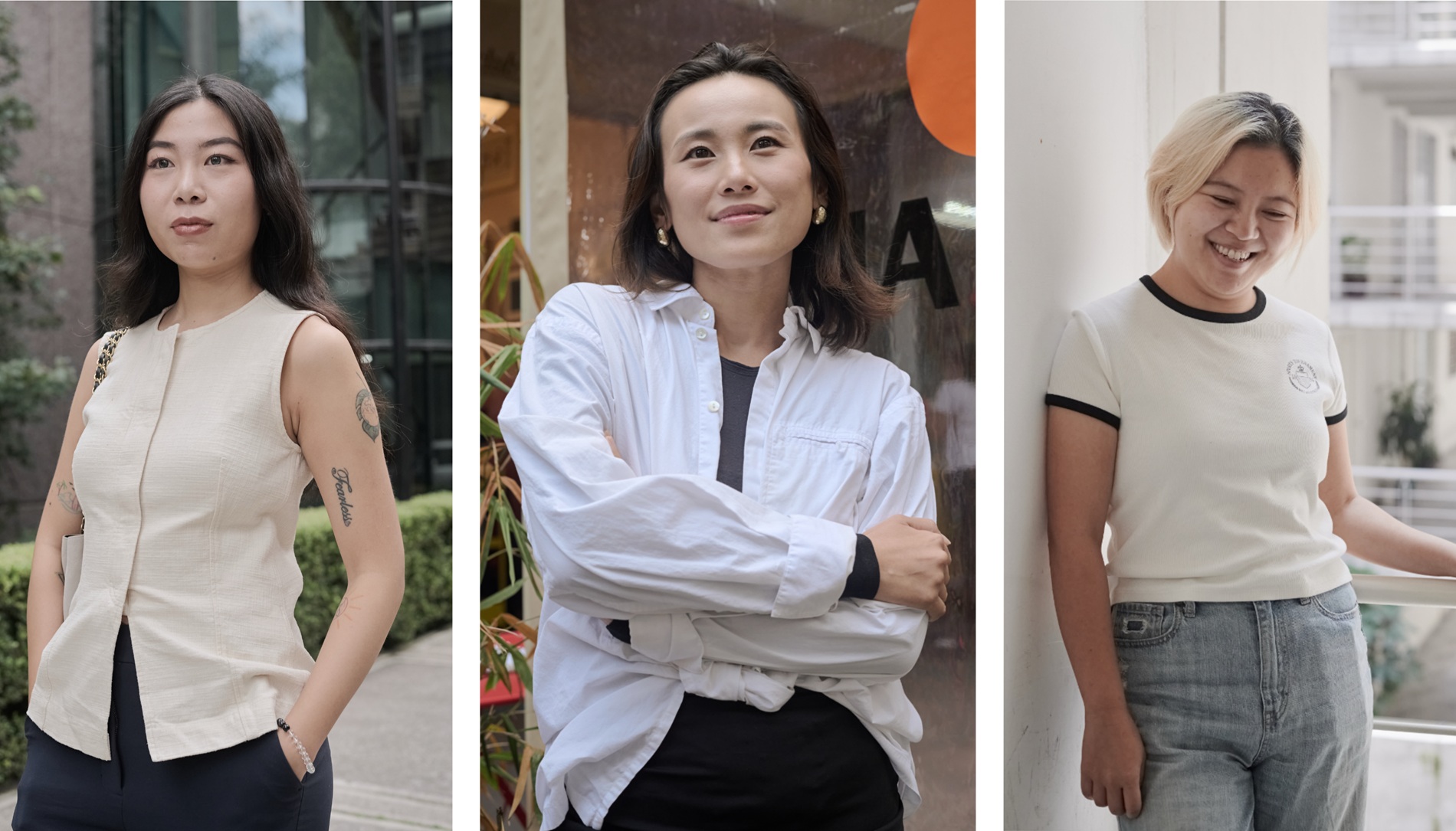
Mexico City, Mexico — At around noon, as she wraps up a meeting over the phone, Jiale Zhao steps out of an Uber onto Avenida Presidente Masaryk, sometimes called Mexico City’s Fifth Avenue, a high-end shopping area located in the Polanco district with numerous fine dining restaurants and flagships of luxury brands such as Hermès and Cartier. With long, wavy black hair and wearing a sleeveless light beige blouse, Zhao squeezes through a backdoor into a storefront under renovation, a chain-strap bag with a faint silver sheen hanging from her shoulder. Inside, rows of wires, metal pipes, and bags of construction materials line the floor. Five workers in neon orange vests and helmets are working. A speaker on the ground is playing salsa.
It’s a crisp day. Zhao’s mission in Mexico City is to launch the first and flagship restaurant in the country for a global Chinese chain of hot pot restaurants.
Two representatives from the contractor arrive with news. The opening, once scheduled for December, may be pushed to February. “They say I need to have ‘low expectations,’” Zhao says, her face clouding with frustration. “Oh my god!”
Although starting a business in Mexico is forcing her to accept a slower pace of work than she would prefer, Zhao admits that she is getting ahead faster than had she stayed at home. Educated in the U.K. and sent to Mexico by her company in 2024, the 26-year-old enjoys being in charge of the high-profile launch. “Without a doubt, working here will mean I gain work experience, develop management skills and adaptability, and learn to manage stress in a short period of time,” Zhao reflects in Chinese. “It’s a valuable opportunity for my personal growth and career development.”
As China’s global footprint expands, Zhao is part of a growing cohort of young Chinese women building overseas careers and leadership experience at Chinese corporations in emerging markets such as Mexico.
“Many women say they feel more fulfilled in their overseas roles [than in China],” says Yu Huang, a migration researcher at Nagoya University who studies social segregation among highly skilled East Asian immigrants in Mexico. Among roughly 50 Chinese immigrants working in corporate positions in Mexico Huang interviewed in 2023 and 2024, the majority were women who had been promoted to management roles when they were transferred to overseas postings. “As managers, they can move projects forward directly and communicate more closely with branch leadership,” she says.
Hot pot restaurant manager Zhao says she was chosen to oversee the opening because of her ability to learn quickly—and because, as a single woman, she was more flexible and cost-effective than more experienced executives who might have families and thus be more expensive to relocate. A list of things Zhao has learned about doing business in Mexico over the year and a half since she arrived bespeaks the problems she has encountered: large bank transfers from abroad frequently trigger account blocks; there is a limited pool of restaurant manager candidates who speak English to communicate with members of the team who don’t speak Spanish, and those who do don’t always have visas to travel to the U.S. restaurants for company training sessions; and, most importantly, Mexico has no culture of eating hot pot.
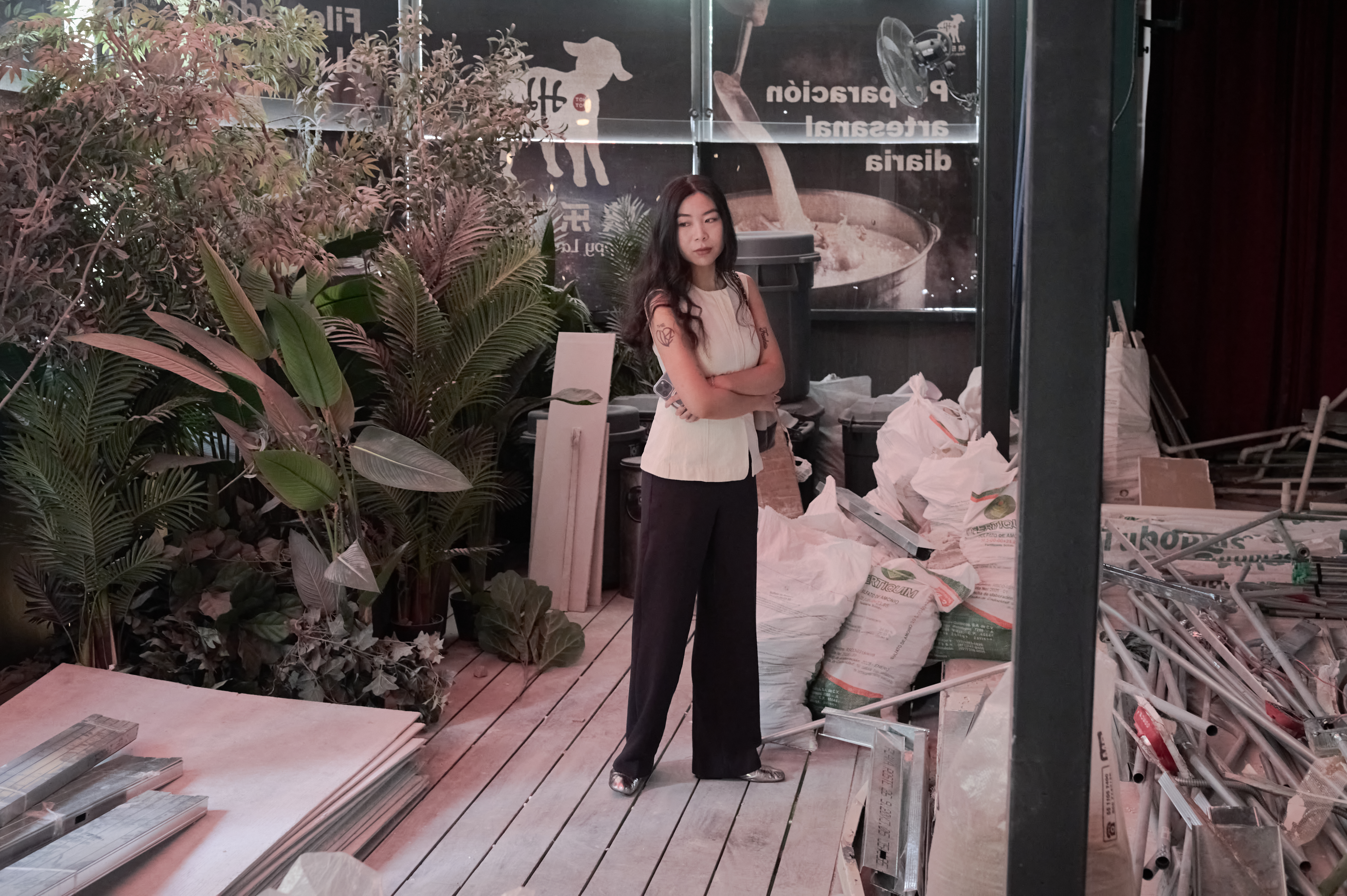
Jiale Zhao, 26, meets with builders to finalize the construction of the restaurant she was working to open, in the Polanco neighborhood of Mexico City, September 12, 2025.
Zhao is undeterred. Hot pot operates on an easy-to-duplicate standard procedure, she reasons. Moreover, the location of her restaurant is impeccable. Third and undeniably, Mexicans also eat spicy food.
“As long as they carry out their marketing, they’ll reach the Chinese community first, and then locals,” says Zhao, who asked that her restaurant not be named since she accepted interviews for this article in a personal rather than professional capacity. “So there’s good reason to be hopeful.”
(At the time this story was published, the restaurant had just opened.)
* * *
U.S.-China trade tensions over the past few years have pushed China toward more trade with Global South countries. China is now Latin America’s second-largest trade partner.
Against this backdrop, Mexico, the region’s second-largest economy after Brazil and a member of the U.S.-Mexico-Canada trade framework, has emerged as a strategic foothold. Many Chinese companies making inroads in Latin America have set up their regional headquarters in Mexico City’s prestigious corporate and residential districts such as Polanco.
The corporate push abroad has sent hundreds of thousands of Chinese employees overseas each year. In 2025, Mexico’s government issued 6,214 temporary residency cards to Chinese migrants, mostly for work purposes—more than three times the number issued in 2019, the year before the pandemic started. By 2025, Chinese nationals had become the second largest group of migrants, after those from the U.S., granted such permits.
One-third of them were women, reflecting a similar trend of female underrepresentation among international expatriates worldwide.
While some climb the career ladder fast-track, others are launching their own businesses, often after leaving their corporate posts.
“Some [female employees] are starting to freelance or just do their own businesses,” says Xi Chen, a former senior manager at Huawei Mexico with extensive connections in the country’s Chinese business circles. “The opportunities for women are fewer, because men would give the opportunities to other men.” Chen now runs her own marketing firm and cultural space from Mexico City.
Many of the people we interviewed say that being their own bosses to some degree frees them from gender-based workplace discrimination. On the Chinese social media platform Xiaohongshu, or RedNote, women share stories of their experiences navigating Mexican society and regulations while running ventures that range from dance and Pilates studios to clothing shops, Chinese regional-flavor restaurants, Spanish-language influencer content, and even co-living space for scuba divers.
“Running a restaurant has always been a dream of mine, and I never imagined it would take root and flourish on the other side of the world,” wrote Iris Yu on RedNote. Yu is the restaurateur of Via Sol, a popular dumpling and wine bistro in Mexico City that opened in 2023.
But greater visibility also brings new frictions. Last September, as Yu spoke with us, a male local owner of an adjacent shop called her “rude” for failing to notice a seat blocking the building’s entrance. Yu apologized immediately, but the exchange continued as regular customers waited to greet her.
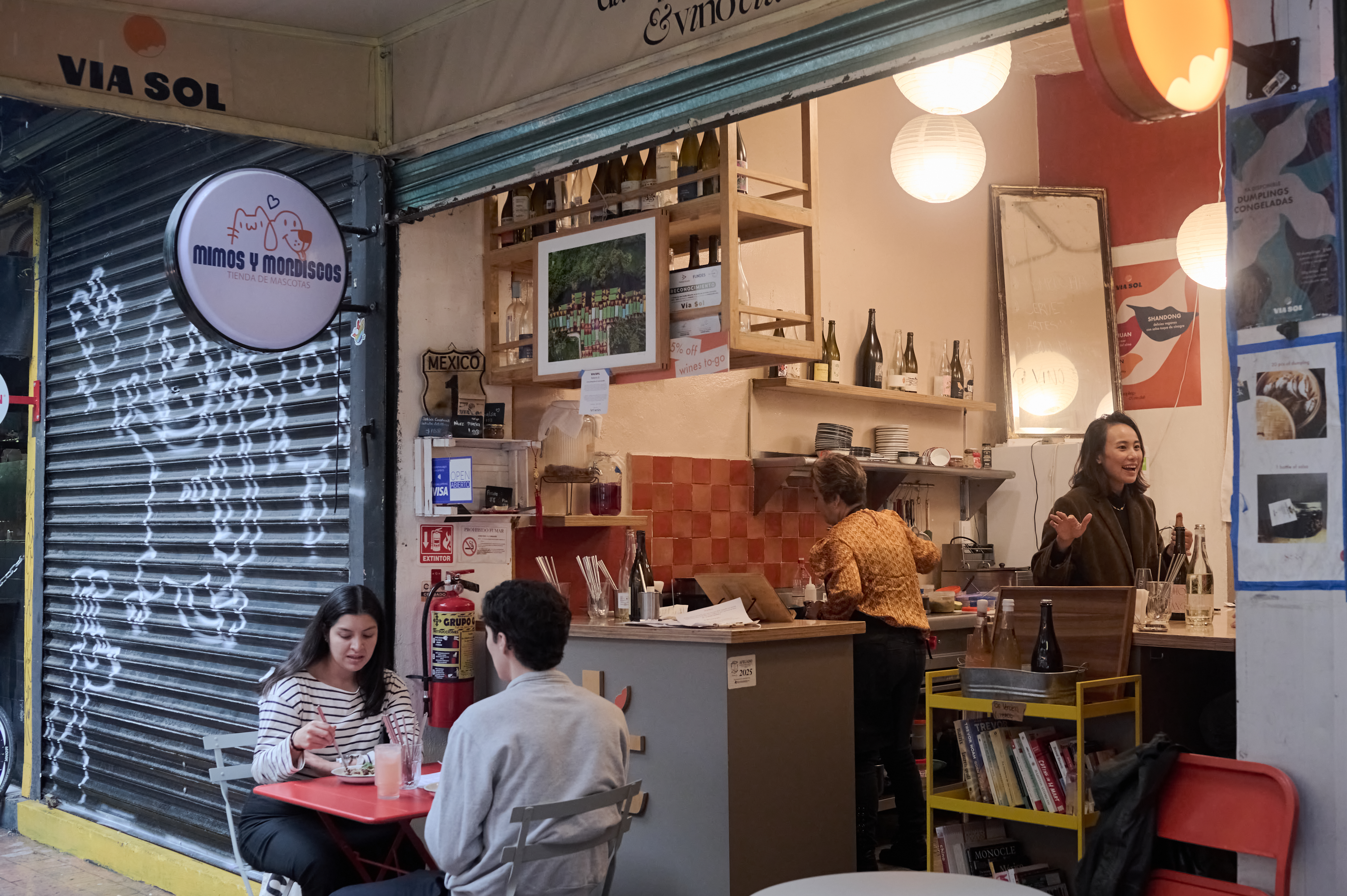
Iris Yu, 32, hosts a wine tasting for customers at her bistro, in the Escandón neighborhood of Mexico City, September 22, 2025.
There is no official data tracking this relatively small female migrant group: Most small and medium enterprises do not register with Chinese business associations in Mexico, and no public dataset in Mexico City captures their presence. Xi Chen, the former manager at Huawei Mexico, estimates that she has met around 30 Chinese women running their own businesses. This tally may be anecdotal, but it’s clear that female Chinese migration to Mexico is climbing. Official figures point to a rapid increase in young Chinese women arriving in the country with temporary residency permits in recent years.
The earliest significant wave of Chinese migration to Mexico was made up of mostly male laborers who worked on railroads, in agriculture, and in mining in the late 19th century. Over the course of the 20th century, exclusionary policies and anti-Chinese sentiment reduced the community’s size and visibility.
Until the 1990s, the majority of female Chinese migrants to Mexico arrived through family unification. After NAFTA came into effect in 1994, Chinese women started coming to Mexico to work as merchants in Mexico City’s marketplaces, selling small products imported from China such as kitchenware and plastic children’s toys.
Chen was sent to Mexico by Huawei in 2018. Not long after, the U.S. banned Google from sharing technology with Huawei, tanking Huawei’s global smartphone sales. After sticking around for four years, in 2022, Chen, a Spanish major, went on to complete an MBA in the U.S. In 2025, she moved back to Mexico City and founded a marketing agency, which signed top Spanish-language influencers from China such as Guadalajara-based Estela Hao, who has nearly three million followers on TikTok.
Around the same time, she opened Casa Vacía, a cultural space based in a luxury condo redeveloped from a historical building in the trendy Roma neighborhood, where she has hosted weekly events, including celebrations of the Day of the Dead. Young Chinese living and working in Polanco go to Casa Vacía as a respite from the corporate grind. At one recent event, four female Chinese business leaders shared their stories with a small audience, also mostly women.
* * *
It is an October afternoon and a light rain is falling on Juárez, an up-and-coming neighborhood along one of Mexico City’s central boulevards, southeast of Polanco.
A couple of young locals who appear to be in their early 30s walk past a chain café, up the stairs in front of a boutique hair salon, and file into a cozy Pilates studio. Floor-to-ceiling windows frame leafy trees outside, alongside a row of reformers recently arrived from China.
“Mexico is like China, but in the 1980s,” reflects Zhuwen Ye, the 29-year-old owner, in Spanish, comparing the city’s booming retail and service scene to China’s market reform era. “Mexico has an untapped market that is ready to be leveraged, and it’s very easy for them [the Chinese] to capitalize on it.”

Zhuwen Ye, 29, guides a student during a reformer machine session at her Pilates studio, in the Juárez neighborhood of Mexico City, August 14, 2025.
The studio is Ye’s second venture within a year after quitting her job with a Chinese vehicle company based in Mexico City. With her savings, she first co-invested in opening a Lanzhou pulled noodle restaurant, which she says achieved positive cash flow within months.
“Five years ago, I wouldn’t have imagined I’d have my own businesses one day,” says Ye.
Originally from a small town in Zhejiang province, Ye speaks Spanish fluently, with a hint of a Castilian accent, a hallmark of her Spanish education at a Chinese university. As a college student, she spent an exchange semester in the Mexican state of Colima, on the Pacific coast, where she went on her first date and learned to dance to reggaeton. She moved back to Mexico after graduation in 2020. After teaching Chinese to Mexican children at a private school for a couple of years, Ye applied for a position as an administrative manager at a Chinese vehicle manufacturer.
During the job interview, she says she was asked about her weight by the male Chinese manager. Hired to be the general manager, she performed miscellaneous duties from HR, accounting, and logistics, to pouring tea and assisting with her colleagues’ personal matters even during the weekends. She was the company’s only female Chinese employee. Once, she accompanied some male employees from China on a business trip in the city; they were stunned to witness the International Women’s Day march, one of the biggest in the world, Ye says. “They thought women’s lives were good enough, ‘why do this?’”
Clearly, many Chinese women making choices similar to Ye’s feel otherwise. Mexico has a robust and thriving feminist movement, fueled in part by persistent gender inequality and violence against women. But in China, discussions of women’s rights and feminism are heavily censored.
In smaller towns like the one where Ye grew up, young women often face pressure to conform to traditional gender roles, says Sisi Sung, an economics scholar at the University of Dundee Business School who studies female Chinese entrepreneurship.
Yet many young women are willing to challenge those expectations by pursuing independent entrepreneurship, even if that means straining family relationships or exposing themselves to potentially more challenging circumstances.
“There must be something that is driving it, because they are actually taking the alternative and not the accepted, preferred way. So they must have a lot of courage, and definitely they must be very committed to this,” Sung explains.
Ye announced her resignation soon after the arrival of a new male director. “My first boss encouraged and looked after me. The second one only belittled and criticized me,” she says. During what Ye describes as a contentious off-boarding, she says her boss threatened her. “Your reputation at other [Chinese] companies will be damaged,” Ye recalls he told her.
“I still feel somewhat traumatized and emotionally scarred,” she says, pausing to steady her breath, but “my life is better now. I don’t have to put up with that atmosphere anymore.”
Today, Ye swims regularly and practices Pilates when she’s not working. She says she feels healthier and more secure, and has achieved “the best I could have in my ideal life, except for a relationship.” She appreciates Mexico’s culture of greeting strangers and the simple act of saying “thank you” in daily exchanges. Here, she says, she feels free from judgment. No one tells her what to do or pressures her to get married—something guaranteed to happen every time she visits China.
Her businesses are quickly expanding. Recently, she opened her second restaurant and rolled out Pilates classes taught in Mandarin Chinese at the studio.
Occasionally, Ye says, she confronts the corruption of Mexican officials firsthand. Soliciting bribes, for example, is a common practice experienced by business owners in Mexico.
“Mexico has its problems, but in the five years I’ve lived here, it has changed me,” she says. “As a Chinese woman who comes from a conservative family, I consider myself lucky for having gotten where I am.”
* * *
Today, Mexico has become a hub of global movement, drawing people from nearly every corner of the world. But opportunities vary depending on wealth, social class, and documentation, highlighting a growing gap between those who thrive and those who struggle.
In Mexico City, gentrification driven by digital nomads and rising tourism pressures grows alongside climbing housing prices and displacement of lower-income residents. These changes are perhaps most visible in neighborhoods like Roma and Condesa, where the influx of affluent foreign residents has gone hand in hand with the arrival of upscale shops that advertise exclusively in English.
For longtime residents, the impact is plain to see. Walking past one of the many branches of Tierra Garat, a well-known coffee chain now dotting Roma, it is hard not to feel a pang of loss remembering that, just four years ago, the same space was home to Tortería Colima, a beloved local business that for more than half a century served tortas (Mexican sandwiches) and fresh juices at affordable prices, only to be forced to close after a prolonged eviction process and repeated threats.
Meanwhile, migrants from across the Americas, stranded as a consequence of U.S. border closures, had been living in makeshift camps scattered throughout the city. As authorities dismantled many of these camps, some migrants were able to find refuge in shelters, while others began renting rooms in the city’s most affordable areas.
The general Polanco area is undergoing significant changes to meet the needs of the growing Chinese community that has arrived alongside Chinese corporations. Plaza Carso, a luxury mixed-use complex that houses Huawei, Oppo, Xiaomi, and ZTE, as well as other international companies, accommodates Chinese employees and their families in a residential wing where they can commute to work and ascend to the rooftop pool without leaving the complex.
New restaurants showcasing a wide range of Chinese regional cuisines are opening in rapid succession. These eateries attract not only Chinese customers, but have also begun to draw Mexican clients, particularly from the business and government sectors. The increase in Chinese-owned businesses has caused tension in some cases, but curiosity about Asian culture remains strong.
Chinese New Year celebrations organized by public cultural institutions regularly draw thousands of spectators. At the same time, shopping centers and minimarkets selling products made in China have become a magnet not only for local merchants who buy in bulk to resell, but also for everyday shoppers.
In February, when the Chinese ice cream and beverage chain Mixue opened its first outlet in Mexico in the capital’s main square, the debut triggered massive lines. Customers waited for hours to try extremely low-cost soft‑serve ice cream, priced at just 8 Mexican pesos (about 45 cents in U.S. dollars), taro boba tea, or a cookie-sprinkled sundae promoted by Snow King, the brand’s crown-wearing snowman mascot.
* * *
In early 2024, before her 32nd birthday, Emily Mei felt a pull toward the far side of the planet. From Beijing, her route would take her through Mexico and all the way down to Argentina, near China’s antipode.
“I need to go somewhere further,” she recalls thinking. “Further than Asia, the furthest I can.”
After studying at a film school in Los Angeles, Mei returned to her native Beijing and earned early recognition as a producer. Her first feature received funding from China’s FIRST International Film Festival, known for championing emerging independent filmmakers. But after years of navigating China’s heavily censored, hyper-competitive film industry, Mei decided it was time for a change.
Being a lesbian woman also shaped her choice, pushing her to seek a place where she could express herself more freely.
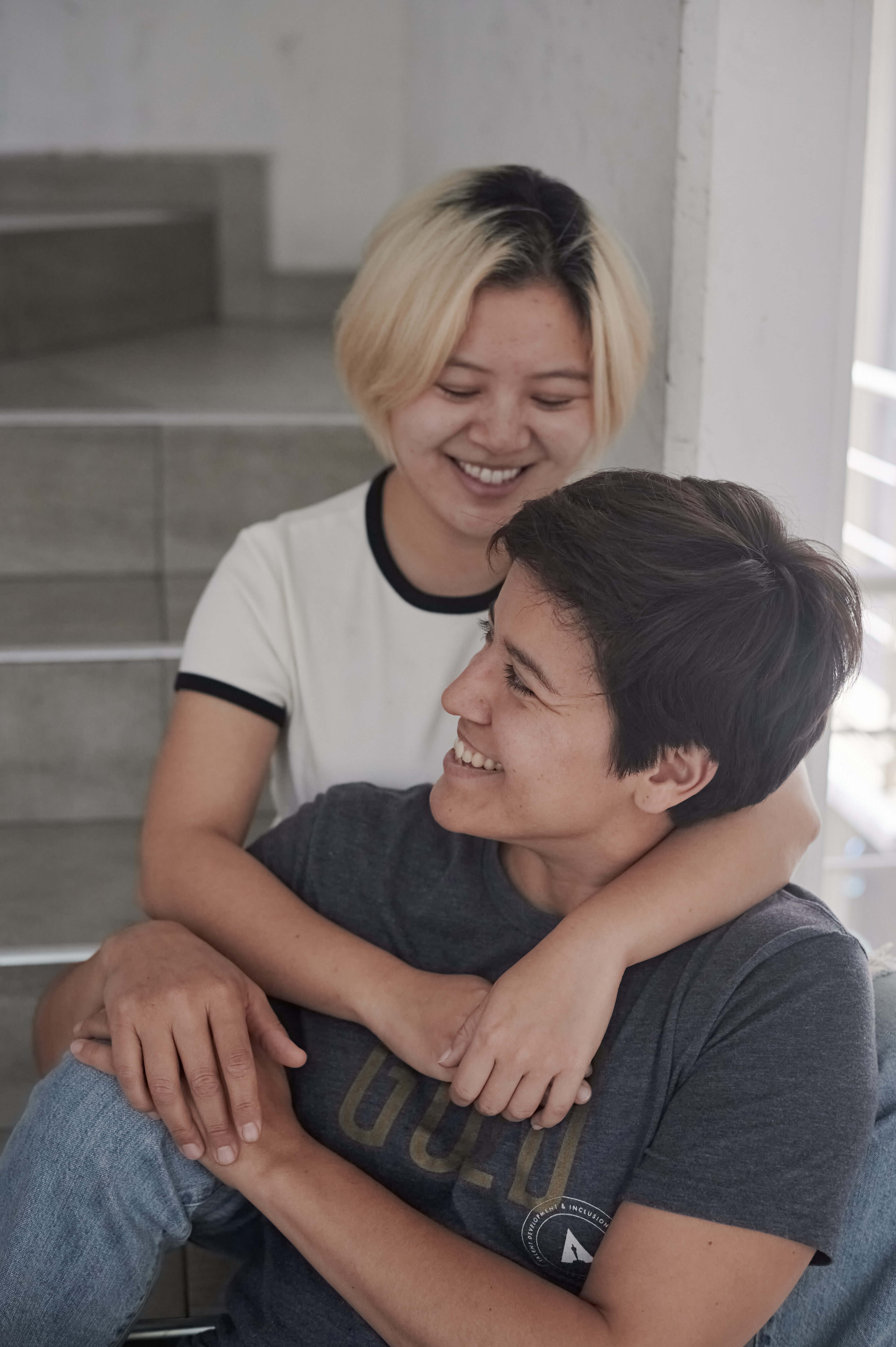
Emily Mei, 32, with her wife, Mayahuel Zárate, in their apartment building in Mexico City, August 19, 2025.
“All my friends, my family, they know I’m a lesbian, but I can’t talk about that through my work,” Mei explains. In China, public spaces for the LGBT community have been deteriorating over the years, and same-sex marriage is not recognized.
Two years later, though she had not reached that exact global antipode, her life had turned 180 degrees.
During a trip with a friend to Oaxaca, in southern Mexico, she met 33-year-old Mayahuel Zárate and fell in love. After six months, they got married and began building a social media influencer business that gradually grew.
They initially bet on creating travel content as a cross-cultural, lesbian married couple exploring Mexico and Asia, but it never really took off. Then one day Mei had an idea: to record videos demonstrating basic Chinese massage techniques on Zárate. Something clicked.
Less than a year after that first viral content, they have about 900,000 followers across Instagram and TikTok, with fans spanning from Mexico to the Southern Cone and as far as Spain. One Peruvian follower even suggested that Mei should open a clinic to see patients.
Mei shrugs and says she is not actually a massage professional, but the videos have become a source of income. Together, the couple launched a series called “the 100 massages my Chinese wife taught me,” and then started a self-care brand, ChuchuChula, which sells products such as acupressure clips and massage oil.
Mei and Zárate are still adapting to their new identity as wives, influencers, and entrepreneurs. Daily routines are gone, especially for Mei, who often stays up late to arrange deliveries from China.
Still, Mei says she is happy with her new life.
“I feel like Mexico pretty much fits my diagram,” she says with a grin, referring to a four-dimensional personal chart she created to figure out if a place is worth living in.
“I feel safe as a woman, I feel safe as a lesbian, I feel safe as a crazy dog lover,” Mei laughs. “And I feel safe as a Chinese person.”