


For scholars researching authoritarian regimes, the world is becoming harder to read. Access to fields, archives, and information in China, as in Russia and elsewhere, has dwindled. Sweeping data security laws now frame routine in-country data-gathering as potential espionage. We are returning to an era reminiscent of the Cold War, in which researchers must once again navigate inherently hostile environments that systematically constrain access, criminalize investigations, and conceal data.
Yet, retreat is not an option. As China and the West remain deeply intertwined economically and geopolitically, policymakers and scholars need actionable insights into the state’s inner workings. But with highly restricted access, how can we construct valid knowledge?
One of the world’s most aggressively restricted environments for independent research, Xinjiang, can offer a roadmap. Despite formidable barriers to access and a draconian surveillance apparatus that renders traditional fieldwork impossible, I have been able (repeatedly) to uncover significant evidence of Beijing’s campaign of repression against Uyghurs and other ethnic groups in near real-time.
The key to these discoveries was a method I have now come to call “Investigative Policy Analysis.” An innovation born out of extreme constraints on access, this approach synthesizes techniques drawn from different academic disciplines. It combines the ethnographer’s mindset of following a lead wherever it goes with the rigor of document-based policy analysis. By treating the online paper trail of government bureaucracies as a virtual field to explore, this method allows researchers to reverse-engineer state secrets from afar. Investigative Policy Analysis reconceptualizes the internet not merely as a repository of information, but as a crime scene of scattered digital traces awaiting forensic reconstruction.
Digital Breadcrumbs: Tracing the Trail to the Camps
Beginning in 2017, swaths of Uyghur communities began to disappear across Xinjiang. Those who went missing seemed to be winding up in facilities rumored to be internment camps, even as locals overheard state officials euphemistically referring to them as “schools” where people were sent to “study.” Neighborhoods fell quiet, and relatives abroad suddenly lost contact with their loved ones. Yet, as the state engineered this demographic erasure, the earliest cracks in its wall of secrecy were not leaked official documents. Rather, they appeared in the form of “digital breadcrumbs” scattered across obscure corners of the Chinese internet, hidden in plain sight.
Some of these clues were desperate questions posted on everyday legal advice websites. In one instance, a Uyghur child wondered about the length of their mother’s “sentence” after she was detained for observing Islamic funeral rituals. In April 2018, just over a year into the mass internment campaign, another netizen asked for guidance on how to initiate divorce proceedings against a spouse who had vanished into a camp. These fleeting cries for help came to represent the inadvertent administrative traces of a vast, concealed campaign of social engineering.
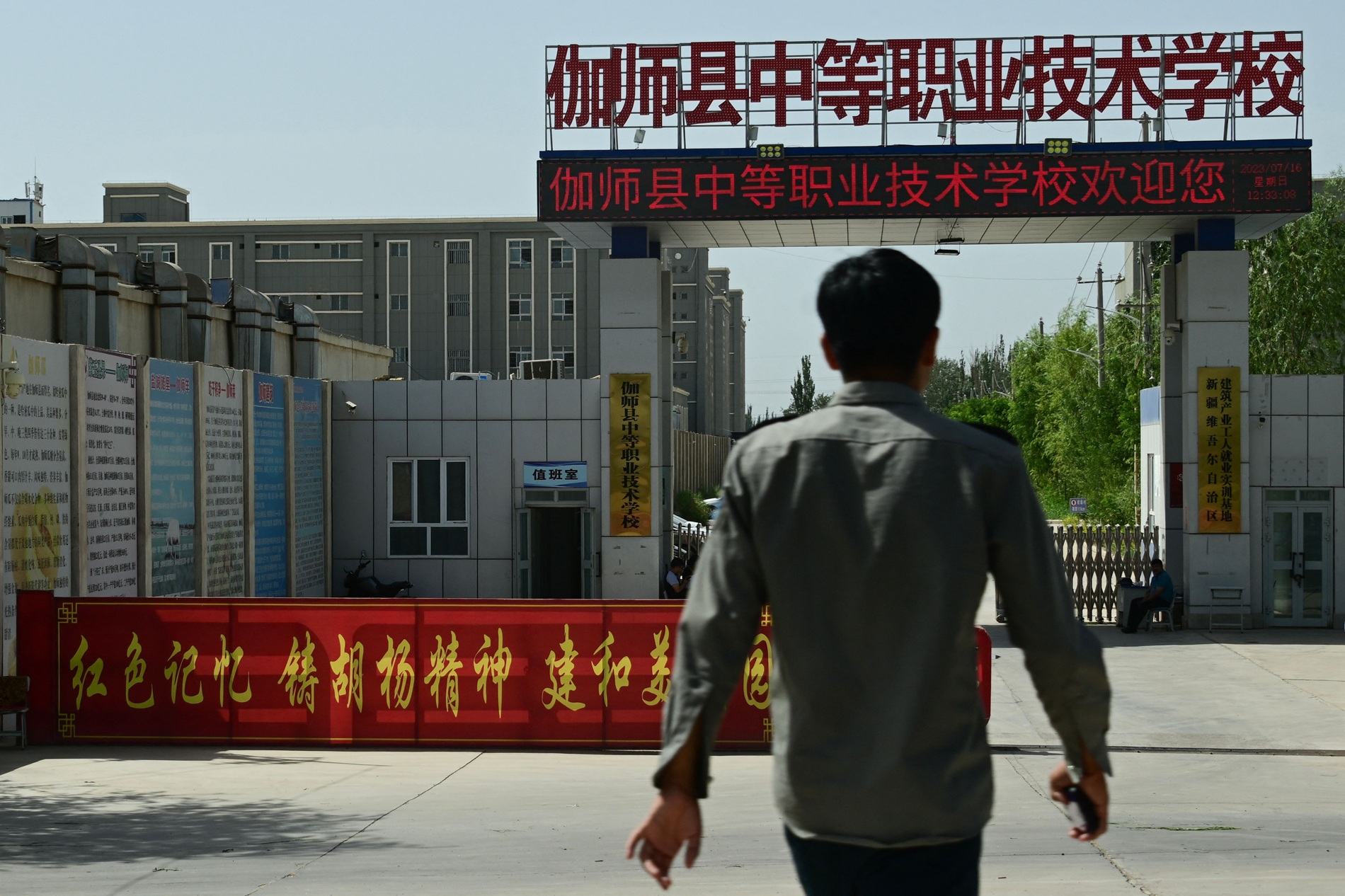
In the spring of 2017, several seemingly routine construction bids appeared on government websites. They solicited contractors to build new facilities with high perimeter walls, watchtowers, barbed wire installations, and internal police stations. To the casual observer, the architectural specifications suggested prisons, yet the local bureaucracy referred to them as “vocational skills education and training centers.” When triangulated with satellite imagery, policy directives, and recruitment bids, these documents became the cornerstone in exposing one of the largest mass internment campaigns since the Second World War.
Beyond Cold War Pekingology: The New Digital Challenge
In 2023, China scholar David Shambaugh argued that contemporary China studies was “coming full circle.” This meant a return to an era in which researchers must observe a closed regime entirely from the outside. Following Deng Xiaoping’s reforms in the ’80s, fieldwork opportunities had expanded. But under Xi Jinping, this trend has decisively reversed. In light of this shift, Shambaugh suggested that China studies may have to reacquire the methods of “Pekingology,” or the art of “peering into China from the outside” by interpreting indirect clues.
Shambaugh’s diagnosis accurately describes where we stand today. Yet, a simple reversion to Cold War Pekingology is insufficient. While our methodological tools have multiplied, today’s scholars confront something the original Pekingologists never did: a wealth of data that often yields little actionable information. The challenge is forensic: reconstructing reality from a deluge of propaganda and routine bureaucratic records.
Before Deng’s reform era, scholars treated research on the People’s Republic of China (PRC) as an exercise in remote sensing, in which researchers such as Michel Oksenberg and Andrew Walder developed sophisticated techniques with which to read between the lines of the People’s Daily or to interpret the nuances of provincial radio broadcasts. They treated every snippet of information as potentially valuable, triangulating fragmentary data to discern élite politics and modes of social control.
For instance, researchers examined Chinese news articles to assess topics including rural land reform, public health programs, participatory worker management in factories, and ethnic policy implementation. To bypass physical restrictions, scholars interviewed Chinese émigrés in Hong Kong and analyzed fiction, including children’s books, for clues about social life. They gleaned commentary on contentious matters from provincial radio broadcasts and complemented these insights with rare internal documents such as leaked politburo speeches. In their effort to triangulate these sources, scholars pursued diverse strategies, such as reading Chinese academic papers in which debate was sometimes tolerated during the lead-up to the finalizing of new policies.
Deep familiarity with sources and an investigator’s habit of reasoning backward from clues characterized this era. However, as China opened up, scholars allowed these skills to atrophy as the standard toolkit of modern social science—surveys, interviews, and sophisticated quantitative analysis—supplanted them. The field has begun to say as much about itself: A workshop series at Johns Hopkins now runs under the title “Relearning the Lost Arts of China Scholarship.” China studies gravitated toward methodologies that prioritized “rigor,” often narrowly equated with statistical precision, and dismissed “detective work” as impressionistic or unscientific.
We now inhabit a transformed landscape in which archives are closing and researchers are increasingly denied fieldwork access. Yet, unlike in the 1960s, the Chinese state is now a digital entity. It cannot govern 1.4 billion people without generating a substantial digital footprint. Every bid for a surveillance camera, every propaganda report about supposedly happy cotton-pickers, can become a data point. The state may scrub some of it, but the sheer volume of governance makes complete erasure impossible.
The challenge for the contemporary scholar is to adapt the creativity and persistence of Pekingologists to this new digital environment. The researcher must trade the surveyor’s role for that of the forensic analyst, mining volumes of data to reconstruct the underlying mechanisms of state policy.
Investigative Policy Analysis is a research strategy that represents a synthesis of various methodological approaches and tools that combine the fluidity of ethnographic investigation with the rigor of document-based policy analysis. Like the shape of a funnel, the investigative process starts with a broad space for creative exploration but concludes with a structured account.
Tifa: Linguistic Fingerprints of the Party-State
The primary tool for this investigative strategy is tifa (提法), politically binding standard phrases or watchwords used to signal conformity and transmit directives. The concept is rooted in the Confucian doctrine of the rectification of names, which Mao Zedong revived to enforce ideologically correct language across the Party-state apparatus. Formulated at the top and replicated down the chain of command, tifa appear in speeches, work reports, and procurement bids.
For investigative scholars, this makes tifa the key to exploiting the intertextuality (the presence of elements of one text within another) that characterizes Chinese bureaucratic discourse. Because local officials must use precise terminology to demonstrate loyalty and avoid penalties for linguistic deviation, they leave a trail linking local action to central intent. This rigid adherence to terminology leaves the traces upon which Investigative Policy Analysis relies.
Investigative Policy Analysis exploits this system by tracking tifa: The researcher identifies relevant phrases through exploratory searches, traces their use across networks of inter-texts, and analyzes variations in usage before synthesizing the findings into a reconstruction of the policy framework. Researchers can thus link a low-level construction bid to a high-level policy document.
Uncovering the Camp System
The investigation into the Xinjiang camps illustrates this process. It began with anecdotal reports from foreign media and the Uyghur diaspora of disappearances into so-called re-education facilities, where detainees were reportedly held without trial for political indoctrination. At this stage, hard data was absent. All I had were questions: If the state were detaining hundreds of thousands of people, under which policy was it doing so, and how were the facilities that held them formally designated? The existing prisons could not have absorbed such numbers, and local accounts pointed to mass detentions in securitized “schools.”
The facilities went by no single name. Some documents spoke of “vocational skills education and training centers,” others of “legal system transformation through education schools.” One element, though, kept resurfacing in the paperwork: jiaoyu zhuanhua (教育转化), “transformation through education,” an administrative tifa rooted in the Party’s history of thought reform.
I traced this tifa backwards in time. The campaign, it turned out, had recent precursors: local counties were already experimenting with “transformation through education” on a smaller scale. The atrocity had been piloted before it was rolled out. I then found a pivotal document: the Regulations on De-extremification of March 2017. It authorized the use of “transformation through education” to combat religious extremism. Here was the legalistic basis for the camps themselves. By linking the tifa in the regulation to the tifa in the construction bids, I could prove that the “schools” under construction were, in fact, the extrajudicial internment facilities the state had authorized. With that, the process shifted from data collection to policy analysis.
None of this emerged in an orderly sequence. I had been casting a wide net across the Chinese internet, and the search for the tifa “transformation through education” eventually led to the public procurement (bidding) documents. One bid for a facility in Bachu County, Kashgar Prefecture, described the installation of four watchtowers and “security installations,” including security barriers (to prevent escapes), secure doors and windows, and partition fencing (commonly used in camps to separate detainee groups). Satellite imagery confirmed a vast, securitized compound that matched the specifications. Other bids outlined re-education “centers” with armed police stations, barbed wire, and surveillance systems.
Uncovering the camp system had become an exercise in forensic reconstruction. The state never announced it was building a vast camp system. Still, by collecting the debris—policy experiments, bids, satellite images, social media posts, administrative regulations—researchers could reconstruct what we now believe to be a reasonably accurate model of it.
Investigating Forced Labor Transfers
I have used the same method to document other social engineering efforts, in particular forced labor. Again, the process moved from anecdotal leads to systemic documentation. Identifying the specific tifa that anchor state actions in bureaucratic language led to transforming isolated data points into a cohesive body of evidence.
For example, the inquiry into forced labor in Xinjiang’s cotton harvest at first ran into a linguistic impasse. Searches using widely known terms such as “pick cotton” (caihua) returned generic agricultural reports. The opening came by accident, during research into the region’s poverty alleviation programs. A 2018 Ministry of Agriculture report detailed a seasonal labor transfer program that mobilized 210,000 Uyghur workers to pick cotton. The document relied on a term for “picking cotton” less common in official texts: shihua (拾花), literally “picking up flowers.”
I subsequently used this term to systematically search government, state media, and local news websites. One image contained in a September 2017 report from Kashgar’s Jiashi County government depicted elderly villagers boarding buses ferrying them to the cotton fields. So many younger men had been detained by then that the cotton harvest fell to the old. The report quoted officials saying that residents were “unwilling to go out to work.” The report outlined how, in order to address this unwillingness, state work teams entered every home a second time to conduct “thought education work” until mobilization quotas for cotton-picking were met. Ultimately, my searches for the term shihua identified a body of government directives, reports, and propaganda accounts describing the mobilization of “surplus labor.” Together, they documented a systematic state policy of coercively transferring Uyghurs into cotton picking.
To understand the structures driving these deployments, it was necessary to differentiate between work placements for re-education detainees and the transfer of rural surplus laborers. Revealing this distinction relied on a hallmark of ethnographic fieldwork: serendipitous discovery. By maintaining a flexible posture, researchers can allow unexpected anomalies to dictate new lines of inquiry. In this instance, I discovered the overarching labor transfer policy while investigating parent-child separation. I had been tracing the construction of state-mandated nurseries attached to industrial parks. Government directives framed these centralized childcare facilities as a mechanism to “liberate” Uyghur women from domestic responsibilities. By following this tangential thread of family separation, I saw the underlying state machinery designed to force Uyghur women into factory labor come into full view.
Iterative searches involving several search engines and covering a broad range of both public and private Chinese websites revealed numerous sources detailing work placements and structurally embedded coercion. Bureaucratic materials indicated that these centralized, state-led transfers were tightly controlled, with mobilized workers frequently escorted in groups to their assignments, transported by government buses or trains, and accompanied by government officials and police guards.
A discovery that tied these disparate, individual strands together was a January 2018 regional government document. Issued by the Xinjiang Uyghur Autonomous Region (XUAR) Department of Human Resources and Social Services, the file outlined a specialized initiative mandating the transfer of 100,000 laborers from 22 impoverished counties in southern Xinjiang to other regions. The document detailed a highly regimented and coerced preparation process emphasizing intensive political indoctrination, expressions of “gratitude to the Party,” strict work discipline, and military drilling.
To contextualize this cycle within the broader trajectory of state planning, I subsequently conducted a chronological analysis of XUAR-wide planning documents, including Five-Year Plans. The documents showed that the evolution of the labor transfer system accelerated after 2014, when the central government framed Uyghur underemployment as a national security threat and shifted its regional strategy toward stability maintenance. Set against this arc, the separate documents on labor transfers that I had examined earlier pointed to a single centralized system.
The Logic of Forensic Reconstruction
Mainstream social science methodologies are ill-equipped to study authoritarian opacity. First, these methodologies adhere to a linear research cycle that rests on the assumption of data availability. That model resembles clinical pathology: a cooperative environment, a natural phenomenon to diagnose. Investigative Policy Analysis works more like criminal forensics. Under what China scholar Minxin Pei calls the “sentinel state,” the authorities actively suppress sensitive data, and the task becomes reconstructing a concealed crime in an adversarial environment.
Second, the same pursuit of formal “rigor” noted above, prioritizing statistical validity over the complex reality of discovery, has narrowed the field’s vision. As Michael Desch argues, this risks transforming political science into a “cult of the irrelevant,” where insistence on methodological perfection leads to silence.
Investigative Policy Analysis aims to avoid this issue by adopting an epistemology of discovery. The process begins with a high degree of fluidity, during which researchers follow leads from initial eyewitness insights to a diverse range of online sources. The immersion develops what anthropologists call a “thick description,” a feel for how the bureaucracy writes and thinks. Once the researcher finds a lead and establishes connections to potential policy frameworks, the process pivots to rigor: verifying and triangulating the fragment to situate it within state policy. A construction bid remains a piece of paper until it can be linked to a regulation and corroborated by satellite imagery or local propaganda stories.
Ethnography offers a repository of investigative techniques suited for opaque environments. At its core, the ethnographic process relies on methodological opportunism: an adaptive approach that trades rigid formulas for deep immersion and a puzzling-out process to connect disparate clues.
Investigative Policy Analysis draws on these qualities, adopting an ethnographic logic of discovery to navigate restricted contexts. It treats networks of intertextual documents (bids, regulations, or propaganda stories) as multi-sited fields of inquiry.
The Limits of Remote Investigative Research
Investigative Policy Analysis is a methodology of necessity where direct observation is impossible. Its primary limitation is that it cannot assess implementation with precision. We can see snippets of political mandates and the facility built on the satellite image, but we cannot walk inside to interview the guard or the prisoner. There is always a lack of resolution. Policy instructions are also not equivalent to policy implementation and thus require validation using data points that indicate implementation. For example, policy evidence of systematic birth prevention among Uyghur women in 2017 aligned with precipitous birth rate declines, increased sterilization rates, and testimonies of women who had undergone involuntary sterilization during the same period.
Some field access is still possible and remains essential. However, observations and conversations in China are inevitably filtered through the surveillance state. Consequently, such data is most effective when it is part of a dataset analyzed through an investigative approach.
Furthermore, the state is adapting. After researchers started publishing investigative reports uncovering Xinjiang’s human rights violations, the Chinese government began to scrub the internet more thoroughly. After procurements for detention camps were exposed, the authorities removed thousands of these documents from the web.
Despite these challenges, the investigative approach offers important opportunities for uncovering policy because the PRC is a vast bureaucracy that cannot execute large policy campaigns without generating significant paper trails.
The Future of China Studies
Shambaugh is right that the field is coming full circle, but the circle does not close where it began. Scarcity forced the original Mao-era Pekingologists to infer the whole from the part. Today’s challenge is a deluge of data engineered to mislead, worked over with tools that our predecessors could not have imagined: satellite analysis, document scraping, machine translation. Examples of this type of data include bids that call internment compounds vocational schools and propaganda stories that portray labor transfers for the cotton harvest as a path out of poverty.
This is where Investigative Policy Analysis provides a possible roadmap for modern Pekingology.
The digital era has shown us that having the data is not the same as understanding the state. As the initial deluge of information emerged from Xinjiang, the first wave of discovery involved Open Source Intelligence (OSINT). OSINT was vital for documenting the visible effects of the atrocity: identifying physical camps or archiving audiovisual evidence. But it is built to capture incidents. OSINT exposes the crime scene, yet the command structure behind it remains invisible.
Consequently, the systematic nature and underlying policy frameworks of the atrocities in Xinjiang had to be uncovered through Investigative Policy Analysis.
Investigative Policy Analysis is not limited to Xinjiang. I have applied the same logic to labor transfers in Tibet. Other topics that could be examined through this approach include opaque central government politics traced through tifa networks, the sinicization of religion, the expansion of boarding schooling, the local reach of the social credit system, the impact of sensitive economic policies, family planning, and, beyond China’s borders, overseas policing and United Front work.
Investigative Policy Analysis can complement other established methods. Process tracing, for example, a common method in political science research, reconstructs how a causal sequence unfolded, and it requires exactly the evidence that closed systems withhold. Investigative Policy Analysis can help supply the missing pieces. In a 2025 article, I used the initial camp discoveries as the entry point for tracing how the re-education campaign evolved between 2013 and 2019 through policy experimentation. The camps thereby became evidence in a debate on Chinese policymaking that had previously rested almost entirely on economic and social policy.
The “sentinel state” assumes it can hide behind a veil of sovereignty and secrecy. Investigative approaches challenge this assumption. By following the tifa and reconstructing the system from its scattered parts, at least some veils of secrecy can be pierced.