


23.
China is a powerful nation now. Decades of fast GDP growth. The second largest economy in the world. Yet another “New Era” has been declared by yet another strong and wise leader (Mao Zedong used the phrase “New Era” as early as 1940).
The official drumbeat about “the great rejuvenation of the Chinese nation”—Xi Jinping’s version of “Make China Great Again”—has been deafening. The West is declining. The East is rising. The United States is stumbling. China is moving to “center stage,” says Xi. Our national team is winning. Look ahead, be positive, cheer our captain and our team. Greater victory is in sight. History is on our side.
However, numerous new dunce hats have been created for those who get on the wrong side of history. One of the hats was handcrafted by the captain himself, Chairman Xi, who had the Chinese constitution changed in 2018 to remove the two-term limit for his presidency (“State Chairman,” 国家主席 in Chinese). Xi invented a new hat called “historical nihilist,” a curious label that refers to anyone who criticizes the Communist Party or attempts to shine a light on the dark side of its history. These naysayers, most of whom have now been silenced, keep harping on a few errors made during our “difficult explorations” in the Cultural Revolution and nagging about a few missteps taken in our nation’s “arduous journey of progress.” By smearing our heroic revolutionary history, Xi claims, they aim to negate our great achievements and the Communist Party’s exemplary leadership. This pernicious trend must be stopped.
In fact, the “historical nihilists” have always been restrained. The battle over historical truth and memory, fought between the Party-state and civil society, between gimlet-eyed censors and stubborn citizens and intellectuals, has never ended. Even during the most relaxed periods of the Reform and Opening decades, every gain was hard-won. Now Xi wants to put a stop to it all. He wants to see a decisive routing. So, under his command, “historical nihilists” and their works are getting banned one after another or flooded out by a torrent of “Red culture”—communist hagiographies and aiguo kitsch—in the mainstream media, on the internet, and in all public arenas. In Xi’s “New Era,” to stand on the right side of history means to embrace a history that has been simultaneously white-washed and Red-washed.
Propaganda is usually strident and tedious, but it can still be effective. Most Chinese today, it seems to me, display varying symptoms of irrational pride and selective amnesia about their own recent history. Many youngsters can recite details about the Opium War and the Rape of Nanjing as if they happened yesterday. But the same people do not have the faintest idea about more recent major events like the Great Famine or the Tiananmen massacre. For some, the virtues of forgetting are reinforced by an acute consciousness of the delicate condition of their present prosperity, and the high cost of dissent. Older generations, scarred by the Cultural Revolution, and countless other political campaigns and movements, have learned that there is rarely a cost to silence, but often a cost to speaking out. These people don’t talk to their children about the worst things they have seen.
Apathy seems widespread across generations. Everyone, including victims of the past tragedies and their offspring, seems to understand that releasing “negative energy” about certain things is futile and dangerous. You will gain nothing but a tall dunce hat with “historical nihilist” written on it. And that could lead to all kinds of terrors.
* * *
After moving back to Wuhan from Fularki in the 1970s, Aunt Dongsheng and Uncle Guan were both assigned to work in the same large state factory. They lived in the residential complex built for its workers and engineers. The factory was, and still is, a manufacturer of military equipment, and like all such factories it is located far away from the city center. So far, their predominantly working-class neighborhood had been largely left alone by real estate developers.
But a couple of years ago, the authorities announced that a new subway line would be constructed, and that the line would run right through the area. Like everyone else, Aunt Dongsheng and Uncle Guan had bought their apartment from the factory in the late 1990s during the marketization period, so it was legally their property. But the project was an absolute priority. Nobody, and definitely not Aunt Dongsheng or Uncle Guan, would want to mess with a subway. And as the old proverb goes, a praying mantis can’t stop a cart (螳臂挡车, tangbidangche). Or in this case, a train. The neighborhood and the buildings will be dismantled. The residents will move, and, Aunt Dongsheng assured me, they’ll be happy about it.
But the process of negotiating for compensation and resettlement drained them. “I’ve been a little tired,” Aunt Dongsheng texted me. “I need a rest before talking with you again.”
I wondered what she was going through, whether she and Uncle Guan felt any ambivalence about having so suddenly to leave their home of nearly 50 years. But I didn’t want to disturb her. Of all my Hubei relatives, Aunt Dongsheng has always struck me as the strongest, physically and mentally. She is stockily-built. She has a practical, no-nonsense attitude. None of the dreamy sentimentality of my little uncle and little aunt. She is warm and sincere, but very hardy and loath to whine. In contrast to Uncle Guan’s take-it-easy and enjoy-leisure philosophy of life, Aunt Dongsheng is a perpetual toiler, with indefatigable energy. I’m sure she did 90 percent of the work when they packed up their home. In the past, every time she visited my parents and me and stayed in our Beijing apartment, she’d end up doing more household chores than we did. She just couldn’t stop herself.
But she is over 80 now.
When we did talk again, she was sitting in front of a computer screen in her son’s apartment. The sale had gone through, she informed me, but she didn’t want to go into details. I asked if she was happy with the compensation. She sighed and said simply: “It’s ok. We signed it off. It’s done.” After talking briefly about a plan to sort out boxes of old family stuff, she changed the subject.
* * *
Several years ago, she told me about a visit to our ancestral village of Daye. In the village temple, she saw two large black and white portraits of my grandparents, framed and hung on the walls. A talented local painter had drawn the portraits, based on small old photographs. Aunt Dongsheng was stunned by how realistic the portraits were. “Especially my mother, she looks exactly like the last time I saw her, even the expression in her eyes.” Aunt Dongsheng said she had suddenly become emotional; tears poured down her face. She started wailing and couldn’t control herself. She sobbed in the old temple for a long time.
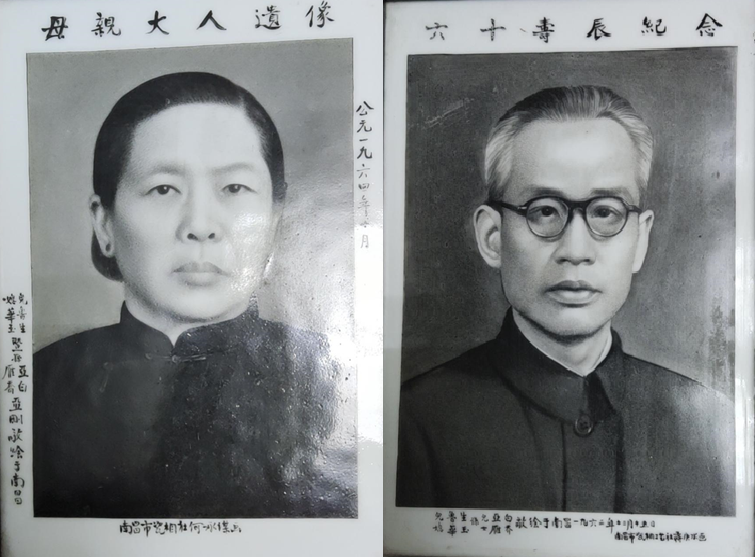
Portraits of the author’s grandparents, drawn by two local artists in Nanchang, Jiangxi. Grandfather’s portrait (right) was drawn in 1962, to commemorate his 60th birthday. Grandmother’s portrait was drawn in 1964, based on a photograph taken during her late years. The two framed portraits were hung on the wall at Uncle Lusheng’s home, to which his three children would gather to pay their respects every Lunar New Year’s Eve before the family would sit down for dinner. These photographs of the two portraits were taken by the author’s cousin Congo, Uncle Lusheng’s youngest son, in 2021.
It was a rare admission of her deeply repressed sorrow. But when I asked her if she had ever talked with Grandpa about why Grandma committed suicide, she frowned, shaking her head emphatically. “No. Never. Why should I ask him? What is there to talk about?”
From her tone, I could tell she was a little irritated by my question. Too probing.
I should have known better. If my mother, with her hothead temper and feisty spunk, was a “Hubei Spicy Sister” (湖北辣妹, Hubei lamei), then Aunt Dongsheng takes more after my grandfather. She is a daughter of Daye. Hardworking. Stoic. Resigned to her fate. My mother left Hubei at 18 and never looked back. Aunt Dongsheng has lived in Hubei nearly all her life. Except for those Fularki years with Grandpa.
There, in the Great Northern Wilderness, she had kept him company during his wordless mourning for my grandmother, she had witnessed his fall from grace and his humiliation, she had watched my little aunt losing her mind and buried her after caring for her for many years. She had raised three children.
Her grandchildren are all adults now. None of their lives have been as hard as hers, not even close.
“I don’t think younger people can understand the mindset of our generation,” Aunt Dongsheng said after a while. “So many things happened in that era. They don’t make sense to people today. Good thing it’s over. All passed now. The memories are buried inside us . . .”
She trailed off. I understand that she doesn’t really want to excavate those memories anymore. I understand, too, her reasons.
* * *
In late January 2020, Wuhan was placed under lockdown because of what we now call COVID. Aunt Dongsheng and I were communicating by the messaging app WeChat (which has become the main way people communicate in China if they’re not seeing each other face-to-face). Wuhan was in the news every day, although many Americans were still oblivious to the coming pandemic, and then-President Donald Trump said it would be gone by April.
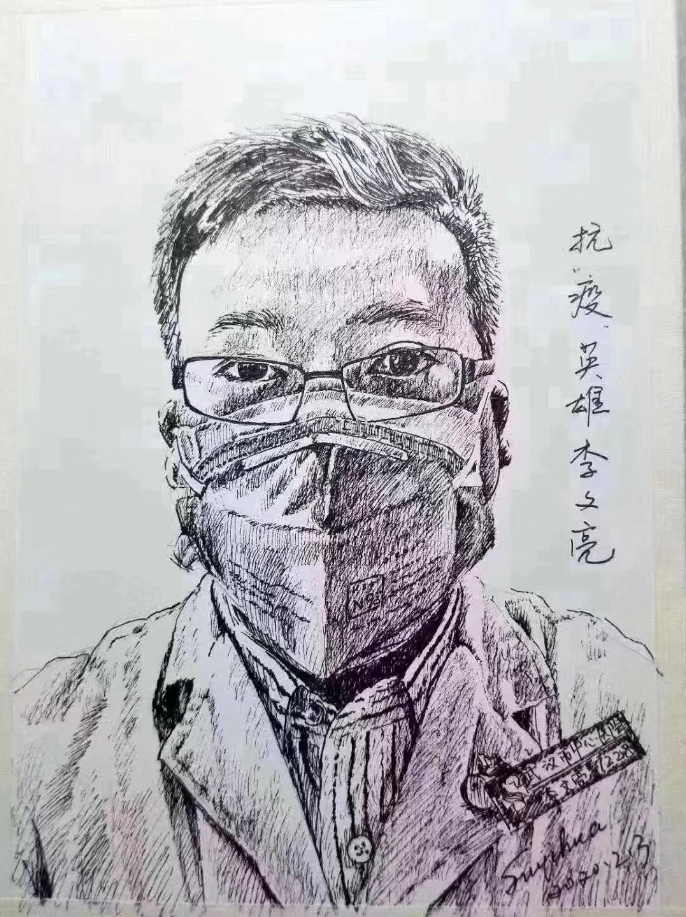
An image of Li Wenliang that was shared widely on social media in early 2020.
I texted Aunt Dongsheng words of concern. Words of support. Words of hope. Her responses were brief, and they always said the same thing: I’m fine here. We are all fine here. Laconic stoicism, tight-lipped reassurances. My mother, too, would have kept her head up and her mouth shut. The Lius, in general, detest whining. (Eventually, I would learn that both Uncle Guan and Aunt Huisheng died of COVID, while Uncle Hangsheng died of unclear causes in the hospital during the pandemic. Aunt Dongsheng knew about all these deaths right away. But she made no mention of them to me for months.)
But I’d read online rumors about Wuhan’s overwhelmed crematoriums. I was imagining untold horrors, silent private suffering. Doctor Li Wenliang, the whistleblower who first tried to alert the authorities to the new virus and was silenced, died in the first week of February. Speculation about a leak from the Wuhan Institute of Virology spread. Specters thrive in opacity. I’d wondered what Aunt Dongsheng might know but would not tell me. I was now, after all, a foreigner: a naturalized U.S. citizen.
Images have a way of creeping into one’s subconscious and getting trapped there . . .
One night, I woke up from a nightmare. In the dream, my mother sits in a dank, dark, rat-infested room. It might be a New York City subway toilet, or a Red Guard interrogation dungeon. My mother keeps combing her hair, trying to brush out lice. Then out of nowhere my grandmother shows up, her hair all white and crazy. She tugs at her daughter while whispering in a deranged voice:
Stop fussing over your hair, foolish girl. The train is coming! Run for your life. The train!! Run!!!
But my mother tries to push Grandma away even as a rusty, grinding noise, clink, clank, clink, clank, becomes audible in the background. The two women get into a tussle. Just as they crash down together onto the floor, I wake up. I was the third woman trapped in that subway dungeon.
* * *
Shortly before my mother died in 2013, Aunt Dongsheng told me this story for the first time:
My mother never spoke to me about the plague that trapped her in a sealed city in 1949. That year, she left Wuhan to go to the northern PLA base in Zhangjiakou, a city about 200 kilometers northwest of Beijing, where she was to go through training. Around the time she arrived, a deadly virus jumped from fleas to humans in a nearby Mongolian pastoral village, killing hundreds or possibly thousands of herders who caught it. The plague quickly spread to Zhangjiakou. The new communist government, barely one month old, implemented a complete lockdown, encircling Zhangjiakou with blockades; highway checkpoints were set up to monitor transportation in all directions. It was exactly the same approach as the “zero-COVID” policy the Chinese government would use 70 years later.
Back in Wuhan, with no news of her daughter for weeks, my grandmother was worried sick. She usually sat by her dressing table in the morning to have her hair done: a maid would prepare a bowl of canna shavings water, dip a comb in it, comb the hair through until it was silky smooth, and then with a piece of red electrical wire she’d tie it up in Grandma’s favorite “banana style.” But in those anxious days, Grandma would sit by the window every morning with her eyes fixed on the street, hoping for the mailman to bring a letter from the north. She sat there for weeks, gazing at the empty street, sighing softly, wondering if her daughter was alive or dead.
* * *
Weeks into the Wuhan lockdown, New York City became the epicenter of the pandemic. The WeChat messaging between Aunt Dongsheng and me made a U-turn. It was almost as though I were reposting her earlier messages back to her. I’m fine here. We are all fine here.
All was not fine. Every day, I’d pace about my home, an old loft on the 10th floor of an old building in lower Manhattan, or I’d stand by the window, gazing at the long, quiet, empty street below, Broadway. Deserted of cars and people, it had never seemed so broad. When I occasionally went down for a stroll, I almost never ran into anyone in the elevator or in the hallways. My bustling neighbors had vanished! A ghost building, in a ghost city. One day, I walked to Union Square. Suddenly, I saw a team of men and women dressed in brown uniforms walking toward me in single file. Fellow humans! Maybe the Army Corps of Engineers, here to help set up temporary medical outfits? I waved at them gratefully and they smiled at me (hesitantly, I thought) and I snapped a quick photo with my iPhone. Back home, I zoomed in on their uniform logo and discovered who they really were: corpse disinfecting professionals. They were here to help handle NYC’s rapidly mounting COVID casualties.
One sunny afternoon, I went out with my husband and daughter to get some fresh air. We walked toward the East River in single file, social distancing: Ben in the front, Siri in the rear. As usual, there were only a few lone people on the street. Near First Avenue, outside an apartment building, a thirty-something man sat on the steps, smoking. He fixed his gaze on us as we got closer, and it occurred to me that we must be a rather striking sight: three tall Asians strolling on a nearly empty street. Then I heard the muttering. “Fucking Chinese. Fucking Chinese!” Did I hear it right? I wasn’t sure, since I had already passed by the man. But Siri confirmed it: she heard it loud and clear. All these years living in the United States of America, this was the first time a racist slur was flung directly at me.
Autumn came and anti-Asian hate crimes continued. One evening at dinner, Siri announced her intention to learn to use a gun: She wanted to be able to shoot properly in self-defense. She also handed me a safety alarm to carry in my pocket as I wandered Manhattan’s back streets at dusk, which I have long enjoyed. I said her little gadget was too awkward to manipulate in a real encounter with an assailant—I had a much better idea. I opened a kitchen drawer for knives and cleavers and took out a honing steel. “This is easier to use and more effective.” I proceeded with a demonstration of how I’d wield the rod if assaulted. Watching me dance back and forth barefoot in an old skirt, Siri doubled over with laughter: “Sheep Mom, now you look like a crazy samurai!” Siri began calling me “Sheep Mom” after we read Amy Chua’s book about Asian “Tiger Moms.” (We hadn’t enjoyed the book, and we hadn’t appreciated the stereotype.)
Spring again, 2021. Trees turning green, flowers blooming everywhere in New York City. In San Francisco, a big man in his 30s attacked a petite, 75-year-old Chinese American woman on the street without provocation. But she somehow found a wooden board nearby and hit him so hard the guy ended up on a stretcher. The news photo of the feisty little old lady with blackened eyes reminded me of my own mother. Barely over five feet tall, my mother was never cowed by northern roughnecks on Beijing’s streets. Even when she walked with a cane in her final years, I watched her loudly chide a rude man in public to “Get some manners!” She lamented that Chinese people had become “coarse.” Visiting the U.S., Europe, and Australia during her retirement, she often noted to me with chagrin: “Westerners are so much more civil in public than we Chinese.”
What would she say, I wonder, if she were alive today?
What would she say if I told her about hate crimes on the New York subway? A Filipino man on his way to work was slashed across his face with a boxcutter by a stranger, and none of the other passengers helped him. The case touched a nerve among Asian commuters. One friend who used to commute from her New Jersey home to her Manhattan job now feels too scared to take the train; another always carries an umbrella with a pointy tip.
I haven’t taken the honing steel or safety alarm on my walks. But after dark, the deserted back streets don’t seem as alluring as before.
* * *
I mentioned none of this to Aunt Dongsheng. Why should I? I’d never swap places with her regardless. America handled the pandemic poorly; the death toll was appalling and unacceptable. But I’d never swap New York City for Wuhan, or Shanghai, or Beijing. No way. China’s top-down, draconian, zero-tolerance, control-freak handling of the pandemic could work only in China. Because the vast majority of China’s population will put safety and health above individual rights and liberty. Way, way above. It’s not just the government. It’s not just the political system. It’s the people.
Two expressions are a constant refrain in a Chinese household with a child: ting hua (听话, “follow instructions”) and guai (乖, “docile, well-behaved”). Both can be translated as “obedient” or “submissive,” but the Chinese phrasing has an attractive, cooing flavor. It sounds gentle, sweet, almost cute. Ting hua. Guai. Kids are continuously urged, chided, praised with these songs of obedience. This prepares them for a Chinese-style public education. At school, the language will change, but the message will stay constant, until it’s fully absorbed, internalized. Over time, young adults will find it natural to obey authority figures: Follow the instructions of a parent becomes follow the instructions of a teacher, a coach, the Communist Youth League, a company boss, a government official, a Party leader. Is this a Communist thing? Yes, but it is also a Confucian thing. This attitude to authority is at the core of Chinese education and Chinese identity.
The vast majority of the Chinese thus socialized are patriotic. Their aiguo is quite genuine and natural. They know the system. They know how to navigate its rules. This is where they fit in. They feel more comfortable in China than anywhere else on earth.
So, during a pandemic, would such a people allow the government to dictate strict rules? Would they be obedient? Well, imagine a meek child who suddenly finds himself in a spooky jungle, with invisible monsters lurking behind every tree, and his strong father tells him: Ting hua. Guai. Follow me. What do you think he’ll do?
In a huge country like China, there are always grumblers, but most of them grumble only in private. Stiff-necked resisters and defiant public protesters are endangered species, a tiny minority completely at the mercy of a massive police force. That’s why the “White Paper Movement”—the anti-zero-COVID protests that erupted in December 2022 in various cities—lasted merely a weekend. That’s why the Aleksei Navalnys of China, as The New York Times’ Li Yuan wrote in February 2024, remain hidden from public view. Worse than in Putin’s Russia, Chinese opposition heroes and martyrs are doomed to obscurity in their own homeland. So long as the leader and the authorities stick to their guns and don’t let the people actually starve, the majority of Chinese won’t rebel. People will put their heads down and collaborate with the government so long as they are safe and alive.
To Live—Zhang Yimou’s celebrated 1994 movie—depicts how three generations of an ordinary Chinese family endure civil war, revolution, mad political campaigns, famine. To live: can anyone argue with that primal urge? The right to live is a human right, a universal value. Americans are no lesser lovers of life, which is made clear in the nation’s founding documents. “Life, liberty, and the pursuit of happiness.” But “liberty” follows “life” so closely you get a sense of its visceral importance. Land of the free, home of the brave; don’t tread on me. If every nation has its style of brainwashing, this is America’s. It’s how an American kid is raised. It permeates the culture. Unlike in China, law is not just handed down by the government; the public, the courts, jurors, NGOs, the media, each has its role to play, each is an independent force to be reckoned with. Civil liberties and legal rights, these are serious, attention-grabbing issues that are a big deal, with or without the pandemic. And it’s not so farfetched to argue that this spirit could be traced all the way back to the time of the Greek polis and the Roman republics.
There are no comparable Chinese aphorisms on liberty, freedom, or the rule of law. As Sun Yat-sen put it, “Foreign countries have waged wars of religion and fought for freedom; in China for thousands of years there has been a perpetual battle over one sole question: who becomes emperor.” In commonplace phrases like ting hua and guai, one hears a clear echo of classic Confucian axioms such as “Restrain yourself, comply with appropriate social norms”; or “Filial piety is the first of all goods.” Top, middle, and bottom: each to their own place.
Then there is the famous line that all Chinese would recognize: hao si bu ru lai huo zhe (好死不如赖活着)—“A bad life is better than a good death.” This ancient saying might as well be a national motto.
For most Chinese, life hasn’t been bad at all in the past decades of rising prosperity. Many would proclaim that the present time offers the best life Chinese people have had for several hundred years. Even today, with the economy slowing and stagnation a looming prospect, the characteristic response of overworked or unemployed Chinese youths is to “lie flat” (tang ping), not “rise up.”
Maintaining stability (wei wen) is therefore not just a Party priority, it has also been a key value for many ordinary Chinese. In a crisis like a pandemic, physical vulnerability and isolation made people even more fearful of disorder or of being on the wrong side of the majority. For the majority, strength lies in self-control, discipline, and unity.
This is especially true for a survivor like Aunt Dongsheng. I know she would not trade places with me. After Wuhan reopened, she celebrated her city’s return to “normal.” Her joy was genuine: restaurant banquets, social gatherings, walking her dog in the parks—the good life was back, and whatever hardship the people had endured was worth it.
Her reaction reminded me of a confession she had made to me in the summer of 2019. Aunt Dongsheng and Uncle Guan had watched the mainland media coverage of the Hong Kong protest movement, which focused heavily on “violent rioters and overseas anti-China hostile forces.” One of the scenes showed the People’s Republic of China national emblem on a government building being smeared with black ink, another showed some protestors blocking off metro stations—as a result some people couldn’t take trains to work for a couple of days.
We and our old friends in Wuhan, Aunt Dongsheng said to me on the phone, we were watching and talking about the chaos in Hong Kong. “All of us, the technicians and engineers, all educated people, we now look back on what happened in 1989 and feel that Deng Xiaoping made the correct call to clamp down on Tiananmen Square. Back then, your Uncle and I were sympathetic to the students, but now we realized if Old Deng hadn’t decided to take control, China would be a mess today, just like Hong Kong. Our country would have missed the opportunity to develop so fast and so well. We wouldn’t have prosperity. We wouldn’t have the good life we are enjoying now.”
Her words shook me profoundly. Not because they were unique or special, but because they were extremely familiar and commonplace. And because Aunt Dongsheng was not just saying that a good life is better than a good death under the tanks. She was also suggesting that a good life comes at the cost of a good death under the tanks.
Such sentiments, I have learned for quite some time now, are shared by hundreds of millions of ordinary Chinese. It is a majority view. But this was my own aunt. My dear Aunt Dongsheng, whom I have loved and admired; who had suffered and endured so much; who has worked hard all her life; and who is a very, very nice woman.
Is it possible that the Hong Kong “rioters” and the Tiananmen “rebels” had somehow evoked in her mind the Red Guards’ fierce old shadows? What muddled paranoia that would be, to confuse largely peaceful protests for democratic rights with the barbarous trampling of basic human decency.
My old image of Aunt Dongsheng is ruined. Seeing her in a new light hasn’t been so easy for me.
I have come to admit what appears to be a simple, undeniable truth: Aunt Dongsheng is one of the people. The people of my homeland. And why should I be so shocked and surprised? She has probably always been one of the people; it is me, a Chinese native with an odd mindset, a pesky personality, who has been alienated, who has embraced “foreign” values, and made a choice to be an immigrant. Yet I have continued to harbor certain fantasies about the people of my homeland, even though I am no longer one of them.
I am no longer one of the people.
I should have known better. I should know the distinction between an individual and a people. A people is the main subject in a narrative of the nation-state. The “Chinese people” think in terms of the collective; they don’t think an individual (or some individuals) should ever really stand up before a nation to claim their own rights and liberty. The “Chinese people” will always stand with the Chinese nation. They are the nation. Noting how deeply secular Chinese culture is, the great sinologist Simon Leys once observed to his students, as recounted to me by Australian sinologist Geremie Barmé: “The only religion the Chinese believe in is China.”
I, too, love China, but it’s a China of my own definition. I have fantasized about “alien skies” and “faraway cities” since my train-hopping childhood. Moved by the vast expanse of “alien skies” and “faraway cities,” I have grown rather impatient with the endless Chinese patience for despotic rule. I have chosen not to “remain with my people.” Indeed, I have chosen to get off the great train, to leave the tracks far, far behind. To run! Run for my life! This is desertion, maybe some would call it cowardice, even betrayal. But the way I see it, I’m not running to save my skin so much as to save my soul.
An oft-cited but probably apocryphal Dostoevsky quote goes, “There is only one thing that I dread: not to be worthy of my sufferings.” As I read The Future Is History, M. Gessen’s brilliant, chilling 2017 account of how totalitarianism reclaimed Russia, Dostoevsky’s words haunted me even more than in the past. Of course this is a highly individualistic idea that would make sense only to another individual, and to a community made up by such individuals. Whereas a people, I have come to realize through many years of close encounters with so many from my homeland, are not likely to be preoccupied with such idiosyncratic, self-tormenting thoughts. They are far more likely to be concerned with the more immediate, practical, and cheerful things in life, such as bread, circuses, and trains.
In the 1990s, when China was still a very poor country, I often heard people taunting those who advocated for democracy with this line: “Democracy? Have you had enough to eat?” (民主? 你吃饱饭了吗?, minzhu? ni chibao fan le ma?) These days, the line has been slightly revised, though with the same mocking tone. “Democracy? Have you eaten too much?” (民主? 你吃饱了撑的吧?, minzhu? ni chibao le cheng de ba?) Either way, you can’t win against a philosophy of life that centers obsessively on the necessity and the pleasure of filling the stomach. Chinese history is littered with the white bones of countless famines, the latest of which happened within living memory: over 30 million people starved to death during the Great Famine of 1960-1962, the biggest man-made disaster of the Mao era. So can you blame the Chinese obsession with food? Burrowed deep in the Chinese psyche, it is what I call “the famine gene.”
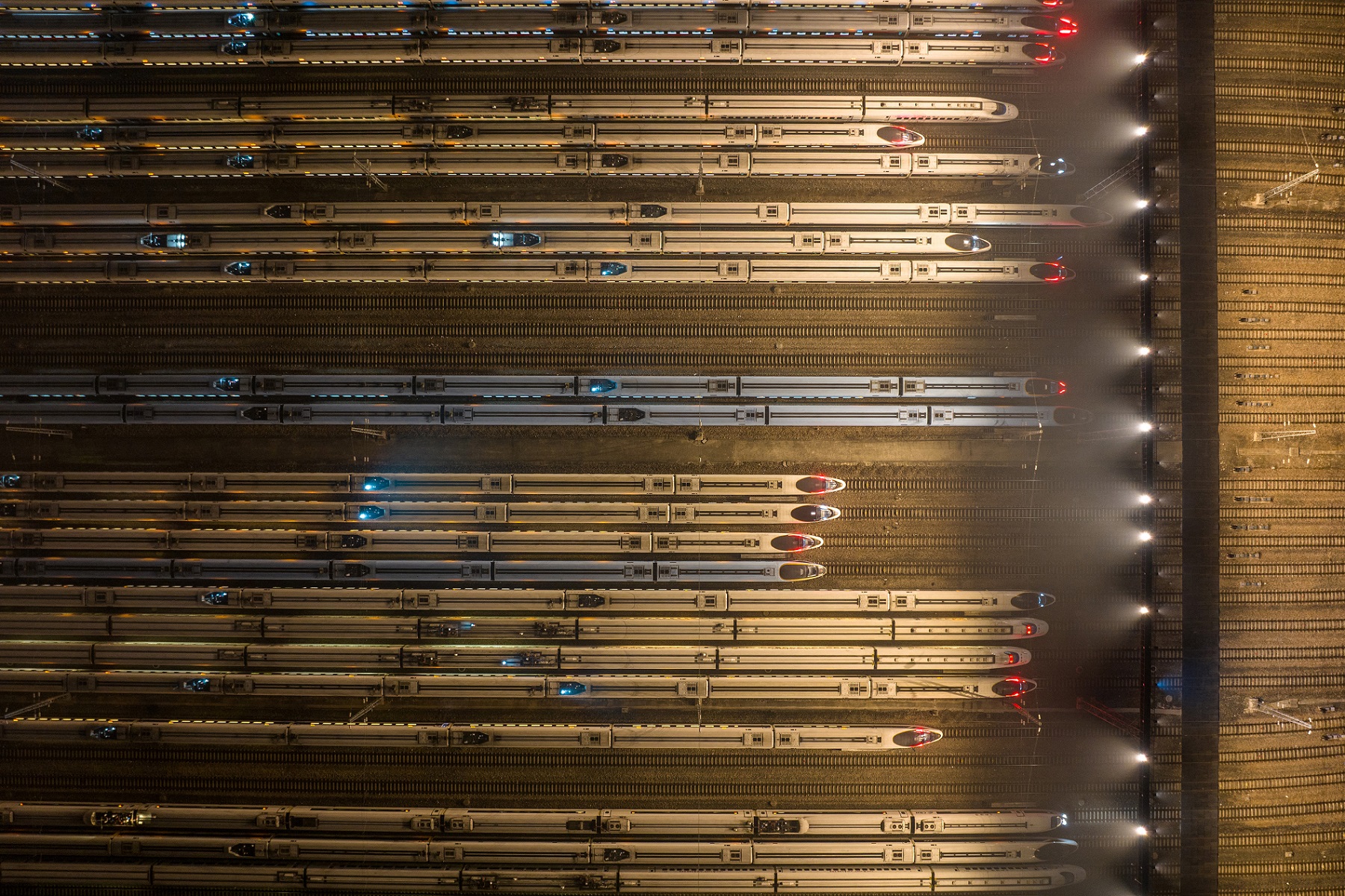
And trains. Yes, like Mussolini’s Italians, my homeland’s people also like the trains to run on time.
But I am heeding a distant call, a call stifled a full century ago. It is only a hint of a voice, as tremulous and frail as a half-suppressed sob in a dream. Yet I can hear it distinctly, as though hearing a song rising from the depth of my own soul. It is the voice of my grandfather, beckoning me to get on with my journey on foot.