


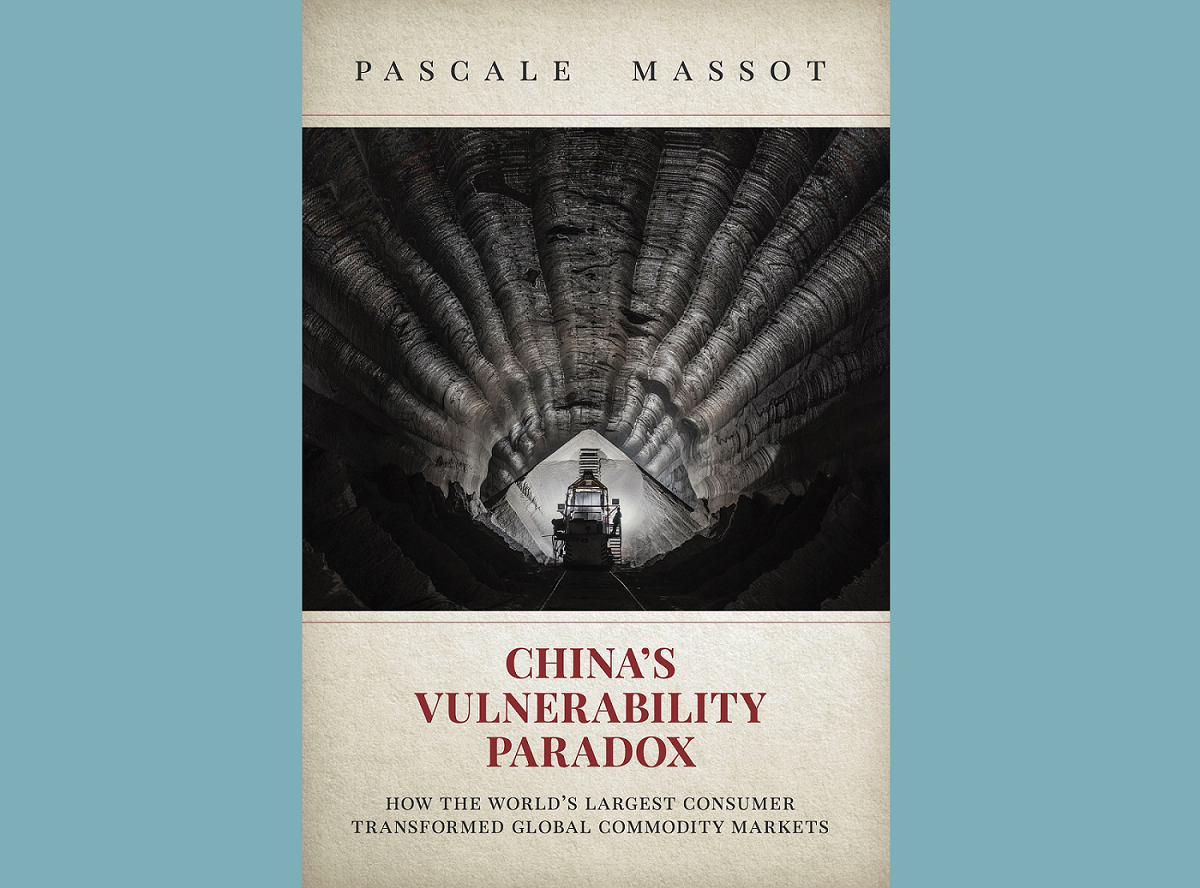
China’s appetite for critical minerals, fossil fuel, timber, and other commodities is the subject of countless news articles and has created anxiety in capital cities around the world. The dominant narrative is one of concern over Beijing’s dominance of global supply chains. Yet while the country clearly exhibits strengths as a commodity superpower, it also suffers from important vulnerabilities. A new book by political economist Pascale Massot, China’s Vulnerability Paradox: How the World’s Largest Consumer Transformed Global Commodity Markets, examines this paradox, and is the subject of this Q&A by author Paul French.
Paul French: Pascale, can you explain for us succinctly China’s “vulnerability paradox” when it comes to commodities?
Pascale Massot: China’s “vulnerability paradox” refers to the tension between China’s market size and its (actual or perceived) market power. As I was conducting interviews for the book with industry and government insiders in China, it struck me that the perception of China’s power in the West was not necessarily shared by commodity market participants in China. This is one of the puzzles I seek to elucidate in the book.
This “vulnerability paradox,” or how a country can be the largest player in a market and yet feel vulnerable, is, I suggest, the result of a few interrelated dynamics. One of them is the fact that China remains heavily import-dependent for most raw metals and minerals (rare earths and a few other critical minerals are the exception). China’s current dominance of global supply chains is in the refining and processing segments.
There is another way in which China has experienced vulnerability vis-à-vis global commodity markets over the past decades, which I label “market vulnerability,” referring to the market power differentials between domestic and global market stakeholders. Given China’s industrial and development history, the political economy of certain domestic Chinese markets is particularly fragmented—here iron ore comes to mind. China is home to thousands of iron ore mining and steel firms and has consistently missed its own consolidation targets. At the turn of the century, the top four Chinese steel producers were responsible for around 30 percent of domestic production, compared to over 70 percent for the top three Japanese steel makers, and over 500 Chinese firms were importing iron ore. In 2020, the top four Chinese steel producers were responsible for less than a quarter of domestic production, whereas the top two Japanese firms were responsible for over 80 percent of domestic production. High fragmentation has led to domestic difficulties in China, for sure, but here what interests me is the negative impact on China’s capacity to coordinate its procurement behavior internationally. To put it plainly, it is more difficult to coordinate import strategies among a handful of large importers, like Japan did for decades, than it is to do so among hundreds of firms, going from medium-size to larger importers, as was the case for China. In fact, I was able to document in my book the extent to which Chinese iron ore importers ignored or actively skirted coordination attempts by the central government in the late 2000s. Adding to this fragmentation was the fact that the global iron ore exporters are very concentrated (four companies are responsible for 70 percent of global iron ore exports). So you have a combination of China’s domestic market fragmentation and the concentrated nature of the global iron ore producers, and this resulted in a position of market vulnerability that was particularly sharp for China in this case.
I don’t want to suggest that China is experiencing only vulnerabilities in regard to global commodities. In fact, China is in a position of strength when it comes to the production of some commodities such as rare earths or graphite, and quite dominant in the refining and processing of a number of others as well. Rather, I want to help us understand where the current situation comes from. First, China’s current position of dominance in the global value chains for many critical minerals is uneven, both across commodities and across the various supply chains. By this I mean that China’s dominance or vulnerability modulates (goes up or down) along the supply chain. It can be vulnerable to imports of raw commodities, then dominate the refining and processing segments, then dominate some of the product creation/research/innovation space but be dependent on the West in some areas. Then it may dominate the manufacturing space, but be vulnerable to export acceptability at the very end of the supply chain, as it faces pushback from a growing number of countries internationally. These patterns are not the same for every metal and mineral. Rare earths, germanium, or copper supply chains shake out differently. Second, China’s overall approach to commodities procurement is directly linked to its experience of import vulnerabilities over the past decades. We have to remember that China’s deep concerns about import dependence for food, energy, and resources go back to the Mao era and even prior to that. This has led to a more assertive set of commodity procurement policies over the years. In the West, the dominant paradigm until recently was a market-led one. Only since the pandemic have we seen a resurgence of economic security narratives regarding China’s dominance of critical minerals supply chains.
You also talk about a second paradox—that China’s rise in consumption (using the example of iron ore) was “too fast for its own good.” Usually, the story of rapid growth in China is presented as a good one, beneficial for the country, so why was this growth problematic?
China’s rise was in some ways too fast for its own good. There were growing pains that resulted from the speed and amplitude of China’s growth over the past decades. At the turn of the 21st century, global commodity supply was squeezed by China’s rapid consumption rise. The scale and speed of China’s growth in resource consumption was nothing the world had ever seen, and it took many seasoned market participants by surprise. This led, in part, to the commodities supercycle of 2007-2008, in which prices rose rapidly in the leadoff to the 2008 Global Financial Crisis. Commodity prices have continued to experience a high level of volatility in subsequent years, most recently illustrated by the spike in lithium carbonate prices which rose above $70,000 in 2022 and dipped below $10,000 in early 2025.
The first decade of the century presented unique difficulties for China. There can be certain advantages to relative technological “backwardness” for developing countries that allow for leaping over technological stages. However, this was not the case for the commodities that China needed, especially for legacy metals and minerals. First, the best international mining deposits, with the highest grades and easier logistical access, had already been discovered and were owned by large mining conglomerates by the time of China’s emergence. This pushed China into developing deposits that were not economically efficient, often in politically unstable countries. Many Chinese-backed projects floundered over the past decades, for a variety of reasons. One example is the Simandou iron ore project in Guinea, which China became involved in in 2010. It encountered decades of setbacks and has yet to ship a single ton of iron ore.
Aside from the difficulty of securing mining resources, at the turn of the century China faced commodity markets that were firmly embedded in Western institutional systems, including the U.S. dollar, and price-setting mechanisms and commodity exchanges that were located in the West, such as the Chicago Mercantile Exchange or the London Metals Exchange (which Hong Kong Exchanges and Clearing acquired in 2012). Chinese commodity market stakeholders entered an arena that was already occupied by mining giants, and dominated by Western market institutions.
During the course of the interviews I conducted for the book, these issues came back often enough that I had to stop and reflect about them. I think this taps into a reality that is shared broadly across developing countries. The extractive resource industry operates under extraordinary levels of industry concentration, and a difficult history of exploitation by Western powers, which we have to consider carefully as we think about China’s evolving role in global commodity markets—and how the West should respond.
China’s growth was in large part predicated on its ability to acquire vast amounts of commodities (inputs) to drive manufacturing, infrastructure development, and energy production. Yet to achieve this China had to deal with a relatively small number of global mining giants. This had led to some tricky, and sometimes adversarial, negotiations over the years, not always to China’s benefit. How well do you think Beijing has handled this situation?
It has varied. In the book, I devote a chapter to the iron ore market, and I do this in three parts. First, I do a deep dive into the 2010 fall of the iron ore benchmark pricing system, which consisted of annual, closed-door negotiations between iron ore importers and global producers for a price that remained valid for the global market that year. Then I study some of the parallel developments in the iron ore shipping sector. I also conduct a historical comparison with Japan’s emergence as the number one consumer of iron ore 50 years earlier.
When China replaced Japan as the lead benchmark pricing negotiator in 2006, only three years after becoming the world’s number one consumer of iron ore, it took a hard stance against the “Big Three” global iron ore producers (Rio Tinto, BHP Billiton, and Vale) in the annual benchmark negotiations, and tried to negotiate markdowns. In 2009, while the negotiations were ongoing, the China Iron and Steel Association (CISA) demanded that its members (and iron ore import license holders) refrain from buying on the global iron ore market. However, CISA’s strategy backfired. A multitude of small- and medium-sized Chinese firms ignored the request and purchased iron ore on the global market through individual “spot” contracts, delivered to China by BHP Billiton, quickly followed by Vale and then Rio Tinto.
Only three years after China had become the world’s top iron ore consumer, the behavior of its iron ore importers disrupted a decades-old, stable pricing system that had been established by Japanese buyers. The iron ore benchmark pricing system was China’s to lose. The Chinese position of market vulnerability and its lack of coordination of procurement behavior, combined with the decisions of key global iron ore producers, led to this outcome. The fall of the iron ore benchmark is a fascinating case, because the outcome is the opposite of what the most powerful Chinese stakeholders wanted.
Diagnosing this exact lacuna—the lack of domestic coordination—in 2022 the Chinese government announced the creation of the China Mineral Resources Group, a $3 billion procurement giant whose mission explicitly includes the coordination of the various Chinese iron ore market stakeholders at the interface with global markets. China’s experience in the iron ore market may have informed its policy decisions in the rare earths space, including the consolidation of the industry and the creation of the China Rare Earth Group in 2021.
One lesson is that we cannot assume that China’s largest impacts internationally would be the result of a position of strength, whereas a position of weakness would lead China to be a “rule-taker” or to seamlessly integrate into international markets. The relationship between Chinese domestic dynamics and institutional change at the global level is more complex. Given China’s size, vulnerability and strength can both create a large global impact.
You give a good history of the development of benchmark pricing in commodities, using Japan’s economic emergence as an example. How has China’s supremacy in the market as a customer changed international pricing in sectors like iron ore, uranium, potash, etc. in the last few decades?
As a comparativist, I pay attention to variation across cases. I coin a phrase in the book to describe this variation: China is a heterogenous power. I think it is important to understand why there is concurrent variation in Chinese behavior and impacts at the international level. This is more intuitively recognized across different issue areas (say climate policy vs. defense policy), but it also happens within the same issue-area, in this case commodities procurement.
As I touched on earlier, Chinese market stakeholders’ fragmented behavior in the iron ore market led to the fall of a decades-old pricing regime. This was the very regime that Japanese iron ore importers had spearheaded decades earlier. At the time, Japanese iron ore importers acted as part of a coordinated purchasing group, while Japanese financiers invested upstream in the mining industry to guarantee adequate supply. Chinese importers were not able to maintain this regime in the iron ore case, even though this was very much the wish of the leading Chinese state-owned enterprises and CISA.
In the potash market, however, the benchmark system survives to this day. China is the lead benchmark price negotiator, despite the fact that the global potash market had many similarities with the global iron ore market when China emerged as the number one consumer. This derives from a more evenly balanced position of market power between Chinese domestic and global potash market stakeholders. It turns out that Chinese potash importers are much more concentrated and better coordinated than their iron ore counterparts. Indeed, two key state-owned entities control close to half of all imports and negotiate their import strategy carefully as part of a leading group. This has led to more stability in the international potash pricing regime.
If the Chinese importers continue, with the support of the government, to coordinate their behavior and extract rents from other Chinese fertilizer market players, such as distributors and fertilizer manufacturers, the benchmarking system could survive a while longer. If they fail, we could see the fall of the relevance of benchmark negotiations as price signals, and the rise of the dominance of spot pricing.
Interestingly, Brazil’s rise as a significant consumer of potash (it now is responsible for over 20 percent of global potash imports) and the fragmentation of its domestic industry have weakened the benchmark system and the influence of Chinese importers. Just as in the iron ore market, the gradual dissolution of the potash benchmark pricing regime is the result of the emergence of a fragmented consumer, facing oligopolistic global producers, and occurring despite contrary preferences from the largest Chinese importers.
Arguably, we are now seeing China’s economy slowing—manufacturing as well as infrastructure/property development and perhaps power consumption. How will this affect China’s commodity hunger and how does that affect its “vulnerability paradoxes”?
I’m not in the business of predicting Chinese commodities consumption trends, but I would just say that while some legacy commodities such as iron ore and coal are unlikely to see as big a rise in demand as the one we have seen at the turn of the 21st century, absolute levels of consumption will remain very high. Just to give a sense of the scale here, China has gone from importing around 1 percent of global iron ore exports in the 1970s to importing over 65 percent of global iron ore exports in the 2020s. The end products driving domestic demand for steel are shifting in China, and as a result it has sought to find overseas sources of demand to compensate. This means that China remains the number one steel producer with over 50 percent of global production even despite decreasing domestic consumption, and will remain the dominant global actor for the foreseeable future. China’s share of copper ores and concentrates (a more processed form of copper, ready for smelting) imports is also at 65 percent currently.
Of course, in terms of commodities needed for the green transition and growing need for energy given the expansion of AI, worldwide demand is projected to grow rapidly. Here, China’s share of global consumption is not only dependent on China’s domestic needs, but also on the world’s continued reliance on China for refined commodities and manufactured products, which has opened new vulnerabilities.
It may be that the Chinese government, understandably, makes decisions based on a predominantly domestic reading of the economy. However, many stakeholders central to China’s continued economic development sit outside of China’s borders now, whether China likes it or not. At the same time, the “open markets” assumptions that had underpinned global economic exchange over the past decades are being profoundly disrupted. China now needs to address concerns about the impact of its exports on the job markets of countries far away from its borders, as part of its domestic economic policymaking. This is a tough spot for China, as Xi Jinping had specifically decided to solve some of China’s domestic economic issues (post-COVID economic recovery, real estate market restructuring, self-reliance agenda) via a huge ramp-up in manufacturing exports.
Every economy that has a relationship with the global economy has vulnerabilities. What we are seeing right now is the evolution of China’s—and other countries’—vulnerabilities over time. A more granular understanding of both could help better guide an economic resilience agenda, in an age of continued global interactions.
Where is all this going? A slowing China maybe, a changing international trade regime perhaps, a move away from non-renewables hopefully? What do you think the future holds, and where does that leave China in terms of vulnerability?
We have entered a different era in the relationship between China and the global economy. The reform and opening-up era, where the ramping up of China’s economic interdependence with the rest of the world was seen as a net positive, especially in the West, ended sometime in the 2010s. A few years of escalating tensions with the U.S., starting in 2017 and continuing under President Joe Biden, until the return of President Donald Trump in 2025, saw the Chinese leadership react with what was seen by many as relative measure, at least in the economic sector. The rare earths export control measures announced by China in April 2025, and the subsequent panic that ensued around the world, signaled a change in the leadership’s willingness to use critical minerals and associated technologies as tools of economic leverage. There remains high uncertainty regarding how the U.S.-China relationship may evolve over the next few years. One of the many unfortunate impacts of escalating distrust and strategic tensions across the Pacific is that this may lead to entrenched positions and hubris, lowering the likelihood of needed structural readjustments. We have not arrived at a place where a new “grand bargain” that would recalibrate China’s economic relationship with the rest of the world can be found—yet it is needed.
At the same time, China’s economy is so large and so globally entwined that domestic Chinese dynamics have, as a result, an impact on global markets, whether China intends them to do so or not. This is not only true for commodities, including critical minerals, but also for a range of advanced manufactured products, technologies, and, more broadly, domestic economic policy decisions, investment, standards, and even meta narratives.
This for me demonstrates the importance of studying the impact of China on global markets from the perspective of deep resonance dynamics. The resurgence of discussion about economic security and self-reliance around the world comes from the perceptions of each other’s actions, like a traditional security dilemma, but it also stems from profound domestic realities—fractures and failures in both sides’ domestic systems of political economy, which are, incidentally, not entirely unrelated to each other.
Another lesson I draw from this book is the importance of unintended consequences and second-order effects. The impacts of China’s rise on the economies of other countries vary only in part according to the preferences of the Chinese Communist Party, state, and private actors. In the case of resource security and supply chain resilience, there are many interacting effects and powerful drivers at play. This means, on the one hand, that we cannot underestimate the structural forces that have taken us to where we are today. In the case of critical minerals today, it also means that given the complex nature of global supply chains, their excessive securitization and weaponization would be detrimental to global resilience and supply security. In other words, while recalibration is clearly needed, we should, on the one hand, encourage the development of realistic and specific critical mineral supply chain resilience goals and, on the other, realize that these should be balanced with investments in bolstering trust, the elaboration of credible reassurances, and a commitment to stability, transparency, and continued open access for most metals and minerals.