


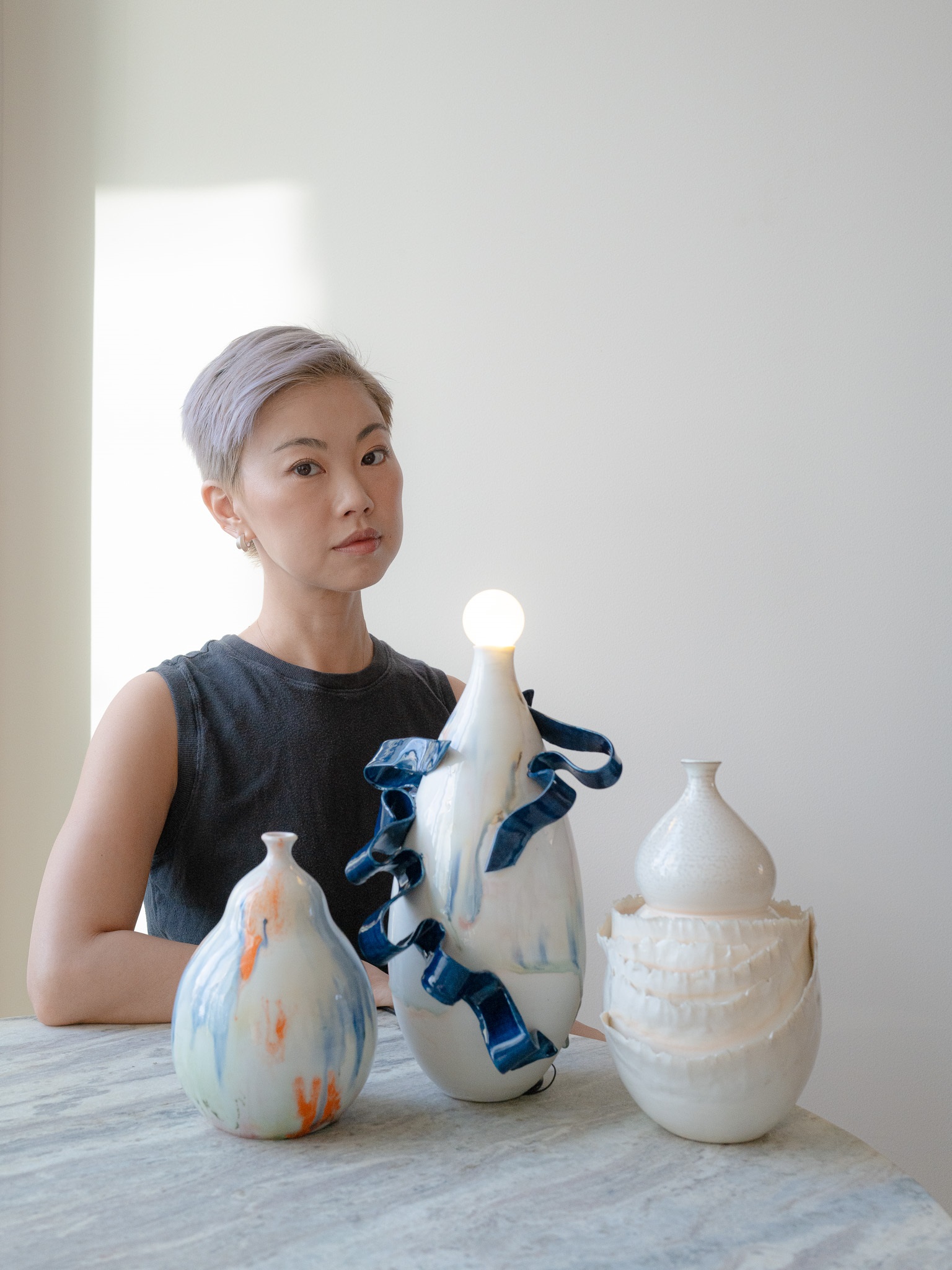
Chang Liu used to write code. Now she throws clay, fashioning understated pieces of teaware and sculptural work that is both contemporary and draws on Chinese traditions. I spoke to her recently about switching careers and how her exploration of different periods of Chinese art influences her approach to ceramics. The transcript below has been abridged and lightly edited for clarity.
Jeremy Goldkorn: You don’t have a formal education in ceramics or art, and you were previously working as a software engineer. How did you get to Silicon Valley, and how did you get out?
Chang Liu: Yeah, I don’t really have a background in art at all, although I was always really interested in something between art and design when I was growing up. I moved to the U.S. to go to grad school in engineering, not necessarily in computer science, but one thing led to another and I ended up becoming a software engineer and that was almost 10 years ago.
I worked for a couple of tech companies. Most recently, I worked at a tool company for digital product design, and there were a lot of like-minded designers and engineers in the company. Everybody’s hobby was making cool paintings or design graphics. It was really inspiring.
Eventually I wanted to just do something different, a lot more creative than engineering. So I quit my job in 2023, for a reason that was unrelated to practicing ceramics, but that was when I started taking ceramics lessons and that just naturally evolved to take over my time.
You mentioned classes, so is that how you began teaching yourself?
I took a beginner class in 2023 with a friend. That was my first real introduction to clay. But I actually did a research project at a porcelain studio when I was an undergrad. I was studying material science, and then it was more about how do you strengthen the porcelain so that it doesn’t break during the firing process. So it’s a very different angle to the craft.
What is your creative process now?
I think this is something that is also evolving very fast. I haven’t been doing this for a long time. I’m just really drawing inspiration from things that are around me in my culture.
I went to China last year, and my parents gave me this really big book of copies of the Dunhuang fresco paintings in the caves. I was fascinated by the figures in the paintings, how they move, their clothing, the way the ribbons on the fei tian [飞天, Flying Asparas] move. That has become an inspiration for me in the most recent collection of work that I’ve made, where I really wanted to channel these movements and the color interactions between them.
You’ve said you’re inspired by the New Ink Movement in Chinese painting. What is it, and how were you exposed to it?
I mostly was exposed to it after I moved to the U.S. When I was growing up, a lot of my exposure to art was either Western or very traditional Chinese paintings and other art forms.
I remember seeing some of Zhang Daqian’s work in the Asian Art Museum back then when I came to the U.S., and that was something that I’d never been really exposed to before—the pocai (潑彩) technique, where you splash the ink onto the paper and then let it create the shapes and what you want to express through a natural process.
Later on, there were more galleries showing the New Ink artists’ work. So I gradually got exposed to more and more of it. The work really resonated with me as a first-generation immigrant, in that there is a lot of tradition in the medium that you use, but you’re interpreting in such a different and contemporary way.
Some of this is pretty nerdy. There is this artist named Li Huasheng. He does these very meticulous drawings that are almost like engineering diagrams, repetitive grids using ink. As an engineer, that really spoke to my heart.
How do you and other artists who are cosmopolitan and live outside of China develop and relate to Chinese artistic traditions? What does it mean to be global Chinese, to be a Chinese artist in America?
When I was growing up in China, I took a lot of things for granted. Our culture, the arts . . . All the pretty mountains are right there, the historic pagodas are just right there. It doesn’t necessarily get viewed in this more inquisitive or critical perspective. Now that I’m surrounded by a very different scene, it does actually allow me to view my heritage and my culture from a perspective that I want to understand the origin of things in a more structural way. So every time I go home . . .
Where is home?
Dalian.
Do you feel a need to go back to replenish your roots in some kind of Chinese water?
I do feel like I need to. I go to China quite often, once or twice a year. And I’m interested in how younger artists live and practice in China as well. Last year, I was in Hangzhou. I visited this little arts village area, a lot of grad students from the Chinese Academy of Fine Art, maybe, and they have a little community where they make and sell work. It’s still impossible to get that setting [here in the Bay Area] with people from a similar background, a specifically Chinese background. . . I really hope that we can get something like that eventually in the Bay Area as well.
One of the premises behind this project, Hǎi, is that there is in fact an emerging global Chinese culture. There are certain places where it seems obvious that it would bloom first, and the Bay Area is one of them.
Yeah, I do feel like there’s a trend. “You’ve met me at a very Chinese time in my life” is up there right now. I’ve been here long enough to feel like this is really the first time I feel like people are genuinely more interested in Chinese culture and understanding the subtleties and subcultures within broader Asian culture.
The traditions get used in a marketing kind of way, but I do feel on some level it is worth getting traditions or concepts spread to people who were not familiar with them before. Hopefully it’s a beginning.
How do you compare working as an engineer, working in code, with working in clay?
I was drawn to how it is so different from working with code. There is overlap, but the overlap is that both practices allow me to focus on one thing, and only one thing, for a while. When I was coding, people would say they entered flow. You’d zone in and you wouldn’t think about anything. I think it’s the same with clay.
When I started learning ceramics, I was in the pottery studio for like five, six hours and the time would pass so fast and my back hurt so much, my wrist hurt so much, that kind of thing. I think both of the practices draw me in in that sense. But I think clay is the opposite of software development in the sense that once the piece is done, you can’t really fix it. With software, you launch MVP [minimal viable product] and then you always iterate on top of it. So that gives me a really different perspective of . . . how I live my day-to-day. It allows me to be slow and not be in a hurry about my practice right now.
There’s more commitment actually with clay because once you’re done, you’re done.
Yeah. Although I do feel like I use a lot of iterative processes when I’m still drawing out my ideas. I don’t really have a finalized idea until the piece is built. So that kind of process of reassessing and then changing or adapting to what has been built is something that maybe I have from software engineering as well.
I wonder if another benefit of coming to an artistic life after engineering is that you’ve trained yourself to operate in a business-like way. Judging from your website and the rapid way you’ve developed a very coherent career, maybe it is a lesson for a lot of young artists to take it seriously as a business and do the management side of it properly?
Yeah, definitely. I think coming into this very different new field, I don’t feel like it’s completely strange to me because I’d already built a lot of the skills in my previous life, like project management, how to actually hit a deadline, branding, how to use design tools because I worked in a company that makes one, the website—I just coded it up all by myself, actually. And then also the business aspects I like, being able to get to know people and understand what their motivations are and needs are. It’s similar to running a startup or small business.
Are all of your pieces usable, like tea cups or pots, or are some of them purely art?
I make two categories of things: teaware and then also some things that are a bit more sculptural. But so far everything is technically usable. Actually, for teaware I do focus more on the usability part of it.
Making functional ware is actually pretty different from making something that’s a sculptural thing. The axis you have to optimize for is quite different. But even for sculptural work, pottery has its roots in being functional. And as an art piece, it is both an image, like a painting that you can look at, but it also invites play and interaction and people’s curiosity. So a lot of my pieces will look very different from different angles. I do want to make them at least barely functional, just so that when you add flowers in the piece, my audience can participate in it, making something that is their own. That part is pretty intriguing to me.
Tell me something else about your work.
I’m still a very young artist, and I think my work hopefully a year from now is going to look very different from the work that I have right now. So I’m really excited. I’m always really excited about uncertainty and the unknown. I want to bring that spirit to my work.