


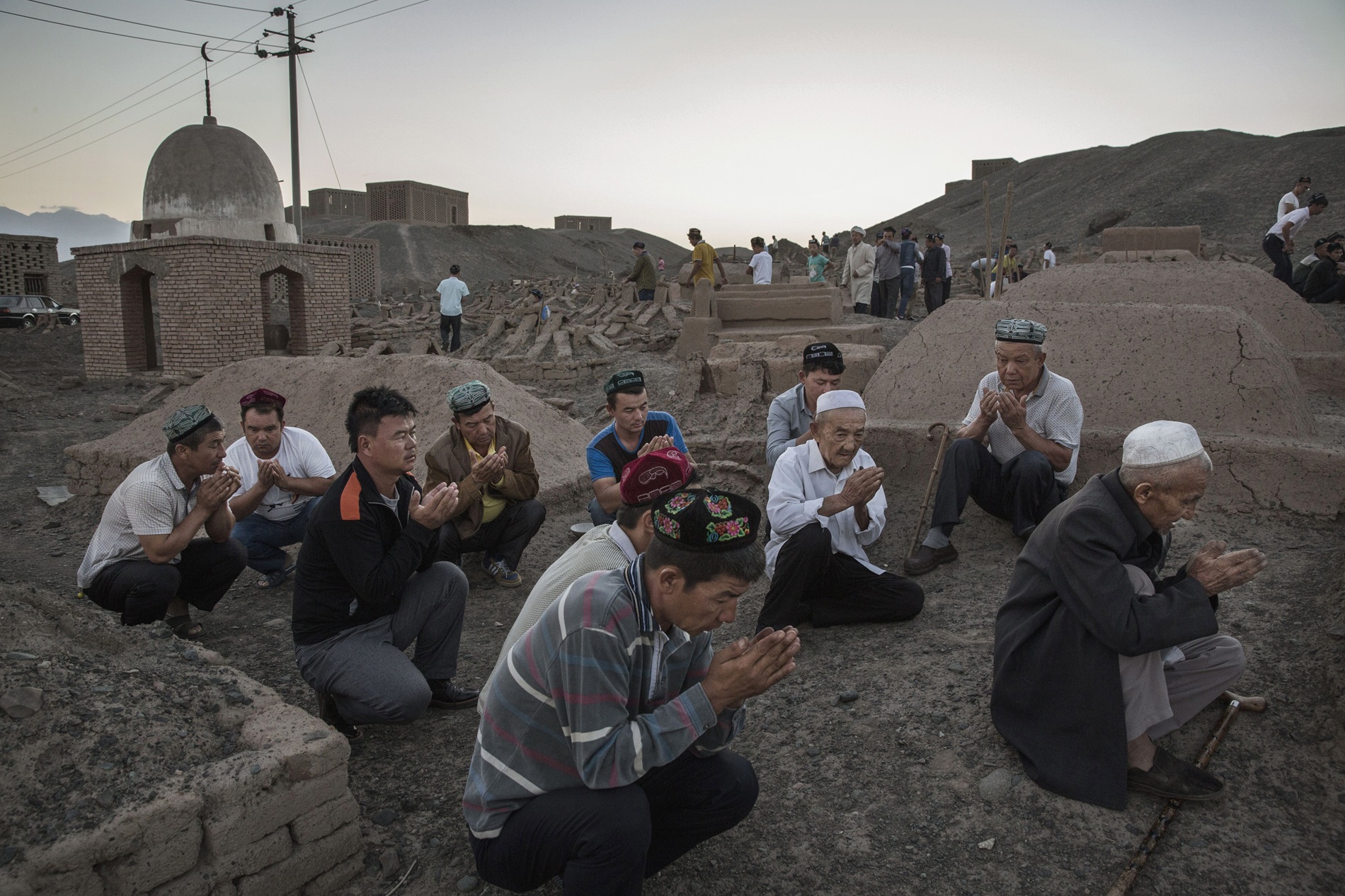
Who are the Muslims of China, and why are they often seen as not really Chinese? Why are the Indian roots and Persian-language origins of Islamic traditions in China often ignored? What is behind Beijing’s campaign to “Sinicize” mosques and Muslim religious practices? ChinaFile’s Jeremy Goldkorn spoke to Rian Thum, Professor of Asian history at the University of Manchester. Thum’s most recent book, Islamic China: An Asian History, traces the history of Islam and its adherents who have been living in China for more than a thousand years.
This is a lightly edited, abridged transcript of their conversation.
Jeremy Goldkorn: Let’s begin right at the very beginning. Who are we talking about when we talk about Chinese Muslims?
Rian Thum: In the People’s Republic of China today, there are over 20 million Muslims. There have been Muslims born and raised in China for over a thousand years. The groups of people we’re talking about are quite varied. There are a large number of ethnic groups that are primarily composed of Muslims. The two that most people have heard about are the two largest groups, the Hui and the Uyghurs.
The Hui number over 10 million people. For the most part, they are people who speak Chinese as their first language—a mix of descendants of converts to Islam over the centuries and descendants of people who moved to China from other parts of the world. The Uyghurs, on the other hand, are a very different group. They are speakers of a Turkic language called Uyghur, and their presence in the People’s Republic of China (PRC) today is the product of conquest in the 18th century, when the Qing dynasty (1644-1911) took over part of Central Asia. They and their descendants have been a part of China to various extents since the 18th century.
But China—or China’s involvement with the territory now known as Xinjiang—goes back further than that, right? It wasn’t a completely new colonization?
That’s right. For most of the last two and a half thousand years, that region has not been part of China, but there were substantial periods in the Han dynasty (206BCE-220CE) and then again in the Tang dynasty (618-907CE) when China-based states set up military outposts—the region was briefly a military protectorate of a China-based state. In terms of a deeply influential, long-standing relationship, it’s really only since the Qing that we could consider that region a regular part of the Chinese polity.
And when it comes to the other, much smaller groups—the Salar, Kazakhs, Kyrgyz, Tajiks, Tatars—where do they fit in? Were they people who migrated from elsewhere, or local groupings that developed in isolation from what became their own countries later on?
Most of the other ethnic groups are found in Eastern Turkestan, or what the Chinese government now calls Xinjiang, and they became part of Chinese history through the Qing conquest—that includes the Kazakhs, the Kyrgyz, the Tatars. Then there are groups mainly found in Gansu and Qinghai, which have a more complicated history. The Salar, for instance, understand themselves as descendants of migrants from Central Asia. There are also the Dongxiang, who have a poorly understood history with both Mongol and Turkic roots.
Can we zoom in on the Uyghurs and what we know about their origins, drawing on your first book?
What we know about their origins often comes from the stories they’ve told about themselves. I think you look at two major forms of this: visits to shrines, and historical fiction. Could you talk about those forms of historical transmission, how accurate they are, and what they tell us about what you, as a scholar, can confirm about where the Uyghurs came from, or what made them become a specific group of people?
The Uyghur identity as it exists today, as an ethnicity and an aspiring nation, is a fairly recent product. The use of the name “Uyghur” by the people who are Uyghurs today really only comes about in the 20th century, when the ancestors of today’s Uyghurs looked back at the history of Central Asia and identified an ancient Buddhist and Manichaean kingdom, the Uyghur Empire, as their ancestors. As of the 19th century, they were mostly just calling themselves “Muslim.” But to say that the name “Uyghur” is a modern revival and a modern identity construction is not to say that this group of people didn’t exist, or didn’t have ideas about their own culture and history, before the 20th century.
If we look before the 20th century, the way people learned about their own history as a community was largely through the history of holy people who died in the region and whose tombs are marked by shrines. There was a robust tradition of people traveling long distances within Xinjiang, or Eastern Turkestan, to worship at these shrines, and when they were there they would learn about the history of the figures who died there. I argue in my first book that this provides the material for a shared understanding of where the people who would come to be called Uyghurs came from, and what makes them distinctive.
Those stories of the saints are often based in confirmable historical facts. One of the saints, for example, is named Yusuf Qadir Khan—a Muslim king credited with converting much of the population of the region to Islam. We know this is a real person from the 11th century; he struck coinage in the region that still exists today, with the names of the cities and his own name on it. So these are real people in many cases, but their stories are filtered through oral tradition, often over centuries. In other cases, they are either not real people under external empirical historical examination, or they are real people whose tombs we actually know are in Medina, or Mecca, or Iraq, but whose stories circulated in the region—and people concluded that this famous person must be buried wherever they lived, and began to worship at the shrine there. In the course of the 20th century, a lot of these stories were transformed into historical fiction, which keeps those stories alive and helps populate the history of the Uyghurs, for Uyghurs, with major figures.
May I ask about the nature of the religious practice of going to the shrines?
I rode a bike around Xinjiang in 1996, mostly on the southern Silk Road. I remember stopping at little hills where there would often be a small shrine. If I were resting there when a bus came, people would pile out and put up what looked like prayer flags on the shrine. It looked like a Tibetan religious practice, or something animist—it didn’t look anything like what I had thought of as Islam. Even what you’re describing, the transmission of these stories, sounds like tales of heroes of the Uyghur people, spreading knowledge, but it doesn’t sound like there’s a very strong Islamic component. Am I misunderstanding?
It’s a complicated question. Many of these sites were probably holy sites before the region became predominantly Muslim—before the arrival of Islam. Some, we have good evidence, were Buddhist temples. Others were very likely sites of the general approach to holy places found across Eurasia, and indeed the whole world, sometimes called animism or shamanism. So a lot of these sites were probably considered holy before Islam arrived, and people then attached an Islamic history to them. Others are clearly the tombs of Islamizers or Muslim scholars. So the stories attached to them have quite a bit of variety, and their origins can be traced to a lot of different sources. Some are sacred trees or sacred springs; others are royal tombs. It’s a wide variety.
However, in those cases where people have a clear story of who is buried there, the stories have Islamic meaning, and there are teachings and rulings about what is appropriate to do at the shrine and what is not. Among more religiously educated people, there is philosophy about what is happening when you pray at the shrine—for example, that the saint exists as a soul and can intercede for you with God, can get God’s ear for whatever you’re praying for. So they are very much Islamic, but they also have roots in pre-Islamic periods in many cases.
How distinctive are Uyghur religious practices compared to those of Kazakhs, Kyrgyz, or people in northern India and northern Pakistan?
I think it’s fair to say there is perhaps no single individual practice entirely unique to the Uyghurs. At the same time, the constellation, the grouping of practices, is unique to the Uyghurs. Tying pieces of cloth on a tree at a shrine, for example, is something you can find in Iran. Similar practices of putting up flags at sacred sites can be found among Tibetans and among Mongols. Some of these practices are spread across Inner Asia. For any one element of Uyghur religious or shrine-worship practice, you can draw a map of where nearby peoples share those practices, and create an overlapping map of different zones of circulation of different practices—but they all come together to make something very distinct in the Uyghur region.
Let’s move on to your new book, which aims, you say “to make China’s Muslims unsurprising, even ordinary.” You open with two epigraphs that embody what you’re pushing up against: a circa-1700 Chinese Muslim text that marvels that the Hui were all formerly in the Western regions—“Who would know they would reside in China forever?”—and a story in Western media asking, “Are they really Muslims?”
It seems both insiders and outsiders find the presence of Muslims in China remarkable. That’s easy to understand; I still do too! My first question, “Who are they?,” is itself an indication that they’re found remarkable by many people. But what’s lost in this approach? What are you pushing against when you aim to make the presence of Muslims in China unsurprising, even ordinary?
This sense that Uyghurs—or not just Uyghurs, but Muslims in China, especially the Hui, who speak Chinese—are surprising, even bizarre or exotic, is very widely present. Of course, a lot of people who pay close attention to China won’t be surprised that they exist, but when you read about them, you often find this sense of surprise built right in. If you were born and raised in, say, a primarily Muslim village in Yunnan, and your grandparents and great-grandparents were all Muslims raised in Yunnan, and for centuries you and your family have always considered yourselves both Chinese and Muslim, it’s not surprising to you that there would be Muslims in China, and you don’t consider yourself exotic. Because that outlook accounts for most of Muslims’ experience over the last thousand-plus years in China, I thought it needed to be represented more forcefully in the academic and historical literature. It’s a perspective on Muslims in China that is standard for Muslims themselves, and I think people outside the region deserve to get a sense of it.
Just to give you an idea of how we can see this surprise as ill-fitting or strange: Imagine saying, “My God, there are Buddhists in China? Where did they come from? How exotic, to have Buddhists in China. Everyone knows Buddhism came from India—how on earth could you be at once Chinese and Buddhist?” This is not a reaction people have. There’s something about people’s idea of what China is, and people’s stereotypes about what Islam is, that makes them assume the two identities are incompatible. And there are a thousand years of Muslims giving evidence, through their very existence, that these are not, in fact, incompatible. I wanted to explore how they see it as natural to be both.
How does it hit differently if you say there are Jews in China, or Russians in China? Russians are one of the 56 officially recognized ethnic groups in China, and while Jews are not an official ethnic group, it’s widely recognized that there is a Jewish community in Kaifeng. Does it hit differently with Muslims even though their presence in China is so much more established and there are so many more of them?
I think it’s a mix of factors. On one hand . . . there are so few Jews in China. The more ancient Jewish communities have more or less disappeared—they’re being revived now. But the smallness in number does account for part of the surprise. Whereas the position of Muslims in China is in some ways analogous to the position of Jews in America: You can find Muslims in every city in China. Any Chinese person who grew up in an urban area won’t be surprised that there are Muslims in China, whereas you could find a lot of people in major Chinese cities who’d be surprised to hear that there are indigenous Jewish communities in China. So some of it is about numbers.
But if we look at the Buddhist example, some of this is about the relationship between these religious traditions and the state. Buddhism had a head start on Islam by a few hundred years. There have also been dynasties and rulers, often the Inner Asian conquering states, who patronized Buddhism—sometimes tried to eliminate it, sometimes patronized it—but there is that tradition of state patronage. There has never been a Chinese emperor who was a real patron of Islam, certainly not a believer. I think that has kept Muslims as an outsider group over the last thousand years, which means their culture, what’s particular to it, is rarely represented as part of Chinese culture, despite the fact that it very much is.
You argue that for centuries, Chinese Muslims learned to read for meaning first in Persian, not Chinese or Arabic. Why has that fact been so overlooked?
Part of the reason is that the outsiders who first studied the history of Islam in China were trained in Chinese, not Persian or Arabic. Also, a lot of Persian-language skills disappeared over the course of the 20th century, so even Hui scholars, and scholars working in China, are in most cases not able to read the Persian-language historical sources. That has caused most of our professional academic historical writing to be based on Chinese-language sources, to the neglect of the Persian and Arabic works that are out there. This isn’t to say no one has ever worked on those sources—there’s a lot of great scholarship produced in Japan using Persian and Arabic sources. But until now, we haven’t had an overview history of Muslims in China based as much on Persian and Arabic sources as on Chinese ones. That’s caused a lot of people to assume Muslims in China over the last few centuries received their education in Chinese, when it looks more likely that Persian was the dominant initial contact with reading for most Muslims in China.
So how did Arabic find its way into Chinese Islamic scholarship and teaching?
It’s been there the whole time. If you want to read the Quran, of course you do that in Arabic. A lot of legal works—interpretations of the rules of worship and social interaction—are in Arabic. It varies by genre: If you want to get into Sufism, mysticism, you’re reading both Persian and Arabic; basic educational texts are largely in Persian. Someone who received a long, well-educated religious training during the Qing would first learn in Persian and then pick up Arabic at the more advanced stages.
It’s been there the whole time. Probably, among the people who immigrated to China, say, during the Yuan dynasty and the Mongol period, Persian was more widely spoken by people coming from outside than Arabic. But the languages of scholarship were both. At the first moment we see original Islamic texts composed in China, in the 1600s, they list their sources, and it’s a mix of Persian and Arabic. The dominance of Persian is really for the introductory stages of education.
You speak or read all of these languages, right?
To various levels of proficiency, yes.
That requires quite a lot of commitment—a bunch of very difficult languages and scripts, different dialects. . . That must be fascinating, and also quite excruciating?
Yeah—I think a common factor among people interested in Islam in China, and in the history of China more broadly, is that a lot of people get into it because they’re fascinated with languages. I’m sure you’ve encountered many people for whom it’s the fascination with Chinese characters that brings them into Chinese history. That’s certainly the case for me—the fascination with different languages and how they work, different writing systems, is a big part of the appeal of this topic for me.
That’s related to some of the other ideas you explore in your second book, about the networks through which Islam was propagated and through which people learned, in India, East Turkestan, and Central Asia.
You argue that India has been underappreciated in its importance to Islamic China. I find that fascinating because on that bike trip I mentioned earlier, I made two crossings from South Asia into the PRC—one from Pakistan into Xinjiang, and again at the end of the trip from Tibet into Nepal. Those routes across the Himalayas and the Karakoram seemed absolutely fascinating. The cultures, the language, the architecture, the people are so different on the different sides of the mountains, but also so many things are the same.
Some of the great Chinese stories, like Journey to the West, describe journeys, religious journeys, across that terrain. Why has India been underrecognized here? Its importance is recognized as far as Buddhism goes—why is it neglected when it comes to Islam?
This is one of the central arguments of the book. Thinking back to Xuanzang and Journey to the West, we’re accustomed to understanding India and China as having a historical relationship wherein India transmits Buddhism to China, which becomes a major part of the Chinese cultural landscape—to the extent that you have pilgrims traveling to India to bring back sacred texts. Buddhism dies out in India around 1000 AD, and if you look at a general history of China or Asia, we tend to drop the story of India’s relationship with China until later, when we get Zheng He’s diplomatic missions, and then the shared inheritance of colonialism and imperialism.
One of the arguments the book makes is that, in fact, the interaction continued—it’s just gone unnoticed, because so much of it happened through the exchange of ideas about what Islam is, and through networks of Muslim merchants and Muslim scholars. Why has this been underappreciated? Other scholars have noticed individual instances of Islamic exchange with India and published on those, but it generally gets very little attention.
There are a few reasons. One goes back to the language issue: Most scholarship is based in Chinese-language sources, but the texts being borrowed from India—the sacred books, the educational books—tend to be in Persian and Arabic, not Chinese. So a lot of these books haven’t been read much by historians, or traced back.
Another thing that’s obscured this is that one form of exchange was the spread of Sufi orders—an organized, mystical approach to Islam that came from India and had a major influence on different forms of Islam in China—but they changed their names when they entered China over the centuries, so their connection to India became lost over time. It’s only by reading the Arabic and Persian genealogies of these groups, and their hagiographies, that you can reestablish that connection and start to see which groups in China were affected by these Indian forms of Islam.
Can you explain what the Han Kitab concept is, and what the problem with it is?
The Han Kitab is a kind of outsider—semi-outsider, semi-insider—name applied to Islamic texts written in Chinese in the 1600s and 1700s. That word doesn’t appear in China until the 19th century, so to begin with, I find it ahistorical to call these works by that name. In any case, these are texts that have gotten a lot of interest from historians. In the academic work of the late 1990s through the mid-2010s, the study of these Chinese-language Islamic texts was a prominent part of the study of Islam in China, and for very good reason—they’re fascinating texts. Many of them are, you could say, defenses of Islam to Confucian audiences. Some are efforts by Muslims educated in Chinese and Confucianism to improve Confucianism with the insights of Islam. What’s attracted so much attention to these texts is this fascinating engagement between Confucian philosophy and Sufi, or mystical Islamic, philosophy.
Where I think things go a bit wrong is when we begin to assume that these exceptional products—of Muslims on the east coast trying to get a foothold among the empire’s prized intellectuals in places like Nanjing—are characteristic of Islam in China as a whole. During those people’s time, most Muslims in China who were reading were doing it in Persian and Arabic, not reading these elevated, Confucian-tinged philosophical texts. Partly because scholars have been so interested in these fascinating texts and written so many books about them, when someone comes to read about Islam in China, they find that much of the English-language writing is about the so-called Han Kitab texts, and they start to assume this is what’s distinctive and characteristic of Islam in China—when, in fact, for a very long time, these texts were quite distant from most Muslims’ experience.
Is there a Chinese Muslim diaspora? How many people are there outside of China who are Chinese Muslims? Is there a diaspora cultural scene?
This varies a lot depending on what part of the world you’re talking about. It isn’t a well-studied topic, and one of the things I wanted to do with this book was reintegrate the Chinese Muslims who live outside China into the history of Chinese Muslims.
The numbers probably aren’t that large in absolute terms, but they’re geographically quite dispersed. In Kyrgyzstan and Kazakhstan, for instance, there are populations descended from Muslim refugees from China who fled during the rebellions and wars of the 19th century. In northern Thailand, there’s a community of Chinese Muslims descended from Yunnanese Muslims who mainly arrived at the start of the 20th century, some in the late 19th century. There’s a small community in Burma established in the late 19th century, and a small community in Saudi Arabia descended from people who came for the Hajj—the Hajj is also a vector for refugee movement. If you need to flee your homeland in an era without flights or a tourism industry, you can rely on the fact that your community has been making trips to a certain part of the world for centuries and understands how that works. People fleeing would sometimes go to Mecca, because the routes and infrastructure were already there. So there's a community of Chinese Muslims in Saudi Arabia too, and groups descended from Chinese Muslims across Southeast Asia as well.
More recently, there are exiles, immigrants, and refugees—Uyghurs, with a fairly large community in Washington, D.C., and spread across Europe now, too.
Yes—and one group that hasn’t had much attention. There’s awareness of Uyghur exile groups in Europe and the U.S., because they’ve spearheaded the movement for Uyghur rights in the Uyghur homeland. But you don’t hear as much about Chinese Muslims in Europe or North America. In New York, for instance, you can find communities representing various Islamic sects from China, and I think pretty much nothing has been written about those communities, as far as I know.
Can you talk a bit more about sinicization, how the Chinese state is attempting to modify Islamic beliefs and architecture?
This connects to the idea I’m pushing back against—Chinese Muslims as exotic, strange, surprising—because the Chinese state has officially deemed Islam a foreign religion. Buddhism, despite coming from India, is considered a Chinese religion; Christianity and Islam are considered foreign religions. The state’s idea is that there’s a range of expressions of Islam. Some, in their eyes, have adapted more fully to Chinese culture, and others are seen as more of an import from Arabia. They’ve decided they need to restrict the more “foreign” expressions of Islam and promote those they see as more sinicized. Official policy holds that Islam—and Christianity too—must be further sinicized, must take on Chinese characteristics.
It’s a funny idea, because Islam has been a Chinese religion for more than a millennium. What they’re really doing is choosing elements of Islamic practice, art, architecture, and language use that are shared with non-Muslims in China, and calling those more “Chinese.” This is being enforced in a very practical way—the most obvious manifestation is the transformation of mosques. There’s a mosque that’s had a minaret for more than a thousand years in China, but the state has decided that round minarets are “Arab”—despite the fact that most minarets in China look more like Indian architecture than Arab architecture. They’ve decided a truly “Chinese” minaret should have a squared or octagonal roof with upturned eaves, more like a Confucian temple. They've initiated a program across China of destroying round minarets and domes on mosques—thousands of mosques have had their domes and minarets removed. That’s a very countable expression of the policy. It’s harder to count things with more impact on people’s daily lives—the closure of mosques, for instance, which you can’t see from satellite imagery the way you can with domes, or the removal of facilities for washing before prayer, which makes it difficult or impossible for Muslims to pray properly at a mosque. Part of this is about changing the form of Islamic expression, and part of it, explicit in the state’s own documents, is simply about reducing the number of mosques and reducing the amount of Islamic practice that Chinese Muslims engage in.
I suppose that goes hand in hand with the effort to eradicate non-Chinese languages on signage and in classrooms?
That’s right. Ten years ago, it was easy to find advertisements online for books for sale in Arabic or Persian. The removal of Arabic from signs has been a strange element of this policy. For example, removing the word “halal,” which usually appeared in Arabic, meaning food appropriate for Muslims to eat. There’s also the closure of schools that taught Arabic, which were common ten years ago. Language policy has been a big part of this, and it’s a very racialized idea too, because Uyghurs tend to look phenotypically different—more likely to look non-Chinese, in terms of people’s understanding of what a Han Chinese person looks like. Uyghurs tend to look, in the eyes of the state, more like people from Afghanistan or Arabia, and are therefore assumed to have a foreign, not-fully-Chinese identity, which the state links to the potential for violence and terrorism—adopting a whole suite of Western-origin Islamophobic ideas. That extends to the use of Arabic, which they associate with resistance to the state and with violence.
There’s quite a lot of popular support for that position. One might argue it’s manufactured, but if you look at the Chinese internet, there is genuine enthusiasm for that point of view.
Yes—there’s a whole subculture of disparaging Muslims online, which the state tolerates and allows to flourish.
Back to your new book: Who was Ma Lianyuan, and what can his life and travels tell us about what it means to be Muslim and Chinese at the same time?
Ma Lianyuan is a figure I profile in the first chapter, and again in the conclusion. He participated in publishing and annotating Chinese-language texts involving Confucian ideas, and so could be held up as an example of how Chinese Muslims are “strange” both as Chinese people and as Muslims, because of his use of Confucian ideas. But at the end of his life, Ma Lianyuan left China and spent his last year or two in northern India. He lived in the late 19th century and died, I believe, in 1903. He got involved in the intellectual communities of Muslims in northern India, and published two books there—one an exposition of Islamic law in Arabic, which looks no different from the many explications of Islamic law you’d see across northern India.
The reason he could slip so seamlessly into northern Indian Islamic society is that the education he received in China wasn’t all that different from what Muslims were learning in northern India. And yet that didn’t stop him from seeing himself as Chinese, from writing in Chinese, and it didn’t stop him from fitting in with Muslims outside China. I think he’s a good example of how people really did find ways to be both Muslim and Chinese at once, and that there’s nothing all that unthinkable about doing so—in the same way there’s nothing unthinkable about being both truly Chinese and truly Christian, or truly Chinese and truly Buddhist. Ma Lianyuan is one of many figures who I think can help us see Chinese Muslims the way we see other religious groups in China.
Perhaps the way to get my head around this is to see Chinese Muslims as we see Jews in America. Well, that era may be ending, but at least until the last few years, Jews were seen as Americans, who happened to be Jewish. The same I guess is true for Amish, or Mormons, or Catholics.
That’s right. Just as in the case of Jews in America—it actually takes a lot of work to frame Jews as not American, as inherently foreign or from somewhere else. It’s just as ludicrous to see Muslims who are the descendants of many centuries of indigenous Chinese people as somehow ultimately foreign or exotic. Jews in America are an excellent comparison—for a long time they’ve been seen as just as American as anyone else, and yet there are many Jews in America who have an education that allows them to visit Israel, publish in Hebrew, or engage in parts of their culture specific to their form of Judaism, without compromising their Americanness, in the same way that Ma Lianyuan didn’t compromise his Chineseness by publishing in Arabic in India.