


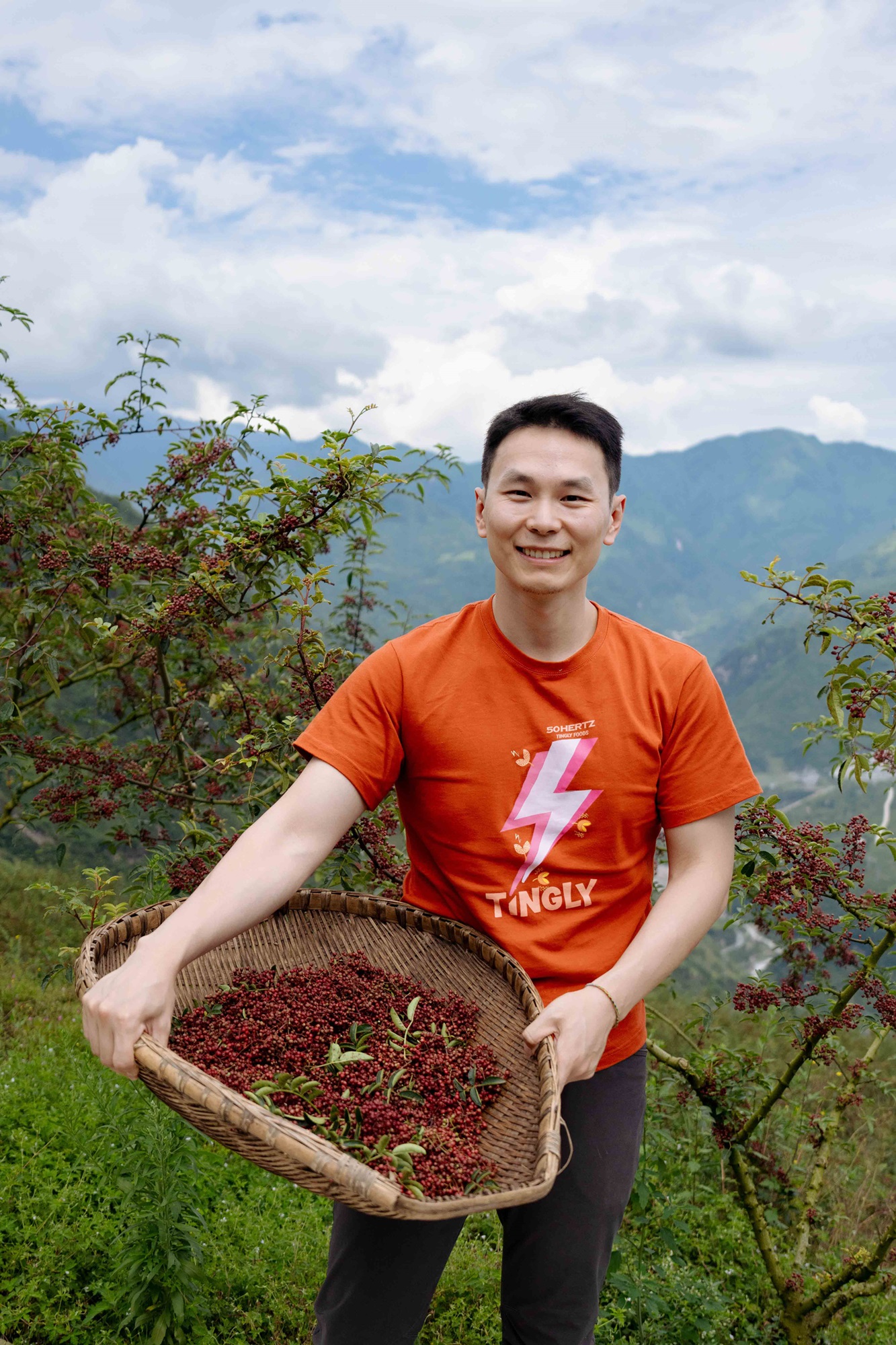
Yao Zhao is the founder of 50Hertz Tingly Foods, a company that sells Sichuan peppercorns (花椒, huajiao) and a variety of oils and snacks made with them. His first career was in clean energy development and rural electrification, but last year he left his World Bank job to devote himself full time to his startup and to proselytizing on the joys of tingly condiments.
He is an exemplar of a trend of young Chinese people opening restaurants and launching food brands outside of China that broaden the boundaries of the cuisine of their native land. I chatted with him recently about 50Hertz, the special products it’s centered on, and what it is like running an import business in the age of Trump tariffs.
Jeremy Goldkorn: You were born in Chongqing and you grew up there, right?
Yao Zhao: Yeah, I was born and raised in Chongqing. I just came back from Chongqing about 48 hours ago! I was there for three weeks visiting family and suppliers and farmers.
Chongqing is very trendy now.
You’re nice.
No, very trendy. Never used to be. I remember first going to Chongqing in 1996 and people in Beijing said “what a dirty place.” And it was kind of gritty.
It’s gritty. It’s a gritty place. It’s always been. It’s a port city, so it has all the characteristics of a port city. But now there’s a new wave of development, the AI wave, tourism is huge. It was palpable when I was in Chongqing [recently]. You see how many international tourists are in Chongqing now.
But you left Chongqing?
After high school in Chongqing, I went to Beijing for college. I actually went to the China Foreign Affairs University, which is supposed to be the cradle of Chinese diplomats. I was supposed to be a Chinese diplomat. I had all the education. I was set to go into the Foreign Ministry. But after four years, I didn’t think I would fit in the Chinese bureaucracy. So then I traveled for a year, backpacking. While I was in India, I saw . . . just . . . sheer poverty. So I decided to do international development.
I applied for one of the best schools in that field, which is Johns Hopkins School of Advanced International Studies. And then I came to D.C., did a two-year Master’s degree focusing on energy, electrification, rural electrification. Then I actually moved to Abu Dhabi and lived there for two years working for the International Renewable Energy Agency. And then I came back to D.C. working for the World Bank. So it’s a bit of a circuitous route.
Doing renewables in the land of black gold?
You would think so, right? You would think it’s such an oil and gas rich place, but they actually—I’m talking about more than 10 years ago, 12 years ago—they really focused on clean energy, green energy back then. Even now, they constantly outbid all the other places to have the cheapest solar power or wind power. I guess they know their wealth is from energy. If the energy is going to come from a different source, they better get on top of it.
But we digress. How did you go from World Bank guy to Sichuan Pepper Guy?
I founded this company called 50Hertz Tingly Foods, focusing on this one unique ingredient, huajiao or Sichuan peppercorns. I think the numbing tingling sensation from huajiao is just so unique. I think it can go beyond Chinese food or Sichuan food, beyond the mala [the Sichuan taste combination of Sichuan peppercorns and chili peppers]. I started ideating this company in 2018, and I started the company in 2020, when the pandemic hit.
Great timing!
Yeah! Originally in 2018, I went home for Chinese New Year and my mom was making a cucumber salad. And then she finished it off with green Sichuan pepper oil, and then I thought, wow, I grew up with this, it’s not something new, but I’d been living and traveling abroad for many years now at that point, and that flavor and that sensation, I’d never had that anywhere else in the world. So when I came back to D.C.I brought back just a run-of-the-mill bottle of green Sichuan pepper oil. At home, I was making pasta with my partner and he added some to a pasta dish. He said, “Wow, this is incredible! Maybe this can go beyond Chinese food, can go into pasta, pizza!” That inspired me to start thinking about this.
Now, you have an empire!
Thank you. No, not not really. But yeah, we are selling different kinds of Sichuan peppercorn oils, candy, snacks, different products. Right from the get go, my whole vision was not just selling pepper oils or peppercorns. I want to sell a new kind of sensation. I want to make this unique spice, this spice that is indigenous to Sichuan, I want to make this indigenous spice known to the world. I want to make it approachable.
My first impression of Sichuan cuisine was, of course, red chili peppers, and I assumed that Chinese had been cooking with them for thousands of years. But of course that’s wrong, they actually came from South America and it was only after the Columbian Exchange after the late 15th century that the chili pepper arrived in China. But the Sichuan peppercorn is truly indigenous. It’s a real native Chinese plant.
Your company has avoided a very Chinese look in your packaging and your brand identity, but when you think about the product and your mission, what part does Chineseness or the Chinese origin of huajiao play?
Oh, I think that’s the origin, right? It will always be a Chinese spice. As you said, chili peppers are a Colombian Exchange product that came into China in the Ming dynasty, even the Chinese name for chilis is haijiao (海椒), hai, “overseas pepper,” “overseas” like your newsletter. For my brand, I want the branding to speak to American or Western [customers], but I think it’s Chinese through and through. Our supply chain is rooted in China. We single-origin source from Chongqing, Yunnan, and Sichuan.
“Artisanal” would be the word that’s fashionable now. You know where they come from?
Yeah. You can even know which farmer harvested which branch because you can trace it back. Because I built the supply chain directly with the suppliers. There’s no middleman. So we know which basket a pepper comes from because it has a name written on it, which farmer this basket is from.
Why are you called 50Hertz?
When I was researching this business idea, I read in this paper that a scientist in London measured the frequency of the buzzing numbing feeling induced by Sichuan pepper. He had 100 people sitting in a room, and then they hooked a mechanical vibrator to their fingers, and they could adjust the mechanical vibrating frequency. And then they applied Sichuan pepper oil to their lips, and the people compared it to the mechanical vibrator and most people said 50 hertz was the closest.
Obviously your lips are not vibrating at 50 hertz. There is a chemical in Sichuan pepper called hydroxy-alpha-sanshool. That chemical triggers your brain to think it’s vibrating, but it’s not actually creating 50 hertz of motion.
The name of the company indicates that you’re going to be pretty focused just on this one spice. Are you looking at sort of different product lines or maybe selling it in industrial quantities to restaurants?
I just want to do one thing. There are so many chili crisps, chili oils, Sichuan food brands out there already. I started with the oil and peppers and then our real big break was our tingly peanuts because, as you know, it’s very hard to explain to people, like, “I want to sell this new spice, it's numbing, it’s tingling.” People just don’t get it. But as soon as they try the peanuts they get it and then actually fall in love with it.
Snacks are actually a very important flavor carrier. Peanuts are great. We want to expand peanuts. We want to distribute peanuts to grocery stores more and more offline. And we just launched Tingly Cashews. We also make chocolate, and brittles.
How are you dealing with the tariffs and Trump uncertainty?
This year has been very, very tumultuous. I went full time after five years. I left the World Bank in April.
So this is it now? You've jumped! Congratulations.
I told my boss that I needed to move on the day before “Liberation Day.” The next day, the tariff went up to 145 percent on my most popular product, the Tingly Peanuts. But we got very lucky, actually, because our products were already loaded on the boat, about five hours before the 145 percent hit. So we just narrowly dodged the bullet by five hours.
And then, I think what I’m good at is communication. I was very candid with all of our customers. I said we’re facing like $40,000, just tariffs. I need cash, $40,000. We put out some sales on our current inventory and everyone came out and supported us. We got one of our biggest sales days after I sent out that email. It was very transparent about what we were facing. So I think that’s the beauty of doing business in the U.S. and also building a small community. You are able to talk to your customers directly and people are rooting for small businesses, bootstrapping businesses. So that’s very heartwarming to me.