


“It’s really tough doing anything in China right now,” my friend told me. He’s a serial entrepreneur in Shanghai with a locked-in grin. We were waiting for our food in a Taiwanese restaurant in a lovingly-renovated toy factory in Shanghai. The place was really nice but it was about half full.
I heard the same complaint nearly the whole month of June, which I spent with my family in Beijing, Shanghai, and cities and villages in Jiangsu, Hebei, and Yunnan provinces. It seemed that everyone we met, aside from pensioners and government employees, felt they were working harder and harder for smaller rewards. Many of them mentioned the word “involution”—which I’d been reading about from afar since 2020—but it also seemed as if life in China had never been this good.
China was my home for 20 years, before moving to the U.S. in 2015. This was my first visit since the pandemic. Almost a decade away from the place where I got married, had kids, started a few companies, and sold one. We did some tourism and mountain walking. We saw old friends, former colleagues, classmates, and relatives, among them entrepreneurs and arts industry freelancers, a family of small-plot farmers with a rural tourism business, a few white collar workers, and people employed by the government. We toured some old-age homes.
It may be hard to make money in China in 2026, but it is very pleasant to spend it. A major element of involution is the brutal competition in every market that puts downward pressure on prices as consumers, spoiled for choice, demand higher and higher quality. Hotels, trains, flights, food, clothes, cars, phones, electronics, massages, mountaineering gear, Labubus: all are cheap compared to the United States.
But first you have to figure out how to pay for stuff. The country has gone cashless, and you need a mobile phone tied to a verified identity to use Alipay and WeChat Wallet, and these are the only digital wallets that work. Our first task after clearing customs at Shanghai Pudong Airport was to get our devices connected; a friendly sales lady helped us fiddle with phones and we left her stall with one working local mobile phone with payments enabled. We had another two American phones which worked for most purchases but not always. Once you have the apps working, you have access to a digital world layered on top of the physical world. App life in China means seamless service, rapid delivery of food or anything else you care to buy, bike-shares, museum tickets, car-hailing, and public transport. (All countries are going this way; but in China, you only need one app: either Tencent’s WeChat, or Alibaba’s Alipay. These give you access to all other digital services, and I never needed to download another app during our time in China. Behave yourself in online spaces and you’re in consumer paradise. This is the bleak future Elon Musk and his Silicon Valley friends would prefer.)

A gourmet hotdog mini food truck in Yangzhou, Jiangsu province, June 2026.
A ride share took us to our hotel—a local chain outlet in the shitty peri-urban zone around Pudong Airport, but new and clean, and serving free espresso and oolong tea in the lobby. After dumping our stuff, we went in search of dinner. We found an outdoor square at a cross-street where a handful of people sat around plastic tables eating and drinking beer, talking loudly. Street vendors were selling fried rice with spicy Guizhou sauces, and a small restaurant run by a Uyghur family was grilling lamb and vegetable kebabs.
What a relief to be gorging on street-cooked food, with no restraint or care what the hell they made it with, away from the constant American anxieties over diet—the allergies and pickiness, the protein-maxxing and Wegovy, the authenticity-policing and foodie one-upmanship. Not on this gritty street. We shoveled wok-fired treats into our mouths like starving soldiers.
Food has been good everywhere in China since the end of widespread scarcity in the late 1990s, but it’s on another level now, with all kinds of new styles and fusion cuisines. Most remarkably, the international food is excellent. There are good coffeeshops and craft burger joints everywhere, even in small towns (Shanghai is the “world’s most compelling coffee city” according to Bloomberg). I ate the best hot dogs of my life at a small food stall in Yangzhou, Jiangsu province. New ice-creams (including those made by famous Chinese brands such as Moutai liquor and Wuyutai tea), snacks, baked goods, and low-calorie sports drinks are delicious.
The excellent quality of the food—and the swiftness of its arrival when ordered by app—is also connected to involution. A friend who owns a chain of restaurants told me he has to constantly offer discounts and do special promotions because all of his competitors are doing it. Chinese consumers find and buy almost everything online, and the algorithms feed them the best deals. Customers also rate restaurants ruthlessly on the apps, so lower prices do not mean a tolerance for lower quality. Every yuan is harder.
* * *
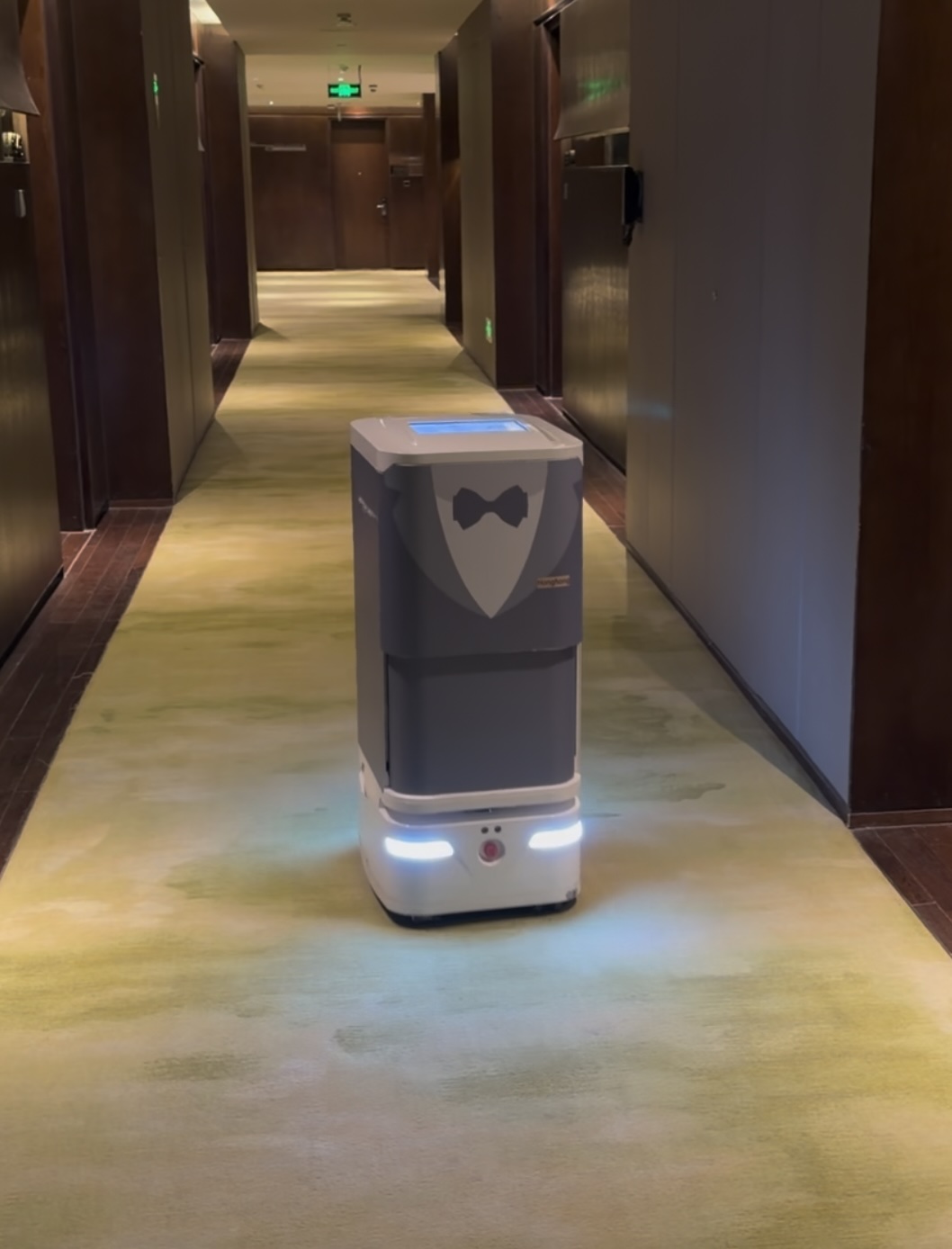
A hotel robot delivers food ordered online from a restaurant in Yangzhou, June 2026.
The enormous Hongqiao Railway Station, with its 16 platforms for high-speed trains, is connected to the equally enormous Hongqiao Airport. We bought our tickets at a ticket window; most people just use their phones, but we did not have our identities verified so we still needed to go to the counter. The waiting room, like all airports and railway stations in China, keeps the lighting low. In summer the air conditioning is set to 26 degrees centigrade (78.8°F), by 2007 government decree. The energy-saving temperature is just on the comfortable side of sticky—for me. But not for my son, who grew up in the icy blasts of Tennessee climate control. Once we were on the train, though, I could have made a wide-eyed Chinamaxxing TikTok of him. We balanced coins on our seat trays as the speed hit 300 kilometers per hour (186 miles per hour), and arrived a little too soon in Yangzhou.
Yangzhou has been a commercial center and salt-trading hub since at least 500 BCE. It sits at a key node between the Yangtze River and the Grand Canal, which goes all the way up to Beijing. There is a Grand Canal Museum, but it was so crowded on the Sunday that we visited that we were pushed past the exhibits too fast for my Chinese reading abilities (there was minimal English signage). No matter, the festive atmosphere was more interesting: I don’t remember ever being in a history museum in China with such an enthusiastic crowd.
We stayed at the Yangzhou State Guesthouse, a sprawling complex of faux traditional buildings, water features, gardens, and pavilions set alongside Slender West Lake 瘦西湖. The hotel is owned by the city government; it’s ballsy enough to call itself “State Guesthouse” because former General Secretary Jiang Zemin is from Yangzhou, and judging from the photos on display, gave his blessing to the hotel. And it’s a nice place: an abundance of extremely helpful and polite staff. Also robots. There were vacuum cleaning bots and street-sweepers. They deliver room service and food bought from ecommerce platforms which couriers leave at reception.
In Beijing, one restaurant manager said the robot that was worth the money was a busboy bot that moves around in a set pattern; human waiters pile trays and dirty dishes on the bot and it makes regular stops at the kitchen, where humans clear its cargo. At the city’s spacious Olympic park, there is a humanoid robot barista who takes orders, talks, and answers questions as it prepares the coffee. But it is assisted by a human. When I asked if it was concerned by job losses caused by robots, it said: “You’re a very deep thinker.”
Also parked in the grounds of the Yangzhou State Guesthouse: a camera-clad drone or robot that looked a little like R2D2 in police livery. It was my first brush on this trip with the panopticon that the Chinese state has been constructing for more than a decade. I remember first noticing the blossoming of surveillance cameras before I left China; my wife and I used to drive around the countryside surrounding Beijing in those years, and in about 2012, I started getting speeding tickets from villages all around Hebei and Shanxi. Every small police jurisdiction had installed speed- and license plate-readers, and every time I’d enter the reduced speed limit of a village or town, I’d get busted by an electronic eye.

A police robot in Yangzhou, Jiangsu province, June 2026.
The system is now vastly more complex. Aside from the ubiquitous cameras, it is not possible to move around a city on any form of transport or pay for anything without the apps, and they always know who and where you are. In Yangzhou’s Geyuan 个园, a lovely traditional courtyard garden of rock and bamboo, you need to watch a video advertisement and scan your face to get toilet paper. Once only: the dispenser remembers who you are and won’t give you seconds. Some parts of Beijing look like a spoof science fiction film about a surveillance state: we visited a friend in a part of Haidian District where there are a lot of government buildings and housing compounds. There are horizontal bars above the street every 50 meters, each bar holding more than a dozen different cameras—we counted them. Our friend pointed out the different types: that one reads license plates, this one is for facial recognition of pedestrians, this one scans the faces of people inside cars, that one is used for gait recognition, who knows what that odd-looking one does? His apartment complex gate no longer had security guards: During the pandemic they were replaced with face-scanners that admit only registered residents.
The ever present surveillance must be one factor behind the remarkable improvement in public manners everywhere we went in China. Very little spitting, no jostling to get off planes, people seem to respect personal space much more than they used to. But it’s not just the cameras and facial recognition software. One friend in his fifties in Beijing said that the pandemic had changed everyone, but also that his parents’ generation were mostly dead or housebound—“they all had really rough manners because of the way China was when they were young.” WeChat and the other apps also mean there’s far less need for physical queues, and no point in jostling to get ahead if you are in one.
* * *
There is more urban space in China than there used to be. There’s body space because of the apps and the good manners. Malls are empty unless they have live events or lots of restaurants. In some neighborhoods, the only humans are helmeted, uniformed couriers in red or yellow jackets buzzing about on electric bikes, anxiously checking their phones to make sure they’re not late for the next delivery. If they’re late, they get punished by the algorithms.
Online life spills onto the streets wherever there is photogenic scenery. In Yangzhou, Beijing, Shanghai, and all over Yunnan, we saw flocks of young women dressed in replica historical clothing for hours-long photo shoots to create images for their social media feeds. At the same locations, you find people livestreaming sales pitches for scenic tours, cosmetics, and training services. Restaurants that get famous for a specialty dish or a visit by a famous customer (like Nvidia CEO Jensen Huang) become “internet celebrity check-in spots” or “must-go selfie spots” (网红打卡点) which then attract crowds of customers whose primary aim is to get a good photo rather than try the food. The selfie economy is global, but China is the selfie superpower. (The Chinese apps also excel at “beautification,” making the selfie photographer’s images preternaturally beautiful.)
It’s all very, very convenient, and fun. But the downsides are evident. Stay in the good books of the algorithms, and nobody on the planet in history ever had their consumption as frictionless as the Chinese consumer does right now. However, there is very little space for cultural, social, or political expression—even less than there was two decades ago when China only had around 100 million internet users. In 2026, you need a mobile phone to do just about anything; if you do something very naughty, your WeChat or Alipay accounts could get suspended and you will become an unperson in China’s online garden of delights. The other major downside of the constant digital connection is that you’re a slave to the algorithms if you run any kind of business. This is perhaps a glimpse of America’s near future.
* * *
From Yangzhou, we went to Hebei province and spent some time in the countryside, hiking on wild parts of the Great Wall and seeing some friends who run a small tourism business in a once-secluded valley about an hour and half’s drive from Beijing. They seemed to be doing fine economically—they had a massive new Red Flag SUV—but, like all our friends in China, complained of involution and the slowing economy, how much more difficult it had become to earn a yuan. During the COVID pandemic, the only road into their valley was sealed off, and villagers were prohibited from leaving for nearly three years. Our friends had to hike 10 miles over a mountain, up and down several thousand feet, to buy supplies. They did it at night to avoid being caught. That’s long over, but their business has not recovered to pre-COVID levels. Nor has their 30-something son’s optimism. Last time I saw him in 2014, he was raving about Jack Ma and startup culture, and he had big ideas for a tech company. Now he is working in corporate gift sales, and his entrepreneurial energy is going into his kids’ education. “Could they get into a university overseas?” his wife asked.
The end of China’s boom years is sadly on display right in their village every day: In 2016, a real estate company in cahoots with the local government succeeded in taking over a large part of their valley. They started building an enormous apartment complex with more than a hundred high-rise buildings, a dense urban living environment in a place without public transit and no chance of ever being fully occupied. A handful of the buildings are now complete and partially occupied, but most of the project is unfinished, cranes still in place more than five years after construction stopped. We saw such “rotten buildings” 烂尾楼, partially-built projects, everywhere in China, sad monuments to easy credit.
The outskirts of the big cities we visited are also dotted with rotten buildings, but not so much in the city centers. In fact, while China felt so different in so many ways, the built environments of the cities have not changed much in the last decade. After Hebei, we spent several days in Beijing, and I walked around my old haunts in Dongcheng District (the area east of the Forbidden City) for several hours every day. My old joke used to be that if I didn’t visit a part of the city for two months, there would be a new building. No longer: I can still easily navigate my way around on my 2015 mental map, no GPS required.
The new boom isn’t buildings: it’s advertising for AI, and a really noticeable health and exercise kick. People are working out everywhere. There’s a lot less smoking, and many men have started smoking slim cigarettes, what we used to call “cocktail cigarettes.” People no longer smoke in restaurants in Beijing and Shanghai, although the men’s toilets usually still smell of smoke, and smaller cities don’t enforce the non-smoking rules. High-end athleisure gear is now the uniform of all my rich Chinese buddies, and everyone is dressed better all over the country, often in stylish and high-quality local brands. (The standard summer outfit for men who work for state and Communist Party organizations and for banks is still black pants, black shoes, and a short-sleeved, collared white shirt.) Local brand cosmetics and skin care products have also taken over the ground floors of department stores, and the ecommerce sites. Chinese sunscreens are widely available, and women have taken to wearing spooky-looking UV-protecting “facekinis” when outdoors. These have been common on Chinese beaches for more than a decade; they’re now urban accessories.
Bikes are back in Beijing and other Chinese cities. The bike-share companies have gotten their act together after years of chaos marked by disorderly streets and bicycle graveyards I read about from afar. Colored rental bicycles are everywhere. You can pick them up wherever you find them and leave them wherever you like, and they are cheap. In Beijing especially, the bike lanes have been reinforced, and the surveillance cameras have mostly stopped cars from driving and parking in them.
The digital panopticon is augmented with police officers making the rounds with their lights flashing slowly around central Beijing. My wife and daughter’s rideshare driver was stopped one afternoon for a quick document check—a smiling cop asked to see their passports and the driver’s ID card 身份证. This has never happened to me previously in Beijing. One night, I sat at a bar in the restaurant and entertainment area around the Drum Tower with a friend who used to run a venue there; we counted patrolling police cars as he told me about the way the authorities had snuffed out much of the live music from the area, especially targeting foreigners. Despite the growing restrictions on cultural life of the Xi Jinping era, and the nightlife-destroying pandemic, Beijing had continued to host a small but lively rock and jazz music scene. No longer: A number of amateur foreign musicians were arrested and deported for not having the correct visas; live music venues have been persistently targeted for permit violations. The owners, my friend said, were slowly being ground down by bureaucracy.
“It’s Kafka, not Orwell?” I asked.
“Exactly.”
* * *

A propaganda slogan reads ‘Uphold our country’s direction of Sinicizing religions,’ in Shizhongshan, Yunnan province, June 2026.
From Beijing we flew to Lijiang, Yunnan province, and drove to a guesthouse near Shaxi, a charming market town that has been overrun by tourists, like every interesting town in that province. The mountains are quieter and we spent a few days walking around Shizhongshan, perhaps one of the loveliest temple complexes in China. Some of the stone Buddhas and depictions of royal families there are more than a millennium old, created during the Nanzhao and Dali kingdom periods. There is a large statue of a vagina that local women visit when they are pregnant and want a smooth delivery. They used to rub sesame oil on it, but that was banned because it was damaging the statue. Also banned, according to one tour guide we spoke to, was any discussion of religion or politics when introducing the shrines to tourists. That makes it rather difficult to explain anything about Shizhongshan, built by Buddhist kingdoms that were ruled independently from the Tang Dynasty.
The temples at Shizhongshan displayed conspicuous signage reminding visitors to persist in the “Sinicization of religion” 坚持我国宗教中国化方向, a reference to Xi Jinping’s policy intended to ensure all religions toe the Communist Party line. There was similar propaganda at other religious sites we visited, and it was noticeable that all Arabic signage had been removed from mosques and Uyghur restaurants. One old-age home we toured in Jiangsu had a Buddhist mediation room. There used to be Christian and Muslim prayer rooms, the sales lady informed us, but those are not allowed any more. “You can pray any way you want here,” she said, unsure why I was curious, “you just can’t have a special room for Jesus.”
* * *
From Shaxi, we drove south to Dali and boarded a plane to Shanghai. The last few days of our trip. My family was exhausted after a month of travel, and Chinese hotel rooms are really comfortable now and the robots bring great food. So I spent much of the time wandering around by myself, mostly around the leafy, steamy streets of Xuhui District. Shanghai is quieter now, aside from passerby conversations and the whirr of electric cars and couriers’ e-bikes.
One evening, I stopped by the Jiaotong University bookstore, which looks like a fashionable café. There was a book by Jiang Zemin that I wanted to buy, but it had no price label, and the cashier explained to me that she could not sell it because the store did not have a bar code reader. At last, in the heart of Xuhui District in Shanghai, I had found a business that had not gone completely digital.