


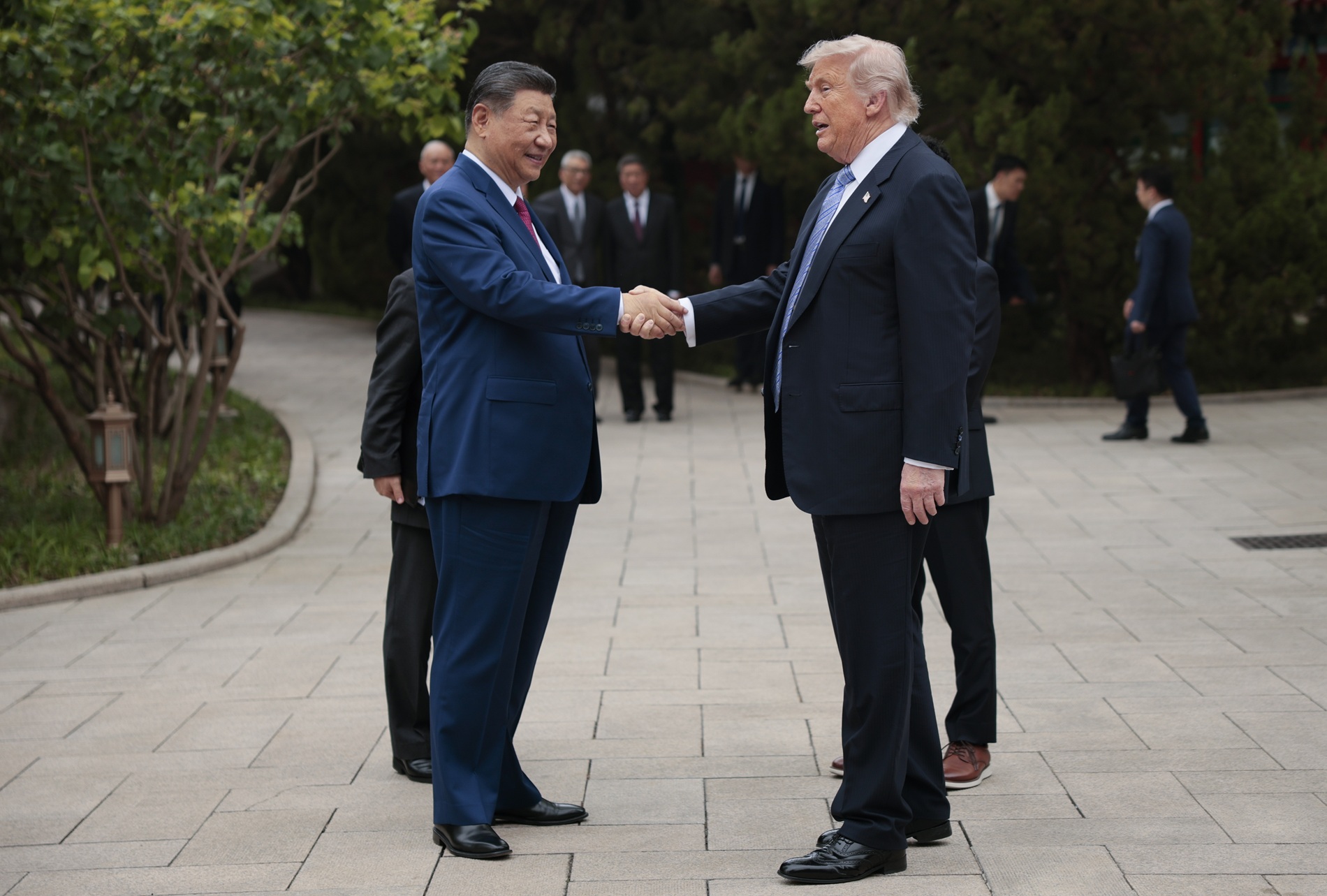
Xi Jinping won the agenda for his summit with Donald Trump before Airforce One touched down in Beijing. America would do it his way. Trump would not ask China to improve its human rights record, strengthen its currency, cease its cyberattacks, curtail support for Russia, or lighten up on Taiwan. Instead, Trump’s purpose would be to celebrate his relationship with Xi and sell stuff. With no need to make concessions or commitments, Xi would offer pageantry, purchases, and platitudes in the hope that Trump would depart Beijing satisfied and move on to other matters.
Trump’s cheerfulness and limited ambitions in Beijing must have surprised many Americans. For a decade, Washington had heralded a fierce, protracted competition with China. Trump rang the alarm bells himself in the early weeks of his first administration. But in Beijing, his team treated U.S.-China relations as a bean-counting exercise rather than as a great historic question. The Pentagon calls China a “pacing challenge” and Congress is attacking American universities that cooperate with China, but at the summit the president lavished praise on Xi and said the United States and China could have a great relationship.
The May 2026 summit will soon be forgotten. Its rhetoric and ceremonies were dull and its few achievements were known weeks in advance. But the meetings did spotlight a conceptual breakthrough of Trump’s which, if sustained, could set U.S. China policy on a more manageable footing: America can live with China. This departure from the first Trump and Biden administrations’ views gives proponents of moderation in American diplomacy reason to hope.
But only a little. The deference Trump offered Xi Jinping and his readiness to accept Xi’s framework for bilateral relations could undermine the encouraging aspects of his approach to China.
Trump’s Insight
Since at least 2018, the dominant idea in Washington has been that China is an existential threat that must be either destroyed, permanently hobbled, or radically transformed. But “existential threat” has failed as a guide to policy: Destruction means war, and hobbling and transformation have proven to be beyond our capacity.
Washington’s animus—much of which is justified and most of which is reciprocated in Beijing—has never taken the form of a coherent strategy, nor has it prevented China from improving its position. The U.S. urgently needs a new concept for relations with China that will allow America to defend its core interests and build its strength while maintaining commercial and “people-to-people” exchanges. Some ongoing engagement is needed to reduce alienation between the powers and to lay a foundation for resumption of normal ties, should mutual distrust ever ease to a point where cooperative relations become feasible. Deliberately or not, Trump has proposed the germ of such a concept.
Since the early months of his second term, Trump has dropped COVID-era racist insults against China, proposed bringing 600,000 Chinese students to the States, and reportedly been open to increased Chinese investment. He hasn’t said it in so many words, but Trump’s implicit message to the American people has been: We can live with China. That attitude, if sustained and operationalized, would be a major and welcome shift. We can live with China rejects the claim that China poses an existential threat and thereby asserts that relations are manageable. It is tantamount to a policy aimed at coexistence—a word that is taboo on Capitol Hill. We can live with China cautions Americans that we must keep this cold war cold.
He is right; of course America can live with China. We are doing it at this very moment, and we’ve done it continually since 1979. It has been difficult, dangerous, expensive, and annoying, but we’ve done it. (It has also been fascinating, fun, and beneficial.) China poses threats to the United States, many of which are escalating, but they need not lead to war. The task for the administration is to form a strategy that builds on Trump’s insight without ignoring the legitimate concerns that have brought U.S.-China relations to the current point of tension.
But there is an unfortunate bit of residue from the summit that should be cleared away first.
Don’t Let Slogans Guide Diplomacy
The watchword of the Beijing meetings was “stability.” Even former uber-hawk Marco Rubio used it approvingly. The word is more important in China’s political lexicon than in America’s, as the Chinese Communist Party (CCP) bases its legitimacy on the claim that only a strong central government can provide the stability required for economic growth and national defense. Stability, in this sense, is invoked by the CCP as a justification for authoritarianism. That is also the sense given to “stability maintenance” in Xi Jinping’s campaigns of that name that have censored, surveilled, and imprisoned Chinese citizens viewed as threatening to the Party. Chinese global propaganda since Trump’s second inauguration, moreover, has painted China as a source of “high grade international stability” in a world made chaotic by the United States. These are not obscure distinctions known only to Chinese lexicographers; most ordinary Chinese are aware of the semantic range and enforcement powers of “stability.” They might be surprised to see an American president marching under its banner.
Stripped of its Chinese political implications, stability is, of course, a useful concept. It might be read as a call for both nations to create conditions that enable restraint and communication between rivals. But that may be too optimistic.
The phrase Xi has proposed, and which Trump seems to have accepted, to guide and limit U.S.-China relations is “constructive strategic stability.” If the president has blessed the phrase and feels obligated to repeat it regularly it could become a trap. The Chinese side will repeat it constantly. Chinese Party media, foreign affairs analysts, and netizens will define any unpalatable American statement or action as an “unconstructive” or “destabilizing” violation of a supposed consensus. That is how such slogans, which are central to the Communist Party’s political discourse, function. “Constructive strategic stability” sounds unobjectionable, but it is code for “do it China’s way,” “don’t annoy us,” or “no criticisms of China allowed.” Trump will certainly be free to ignore such critiques—he is not known to let past pledges constrain present actions—but if the phrase becomes a source of friction, or if it can be ignored at any time, what is the point of mouthing it in the first place? The CCP will likely use it to claim we have understandings we have not reached, and ordinary Americans may think Trump’s use of it constitutes a policy which we do not have.
America has gone through the motions of validating Chinese slogans in the past, and it never benefitted the relationship. In 1997, President Bill Clinton and Party Secretary Jiang Zemin, who were also keen to stabilize relations, gave us “constructive strategic partnership.” Shortly after their summit in Washington, China sent a high-level delegation to the U.S. to try to figure out what the slogan might signify. I spent a week as interpreter for the group in Washington, New York, and Disney World. Despite good intentions on both sides, no conclusions had been drawn by the time the Chinese delegation flew off, and the slogan soon died of sheer meaninglessness. Xi Jinping tried again in 2013, when he floated “new model of great power relations” as a framework for bilateral relations. This was the source of the three-part prescription for the relationship that Xi has clung to ever since: no conflict or confrontation, mutual respect, win-win cooperation. The Obama administration wisely rejected the slogan as vague, unnecessary, and easily manipulable for Beijing’s purposes.
There are deeper potential problems with the new formula. “Constructive strategic stability,” because it must remain constructive, runs the risk of masking bilateral distrust and papering over contentious issues in the relationship. It is, in this sense, dishonest. Xi and Trump both understand the forces that are pushing their nations toward conflict, but rather than use the summit to address those issues and find ways to reduce them, they gave us a slogan. They hailed stability, but what they were really calling for was a time-out in which China could continue to build its military, technological, and economic power vis-à-vis the U.S. while America arms up and builds a critical minerals supply chain to deter or weaken China. Under the cover of constructive strategic stability, each side will bide, but no longer hide, war-gaming each other and making bombs while publicly congratulating themselves on their excellent and stable relations.
The insistence on slogans as tools of policy is a major feature of Chinese, not American, political culture. Beijing is more skilled in wielding such language than we. If Trump agreed to the phrase in deference to Xi, or out of laziness or indifference, he will have cause to regret it, not because it is an absolute obstacle to peaceful coexistence, but because it sets terms for the practice of U.S.-China diplomacy that few American statesmen understand.
Still, it might be argued that constructive strategic stability is an improvement on outright hostility and that we should take this form of diplomacy for a spin. Even if we don’t believe in it and it offers no solutions to actual problems, it beats the sneering invective with which we’ve addressed each other since the COVID outbreak. But if the fates of “constructive strategic partnership” and “new model of great power relations” hold any lessons, the pet phrase of the Beijing summit won’t have a long shelf life. We’ll soon revert to simply calling U.S.-China relations, well, U.S.-China Relations—a phrase that is clear, comprehensive, and has always sufficed.
Looking Ahead
The central question in the U.S.-China rivalry is which superpower will play the greatest role in legitimizing global norms and setting standards for new technologies.
In 1994, Wang Huning, who has been a top advisor to China’s leaders since 1995, wrote: “If a country can establish international norms that conform to those of its domestic society, then that country will have no need to change.” In other words, China must try to shape international principles of governance such that they mimic those the Communist Party employs at home. China’s difficulty is that America will likely oppose systems that privilege state power over personhood. This is the heart of Sino-U.S. friction. As long as China’s “comprehensive national power,” as the Party calls it, continues to grow, America’s interest in upholding a largely transparent and democratic order will be threatened. Not imminently, but inevitably.
The normative contest need not, however, result in complete enmity between China and the U.S. The competition will be confrontational, but also gradual. Both powers are capable of consultation and compromise, and both have domestic constraints on and international distractions from their rivalry with the other. Both are therefore likely to take a restrained approach to order-building competition as long as they believe the other does not seek total victory at any cost. Establishing that understanding will be central to any strategy aimed at peaceful coexistence.
There is no evidence that Trump espouses this view of American interests or cares about democratic norms and systems. He does, however, believe in American primacy, and that will lead him back to the global order question at some point. Primacy was enshrined in his 2025 National Security Strategy (NSS), which Trump introduced as a “roadmap to ensure that America remains the greatest and most successful nation in human history.” The first sentence of the NSS itself declared that its goal was “to ensure that America remains the world’s strongest, richest, most powerful, and most successful country for decades to come.” It is primacy all the way down.
Trump’s challenge is to reconcile his primacist faith with his disregard for global order and his wish to coexist peacefully with China—to move beyond personalistic beliefs and instincts to the design of a strategy. He has taken an initial step by telling Americans that China is not an existential threat. The next stage will be more difficult and will require a degree of expertise and discipline that his administration has not demonstrated to date. If he makes the effort, the expert community that Trump disdains should offer its support to ensure that the issues that divide Americans and Chinese do not lead them into war.
Even if Trump fails to do this work, however, putting we can live with China on the table is a small step forward.