Under the WeiboScope

A New Way to Make Sense of Online Social Media Trends

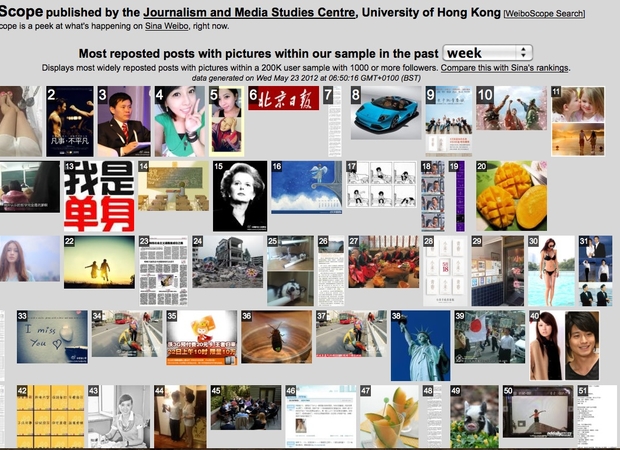
With more than 300 million registered users, the popular microblogging service Sina Weibo—sometimes called the Chinese Twitter—can offer unique insights into the quotidian musings of Chinese netizens. One way to sort through the barrage of microblogs posted each second is to make use of aggregation tools that provide a list of the most reposted or most commented-on microblogs within a specified period of time.

Sina itself provides one such aggregation tool.
Barbarians at the Gate, Again

Ever since foreigners arrived in China in large numbers in the 19th century, there has been a tendency either to lionise all that is foreign or to denigrate it, and to treat foreigners themselves either as gods or as barbarians. That dynamic has been very much on display in recent weeks.

Can China’s Billions Buy Media Credibility?

Having already achieved the status as the world’s second-largest national economy, China has decided that it also needs soft power, the ability to influence world public opinion to promote its commercial and foreign-policy interests. “To some degree, whoever owns the commanding heights of cultural development, and soft power, will enjoy a competitive edge internationally,” declared a communiqué that came out of the October 2011 plenary of the Communist Party’s Central Committee. Toward that end, the Chinese government allocated $8.7 billion in 2009-2010 alone to “external publicity work.”

Columbia Journalism Review

Publication Logo Vertical: 
Publication Logo Header: 

From their website:

CJR's mission is to be the intellectual leader in the rapidly changing world of journalism. It is the most respected voice on press criticism, and it shapes the ideas that make media leaders and journalists smarter about their work. Through its fast-turn analysis and deep reporting, CJR is an essential venue not just for journalists, but also for the thousands of professionals in communications, technology, academia, and other fields reliant on solid media industry knowledge.

Neil Heywood Death Investigation Reopened

A prominent American forensic scientist said that Chinese police asked him to analyse an unidentified blood sample, in a possible link to a spiralling political scandal surrounding the death of a British man. Henry Lee said police did not directly ask for help investigating the death of Neil Heywood, whose body was found in the southwestern Chinese city of Chongqing. The wife of the city's Communist party chief has been named a suspect in Heywood's death.

Identity Crisis Rattles Volvo’s Chinese Owner

New models bearing the Chinese-owned Volvo badge shared a luxury spotlight at the Beijing International Auto Show in April with perennial stars Mercedes-Benz, BMW, and Lexus.

But behind the diamond-studded presentation was confusion over the legal status of Sweden-based Volvo Car Corp., its business operations in China, and the company’s owner China Zhejiang Geely Holding Group Co. Ltd.

Amnesty Internation Annual Report—China 

Amnesty International surveys the landscape of human rights in China during 2011 and finds that China’s economic strength during the global financial crisis increased the country’s leverage in the domain of global human rights—mostly for the worse. Fearful of a protest movement inspired by events in the Middle East and North Africa, in February the authorities unleashed one of the harshest crackdowns on political activists, human rights defenders, and online activists since the 1989 Tiananmen Square demonstrations. Harassment, intimidation, arbitrary and illegal detention, and enforced disappearances intensified against government critics. Ethnic minority regions were under heightened security as local residents protested against discrimination, repression, and other violations of their rights. The authorities increased ongoing efforts to bring all religious practice within the control of the state; this included harsh persecution of some religious practitioners.

Embed Code: 
Topics: 
Organization: 
Amnesty International

Arthur Kroeber: Bear in a China Shop

Time and again, China has defied the skeptics who claimed its unique mixed model -- an ever-more market-driven economy dominated by an authoritarian Communist Party and behemoth state-owned enterprises -- could not possibly endure. Today, those voices are louder than ever. Michael Pettis, a professor at Peking University's Guanghua School of Management and one of the most persistent and well-regarded skeptics, predicted in March that China's economic growth rate "will average not much more than 3% annually over the rest of the decade." Barry Eichengreen, an economist at the University of California, Berkeley, warned last year that China is nearing a wall hit by many high-speed economies when growth slows or stops altogether -- the so-called "middle-income trap."