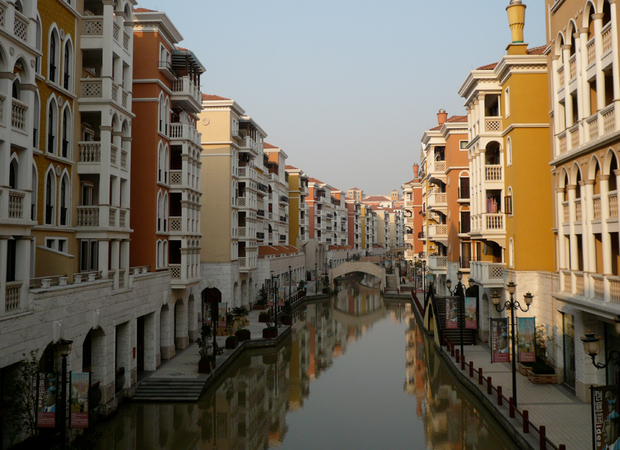
A 108-meter high Eiffel Tower rises above Champs Elysées Square in Hangzhou. A Chengdu residential complex for 200,000 recreates Dorchester, England. An ersatz Queen’s Guard patrols Shanghai’s Thames Town, where pubs and statues of Winston Churchill abound. Gleaming replicas of the White House dot Chinese cities from Fuyang to Shenzhen. These examples are but a sampling of China’s most popular and startling architectural movement: the construction of monumental themed communities that replicate towns and cities in the West.
Original Copies presents the first definitive chronicle of this remarkable phenomenon in which entire townships appear to have been airlifted from their historic and geographic foundations in Europe and the Americas, and spot-welded to Chinese cities. These copycat constructions are not theme parks but thriving communities where Chinese families raise children, cook dinners, and simulate the experiences of a pseudo-Orange County or Oxford.
In recounting the untold and evolving story of China’s predilection for replicating the greatest architectural hits of the West, Bianca Bosker explores what this unprecedented experiment in “duplitecture” implies for the social, political, architectural, and commercial landscape of contemporary China. With her lively, authoritative narrative, the author shows us how, in subtle but important ways, these homes and public spaces shape the behavior of their residents, as they reflect the achievements, dreams, and anxieties of those who inhabit them, as well as those of their developers and designers. — University of Hawai‘i Press
Ian Johnson from New York Review of Books One of the most striking features about daily life in China is how much of what one encounters has been appropriated from elsewhere. It’s not just the fake iPhones or luxury watches—pirated consumer goods are common in many developing countries. In...