


China Says Trade War with U.S. Will Only Bring Disaster to Global Economy
on March 12, 2018
Beijing criticizes proposed tariffs by Washington amid fears it could shatter global growth.
Beijing criticizes proposed tariffs by Washington amid fears it could shatter global growth.
Research group highlights Beijing’s growing share of global arms trade as it tries to strengthen ties with key allies.

China Europe Association for Civil Rights is a nonprofit organization. The association’s mission is to promote the realization and protection of civil and political rights in the greater China region.
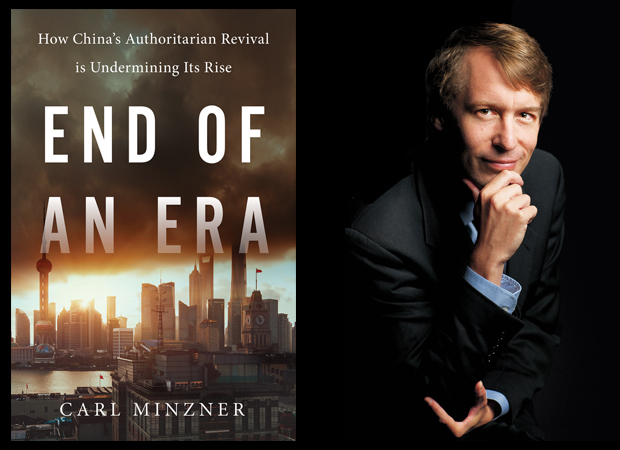
Oxford University Press: Since the 1990s, Beijing’s leaders have firmly rejected any fundamental reform of their authoritarian one-party political system, even as a decades-long boom has reshaped China’s economy and society. On the surface, their efforts have been a success. Political turmoil has toppled former communist Eastern Bloc regimes, internal unrest overtaken Middle East nations, and populist movements risen to challenge established Western democracies. China, in contrast, has appeared a relative haven of stability and growth.
But as Carl Minzner shows, a closer look at China’s reform era reveals a different truth. Over the past three decades, a frozen political system has fueled both the rise of entrenched interests within the Communist Party itself and the systematic underdevelopment of institutions of governance among state and society at large. Economic cleavages have widened. Social unrest has worsened. Ideological polarization has deepened.
Now, to address these looming problems, China’s leaders are progressively cannibalizing institutional norms and practices that have formed the bedrock of the regime’s stability in the reform era. Technocratic rule is giving way to black-box purges; collective governance sliding back towards single-man rule. The post-1978 era of “reform and opening up” is ending. China is closing down. Uncertainty hangs in the air as a new future slouches towards Beijing to be born. End of an Era explains how China arrived at this dangerous turning point, and outlines the potential outcomes that could result.
Peter Neville-Hadley, The Wall Street Journal (March 4, 2018)
“China’s Authoritarian Revival, Explained by Carl Minzner,” Kaiser Kuo, SupChina, March 8, 2018
“Carl Minzner’s New Book: End of an Era: How China’s Authoritarian Revival Is Undermining Its Rise (Oxford 2018),” Jerome Cohen, Jerry’s Blog, February 15, 2018
“Q. and A.: Carl Minzner on the Shift to Personalized Rule in China,” Michael Forsythe, The New York Times, May 24, 2016
China’s Future?, David Shambaugh (Polity Press, 2016)
Perfect Dictatorship: China in the 21st Century, Stein Ringen (Hong Kong Univeristy Press, 2016)
China’s Crony Capitalism, Minxin Pei (Harvard, 2016)
U.S. Secretary of State Rex Tillerson has warned against African nations accepting Chinese cash in agreements which could “forfeit their sovereignty.”
Chinese president Xi Jinping has repeatedly told the world that China is ready to lead on issues like free trade and climate change.
The first posters appeared on a bulletin board at University of California, San Diego on March 1.
As China grows more powerful, it is displacing decades-old American preeminence in parts of Asia. The outlines of the rivalry are defining the future of the continent.
China and Europe lashed out against new U.S. steel and aluminum tariffs, while officials and executives from several American allies caught in the crossfire reacted more cautiously, embracing what the White House promised would be some flexibility in implementation.
President Donald Trump may not follow Elon Musk on Twitter, but the Tesla Inc. chief’s posts decrying China’s automotive trade practices managed to catch his attention.