Hong Kong in Protest

A ChinaFile Conversation

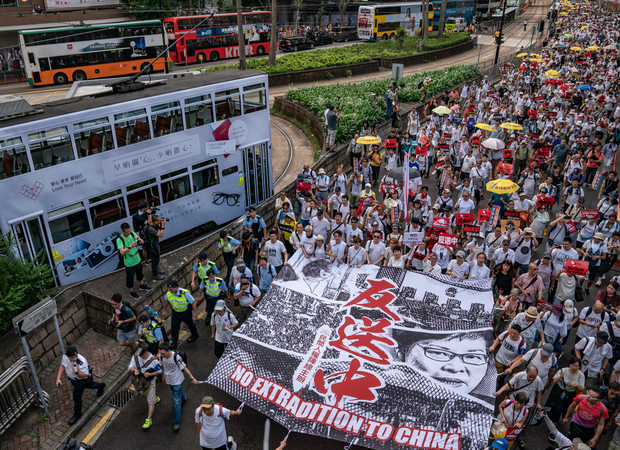
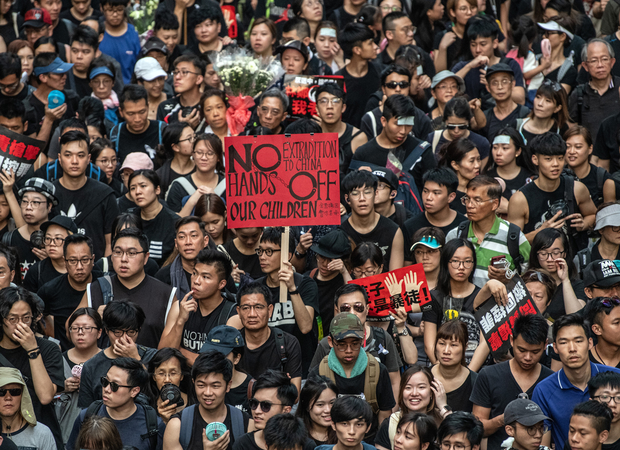
On June 16, an estimated 2 million people took to the streets to protest the Hong Kong government’s handling of a proposed extradition bill. This followed two massive demonstrations against the bill earlier in the month, including one where police used pepper spray and tear gas against protesters. The controversial bill would allow Hong Kong to extradite to the mainland those accused of crimes under the People’s Republic of China’s Communist Party-led legal system. While Hong Kong Chief Executive Carrie Lam has suspended the bill, she has refused to withdraw it. What do the protests mean for the future of Hong Kong? And what do they say about Hong Kong’s relationship with the mainland?
What Does the Pause of Hong Kong’s Extradition Bill Mean?

The Hong Kong people’s historic mass protests during the past 10 days have demonstrated their awareness that the now suspended extradition bill proposed by Chief Executive Carrie Lam represented a threat to Hong Kong’s promised “high degree of autonomy.” The bill’s passage would have deprived China’s Special Administrative Region of its power to defend its citizens, other residents, and even visitors against the demands of the Chinese Central Government to forcibly transfer alleged suspects to it for detention, trial, and punishment that violate international standards of justice.

Where Can My NGO Find Contact Information for Public Security NGO Offices to Register or Report a Temporary Activity?

Foreign NGO registration occurs at the level of the province, which includes five autonomous regions (Inner Mongolia, Guangxi, Tibet, Ningxia, and Xinjiang) and four municipalities (Beijing, Tianjin, Shanghai, and Chongqing). Each province has established a location where foreign NGOs should submit paperwork related to setting up a representative office or carrying out a temporary activity. In most if not all cases, this is co-located with the province’s Public Security Bureau (PSB) Entry and Exit Administration. Contact information for these offices, including address, phone numbers, fax, and email (where available), is listed below.

What Is the Difference between Registering a Representative Office and Filing for Temporary Activities?

A representative office allows for the establishment of a full-time presence in mainland China. For organizations that do not require such a constant in-country presence, filing to hold a single or multiple temporary activities is an alternative way to carry out projects in China. See our FAQ series on representative offices and temporary activities for more information on each.

What Constitutes “Proof of Funding” When Filing for a Temporary Activity?

In conversation with The China NGO project, multiple NGOs have expressed confusion about the exact documentation required to satisfy the requirement for “proof of funding” when filing for a temporary activity. We are unaware of detailed written guidance on this point, and different foreign NGOs have reported supplying different documentation.

ChinaFile Presents: Erasing History—Why Remember Tiananmen

On the evening of June 3, ChinaFile hosted a discussion on the Chinese government’s efforts to control, manipulate, and forestall remembrance of the Tiananmen Square protests of 1989 and the bloody crackdown that ended them. Participating in the talk at Asia Society in New York were Nicholas Kristof of The New York Times, author Zha Jianying, and ChinaFile Publisher Orville Schell, all of whom were in Beijing in the spring of 1989. The discussion was moderated by ChinaFile Editor Susan Jakes.

What Happens if a Foreign NGO Violates the Law?

Articles 45 and 46 of the Foreign NGO Law list the sanctions that can be applied to foreign NGOs that are not compliant with the Law. These include the suspension of activities, the confiscation of illegal assets, and the withdrawal of registration certificates. Article 46 also states that in serious cases, “responsible personnel” can be detained for up to 10 days. As provided in Article 48, foreign NGOs that have had their representative office registration or temporary activities canceled must wait five years before re-applying to work in China. Foreign NGOs that violate Article 47 of the Foreign NGO Law (which, among other things, forbids foreign NGOs from obtaining state secrets, spreading rumors, disseminating information that harms public security, or funding illegal religious activities) will be placed on an “unwelcome list.” In terms of temporary activities, when the MPS finds such activities are in violation of Article 5 (which contains provisions similar to Article 47), they will notify the Chinese Partner Unit to stop the temporary activities.