


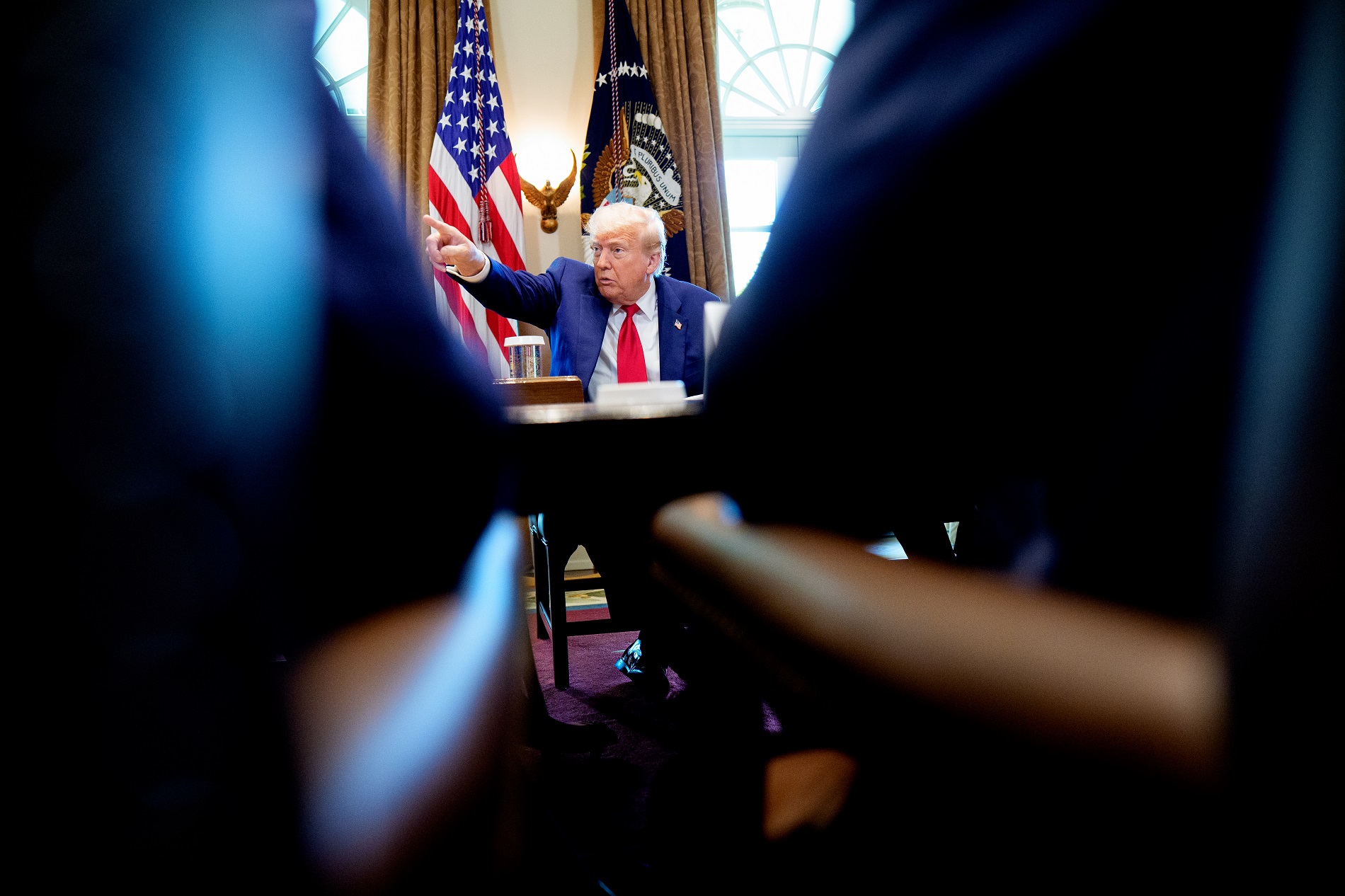
U.S. President Donald Trump came into office with tough talk on China, including promises to enact huge tariffs on China and erect a new trade regime, “aggressive new restrictions” on Chinese ownership of American land, an end to fentanyl trafficking, and more. Now the White House seems to be softening its tone, and moderating its actions against Beijing.
In July, the administration reversed a ban on Nvidia’s H20 AI chip sales to China—technology that national security experts say could advance China’s military capabilities. The White House has also moderated its approach toward Taiwan, reportedly blocking President Lai Ching-te from visiting the U.S., as previous Taiwanese leaders have made a habit of doing. Trump has frequently dropped hints that he would like to visit Beijing, and his words about China and Xi Jinping have remained complimentary. The enormous duties on imports from China have been postponed once again. Meanwhile, Trump continues to delay enforcement of the ban on TikTok without much explanation.
Treasury Secretary Scott Bessent has described recent moves as “all part of a mosaic,” but critics argue this approach mirrors the same transactional dealmaking that ultimately failed to contain China during Trump’s first term. “Trump is surrendering critical capability and leverage the US needs to succeed in global competition,” Johns Hopkins’ Hal Brands wrote recently, “exploiting his hammerlock on the GOP to weaken the anti-China consensus.”
How significantly has the Trump administration changed its positioning on China? Has the President “gone soft”? And, if so, what are the consequences likely to be? —The Editors
Comments
James McGregor
Donald Trump has not gone soft on China. He has woken up to the realization that today’s China is not the same country that he launched a trade war against in his first term. Instead, he is facing a country that has spent two presidential terms derisking from the U.S. while building up its own technology chokepoints that are now forcing the U.S. to step back from egregious trade actions.
On top of this, in launching his “Liberation Day” tariffs against nearly every country on the planet, Trump angered allies and adversaries alike and left his negotiators with a mess to clean up. This art-of-the-deal president has so far cut deals with such heavyweights as the EU, Britain, Japan, and South Korea. But these arrangements are mostly vague frameworks that added together don’t appear to be strategically significant or economic gamechangers for the U.S.
Trump and his senior aides must have been shocked when China punched back strongly against the Liberation Day tariffs. Trade figures had convinced them that the U.S. held all the cards since U.S. exports to China were one-fifth of Chinese exports to the U.S. Treasury Secretary Scott Bessent boastfully declared that China was only holding a “pair of twos” when the country slapped back with retaliatory tariffs.
Soon, the Trump team learned that China held the most important cards. America’s key leverage in the negotiations has been U.S. export controls on advanced chips and chipmaking equipment. China has unveiled the even stronger leverage it has through its near monopoly on the production of rare earth permanent magnets. China can struggle through on lesser chips. Without China’s supply of certain rare earth magnets, U.S. production of electric vehicles, wind turbines, advanced manufacturing, and many vital military applications could come to a standstill.
So, Trump is now playing nice with China because he has no choice. He is desperate for a trade deal with China. Only by inking a deal with America’s most powerful adversary can Trump declare victory in this trade war. Trump will be focused on a “Big Beautiful Deal” much like his “Big Beautiful Bill” that he can hype to the heavens. China knows this and is happy to keep the talks going as long as possible. More time, more U.S. concessions. They just got 90 more days.
Wendy Cutler
President Donald Trump’s China policy is a work in progress. A number of tough steps aimed at Beijing were taken in the early months of his second term, including the imposition of high tariffs, elimination of the duty exception for small packages, and implementation of a steep fee on Chinese ships entering U.S. ports. However, more recently we have witnessed a softening in the administration’s stance towards China, most recently agreeing on a 90-day extension of the tariff truce. What is unclear, however, is whether this shift is temporary or represents a more fundamental change that will play itself out over the next few years.
It’s not unusual for U.S. officials to back off or delay the imposition for measures that Beijing may view as provocative in the lead-up to a possible summit meeting. Other administrations, both Republican and Democrat, have done the same through the years. During my career at the Office of the U.S. Trade Representative, for example, I recall being instructed to hold off announcing the initiation of Section 301 investigations against China until after high-level meetings were concluded. Thus, denying a transit visit by Taiwan’s president and continuing the tariff truce for an additional 90 days could be viewed through this lens.
However, there are signs that this policy and tone shift may be more than temporary. Trump continues to convey positive words about Xi, calling him a “great guy” and a “very good friend,” at the same time he has sharply criticized other leaders, including from allied and partner countries. His administration has relaxed certain export controls on China, reversing a decades-old bipartisan policy of not placing national security related matters on the negotiating table. Furthermore, his economic team, led by Treasury Secretary Scott Bessent, is busy negotiating a trade (or broader) deal with China to be announced during a potential summit meeting with Xi, which could reset the relationship for the next few years.
These negotiations won’t be easy for several reasons. First, time is short, with approximately two and a half months left to reach a deal. Let’s recall that the Phase One deal concluded during Trump 1.0 took over one year of detailed negotiations. Second, this time around China will demand a more balanced agreement, requiring the U.S. to make concessions, including on difficult matters like export controls. Third, Beijing’s announcement of mega-purchases of U.S. agriculture, energy, and other goods will be viewed by the U.S. with skepticism in light of China’s failure to fully implement such commitments in the Phase One agreement. Finally, these negotiations are likely to go beyond the traditional trade realm and include other thorny matters in the bilateral relationship, including fentanyl and Russian oil purchases, further complicating the talks.
All of this will play out over the next two and a half months, after which time we should have a clearer picture of the administration’s China policy, including whether the recent softening is more tactical than fundamental.
Ryan Hass
President Donald Trump is not an ideologue. He is not a member of America’s national security establishment. He is a lifelong dealmaker who believes his unpredictability is a strategic asset. He also is exceptionally attuned to public opinion and his own public image. He has a high sensitivity for sleights, and he jealously guards his reputation for being “tough” and “strong.”
On China, Trump is focused on rebalancing trade relations. He has subordinated all other aspects of America’s complex relationship with China to his desire to secure a trade deal that delivers more economic benefits for American companies and workers. For him, export controls, human rights, symbols of support for Taiwan, and tariffs are tools that can be employed toward his goal.
In Trump’s mind, China is not a singular threat that must be countered. China is but the largest culprit in a long list of countries that have taken advantage of America’s economic openness for their own benefit. He views it as his responsibility to right this wrong, a wrong that he believes previous American presidents were too timid or weak to fix.
There are several factors that enable Trump to pursue such an iconoclastic approach toward China. First, Trump dominates his political party, which itself controls both chambers of Congress. As such, Trump does not fear legislation that would challenge his preferred approach toward China. Second, Trump is more of a climate-maker than climate-taker on America’s policy debates. As he scans the political horizon, he does not see other leaders capable of effectively mounting a sustained challenge to his preferred approach to China. Additionally, Trump seems to instinctively understand that Americans’ views of China are more fluid than those of Washington’s national security establishment. Americans’ top priority with China is to avoid war. Rightly or not, China is not a top-tier concern for the American electorate.
In pursuing his approach, Trump is shifting the terms of debate on China. He is moving away from using threats and fear as persuasion to emphasizing unrealized opportunities that could flow from rebalancing trade relations with China.
Will Trump’s shift on China be enduring? Probably not. Just as he has shown with Ukraine, NATO, and Iran, Trump can turn on a dime. He is no more wedded to friendly relations with China than he is to permanent hostility.
If China underdelivers in negotiations with Trump or treats his outreach as an invitation to overreach in pursuit of its strategic objectives on Taiwan or elsewhere, it could compel Trump to swing from projecting his image as a deal-maker to protecting his image for strength and toughness. In this respect, Trump likely will pursue a Janus-faced approach to China, rather than becoming permanently “soft” or “tough” on China.
James Mann
Yes, Donald Trump is going soft on China—although I would add the qualification that, in his second term, he has never been tough in the first place, other than in the realm of rhetoric and quickly-reversible threats.
During his first term, Trump reversed the course of decades of American China policy, notably with new tariffs and a series of actions aimed at ending the longstanding policy of engagement with China. Back then, Trump had a stream of advisers under him, such as Deputy National Security Adviser Matt Pottinger and Secretary of State Mike Pompeo, leading the way in the change. This time, China policy seems to be overwhelmingly run by Trump himself. And Trump’s outlook is highly transactional and commercial, so that no matter what action he takes, he could head off in a reverse direction within weeks.
There is no consistent long-term strategy. Early on, there was talk of a possible “reverse Kissinger”—that Trump might choose to partner with Russia against China. At the moment, that seems highly ironic, because he’s now pursuing the opposite strategy: trying to enlist China’s help against Russia.
To be sure, Trump announced tariffs of 145 percent against Beijing this past spring, but then he quickly lowered them. And since then, he’s held off on economic pressure, even to the point that he has imposed tariffs on India, but not China, for buying Russian oil. Trump won’t even enforce the ban on TikTok that Congress approved with strong support from Trumpian conservatives. His decision to open the way for Nvidia’s AI chip sales brought forth organized opposition from national security experts and former officials, including Pottinger.
The most telling incident was his refusal to let Taiwanese President Lai Ching-te stop over in the U.S. That clear reversal of the policies of past administrations may seem arcane to the American public but no doubt was taken as an important signal in Beijing.
It looks to me as if Trump is trying to lay the groundwork for a highly publicized rapprochement with Beijing in the fall. He will probably visit China and be given a lavish reception there; it will be a television extravaganza. China will announce new purchases of American goods.
Trump will proclaim, over and over again, that Xi Jinping is his good friend. In doing so, he calls to mind the classic study on Chinese negotiating behavior written by China specialist Richard Solomon four decades ago: “The Chinese distrust impersonal or legalistic negotiations. . . they attempt to identify a sympathetic counterpart official in a foreign government and work to cultivate a personal relationship, a sense of ‘friendship’ . . . and obligation.” In the current administration, the targeted counterpart is Trump himself.
After a Beijing summit, things will go on much as before. Trump will after a while start inveighing against China again, until the bombast then changes direction yet again. In the realm of concrete actions against China, as opposed to rhetoric, however, Trump is showing that he won’t do much.
Stephen S. Roach
In one respect, “Is Trump going soft on China?” seems like a trick question. The notion of “going soft” implies a strategic connotation that is at odds with the chaos and disruptive style of Donald Trump’s approach to governance. A deliberate shift from “hard” to “soft” misses the real point of what the President is attempting to achieve with China.
What has changed is Trump’s perception of his legacy gambit. His fixation on “the deal,” which, of course, has roots in his 1987 book The Art of the Deal, has become the North Star of Trump 2.0. Deal count is the President’s principal metric of success. Ending the war in Ukraine on day one was supposed to be the signature deal of his inauguration. Post-April 2 “Liberation Day,” it was 90 trade deals in 90 days. The Big Beautiful Bill was his defining fiscal deal. Repression of universities and law firms could only be resolved through deals. More recently, Nvidia and AMD struck revenue-sharing deals with Trump to gain market access in China. And so on.
Trump’s critics ridicule his deals as public relations gimmicks—at best, frameworks that lack strategic buy-in that requires long and arduous negotiations and compromise. The President, of course, is dismissive of such blowback, fixated on the potential of two trophy deals: Harvard and China. If he can cut deals with America’s pre-eminent university and its peer superpower competitor, Donald Trump’s self-anointed legacy as dealmaker-in-chief will all but be enshrined.
Has he gone soft on China in order to achieve that outcome? On the surface, it certainly seems that way. His post-Liberation Day bark has been far worse than any bite. Initial tariff threats on China of 145 percent have been slashed to 30 percent. He has kicked the China negotiations deadline can repeatedly down the road—most recently to November 10. He has abandoned AI containment to strike a deal with leading U.S. chip-makers. Forget about Putin, with whom Trump has been congenitally soft. Desperate for a deal with China as the crown jewel of his deal-focused presidency, Donald Trump will stop at nothing to put another notch in his belt.
Beneath the surface, this approach is troubling. A better question is: What would a deal with China, on Trump’s terms, mean for the United States? It would certainly not make a dent in the trade deficit, which will continue to widen as big, beautiful budget deficits push already depressed domestic savings even lower. Nor would it lead to a revival of U.S. manufacturing, where further expansion of China’s unmatched industrial prowess will continue to gain global market share. And a deal with China will not offset America’s shortfall in Federal support to basic research, perhaps the most decisive factor in the AI race.
Going soft on China may well boost Donald Trump’s cherished deal count. But this short-term focus will do next to nothing to make America truly great over the long haul.