


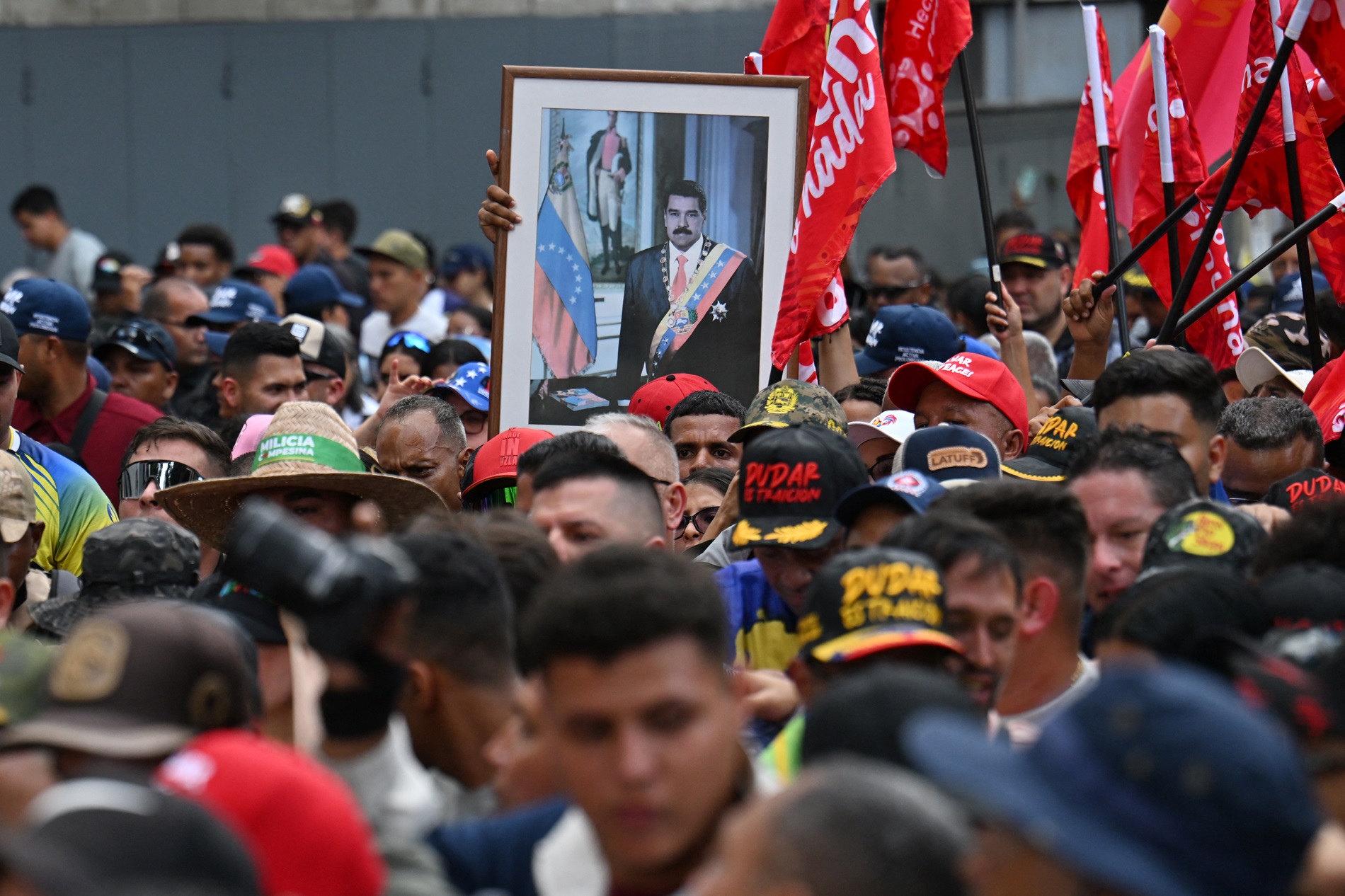
On January 3, the U.S. military captured Venezuelan President Nicolás Maduro and his wife in a nighttime raid on Caracas and flew him to New York to face drug trafficking charges. Trump announced the U.S. would temporarily “run” Venezuela until a transition of power occurs. Beijing immediately released a statement condemning the U.S.’s “blatant use of force against a sovereign state and its actions against the president of another country,” and a similar statement at the United Nations on January 5.
How would you characterize Beijing’s reaction? What has the reaction been on Chinese social media to Trump’s moves in Venezuela, and his administration’s aggressive statements about Greenland, Mexico, and Cuba? How might this affect China’s large investment in the Venezuelan oil industry? Does this change China’s calculus on Taiwan? What is the larger global significance for China of the new American posture? —The Editors
Comments
Parsifal D’Sola Alvarado
Beijing moved quickly and predictably into its usual framing: sovereignty, non-interference, and the UN Charter as the core legal reference point. It also adopted a moralizing tone that treats the U.S. action as already convicted rather than debated. The difference this time is degree. The wording was notably harsher than the boilerplate China often uses—it leaned into terms that convey brazen aggression and coercion, not just disapproval. So it’s the same rhetorical architecture, but turned up to a higher volume.
Put in perspective, China’s investments in Venezuela’s oil industry are not as significant as they are often portrayed to be. Venezuela has never been a major recipient of Chinese foreign direct investment, receiving only about $5-6 billion over the past two decades, despite years of Venezuelan delegations’ traveling to Beijing in search of deeper economic backing.
For that reason, I do not expect China’s current presence in Venezuela’s oil sector to be materially affected. If anything, Sino-Venezuelan joint ventures could even benefit from U.S. intervention. It is already clear that China has been unwilling to invest the tens of billions of dollars needed to revive Venezuela’s oil industry, which was crippled by years of blatant corruption, mismanagement, and chronic underinvestment—long before U.S. sanctions on PDVSA, Venezuela’s state-owned oil company, were imposed in 2019.
The one area where China has remained economically helpful is sanctions evasion. It is estimated that roughly 4 percent of China’s imported oil comes from Venezuela, largely through intermediaries (Chinese customs data reports zero direct Venezuelan oil imports). If sanctions are loosened or removed, China could purchase Venezuelan oil more openly, without the costly and cumbersome workarounds that sanctions evasion requires.
Moreover, if the United States bears the brunt of new investment, restores some degree of order in the sector, and boosts production, that could actually increase Chinese imports from Venezuela and give Sino-Venezuelan joint ventures more room to expand as well.
Finally, for all the rhetoric coming out of Washington about pushing its enemies out of the hemisphere, the Trump administration has, if anything, proven to be highly transactional and openly chrematistic. If China wants to buy more Venezuelan oil going forward, and U.S. oil companies also stand to profit from expanded production and a revitalized sector, I do not see Washington getting in the way.
Will the capture of Maduro change China’s calculus on Taiwan? I don’t think it will, for one simple reason: China views Taiwan as a domestic issue tied directly to territorial sovereignty, not as a matter governed by international law in the way U.S. intervention in Venezuela is typically framed. In Beijing’s view, the two situations belong to entirely different categories.
Moreover, from a military standpoint, U.S. power projection in the Caribbean is not comparable to other scenarios worldwide. The United States has every advantage: decades of experience operating in the region through the U.S. Southern Command (SOUTHCOM), deep networks of military cooperation, and geographic proximity that is difficult to match. There is simply no equivalent comparison to a potential contingency in the South China Sea.
That said, Beijing is almost certainly studying the operation closely to identify lessons about U.S. military capabilities and operational methods.
Brian Hioe
Immediate reactions in Taiwan to the Trump administration’s capture of Venezuelan president Nicolás Maduro were to wonder if something similar could happen here. Some fear that China will be emboldened by the new norm set by the U.S., increasing its appetite to target Taiwan and to carry out a decapitation strike targeting Taiwan’s political leadership.
By contrast, Taiwanese political leaders have suggested that the fundamental calculus for China is unchanged, in that China carried out military threats directed at Taiwan before the U.S.’s actions in Venezuela, and will continue to do so afterward. China had carried out a series of large-scale drills around Taiwan just days before the Maduro capture. And certainly, it is not as though the capture of Maduro changes anything about the high costs China would incur if it were to undertake an invasion or a blockade of Taiwan.
Yet it is telling that, nearly immediately, conspiracies began to circulate in Taiwan about the possibility that the U.S. had struck a deal with China—you let us take Venezuela, you get Taiwan.
Such arguments, of course, greatly exaggerate China’s influence over Venezuela, reflecting a worldview in which outside of American hegemony, the rest of the world is comprised of Chinese puppet states. But if the domestic Taiwanese public reacted—however irrationally—with fears that the Trump administration’s actions in Venezuela heralded the new, multipolar world in which Great Powers hold absolute power in their respective spheres of influence, one can bet that there was a similar reaction in China at the level of society writ large, as well as in the halls of Zhongnanhai.
Again, nothing about the practicalities of conducting a military action against Taiwan has changed. But the Chinese government has long required pretext for escalating actions against Taiwan. Chinese officials have depicted the U.S.’s, Japan’s, and other actors’ support for Taiwan as violating the rules-based international order, while seeking to paint President Lai Ching-te as provocative of China in a way that justifies an assertive response.
Another nail—perhaps the last nail—in the coffin of the so-called “rules-based international order” that the Trump administration’s actions in Venezuela hammered in is that China may no longer require such elaborate justifications to escalate military action against Taiwan. Particularly dangerous is that the Trump administration’s actions project the viewpoint that “might makes right,” and that Great Powers can do as they like to nations proximate to them.
Will China do the same for Taiwan, or will this add to efforts to position itself as the new defender of an international order that the U.S. is no longer interested in upholding? Even if it has historically been more common for the U.S. to accuse China of violating the international order, China has increasingly alleged that the U.S. violates this framework when it comes to its support of Taiwan. To date, China has framed the capture of Maduro as violating international law in favor of the “law of the jungle,” but it remains to be see whether this will lead to a reversal of course on the matter of Taiwan.
Yaqiu Wang
Here I speak specifically to the significance of the United States capture of Nicolás Maduro with respect to Beijing’s human rights record.
As a Chinese human rights advocate who has worked with many activists brutally persecuted by their governments for speaking truth to power or demanding justice, I often feel a flicker of exhilaration when I see a dictator brought low, whatever the circumstances. That was my reaction when I saw the image of Maduro bound and blindfolded on an airplane to the United States. There is also an undeniable sense of schadenfreude in watching the downfall of President Xi Jinping’s junior partner, into whom Beijing had poured so much political capital and financial support. And my sentiment is widely shared among critics of the Communist Party on the Chinese internet.
That said, it is a mistake for anyone who cares about human rights and the democratic future in China to rejoice in this moment. U.S. President Donald Trump made clear the operation had little to do with Maduro’s record as a ruthless autocrat who impoverished Venezuelans, violently repressed those who challenged his rule, and clung to power by denying election results. Instead, Trump repeatedly expressed his desire for Venezuela’s oil and for political obedience from the country’s leaders. In that sense, the episode has nothing to do with promoting human rights and democracy.
Maduro’s capture has drawn widespread global condemnation because it disregarded core principles of international law. When we argue that the Chinese government should protect free speech, stop torturing prisoners, and desist from harassing exiled dissidents abroad, we are appealing to a shared framework of values and rules, namely, international human rights law that is embedded in the broader international legal system. By apprehending Maduro through legally dubious means, Trump weakens the international legal framework, undercutting the system that gives human rights advocacy its moral and legal force.
Trump’s actions will also help bolster Xi’s standing on the world stage in relative terms. While few will suddenly view Xi as a benevolent benefactor, Trump’s stark breach of global norms makes Beijing’s authoritarian behavior look less like an outlier, weakening global resistance to it, whether it involves abducting Chinese journalists in Thailand, grabbing land in Nepal, or interfering with elections in the Philippines.
And for those who think that Maduro’s capture signals that murderous dictators everywhere might suddenly face Uncle Sam’s wrath, here’s the reality check: Xi Jinping is not just any dictator. China is a peer power to the U.S., and the idea that Washington has either the intention or the ability to undermine the CCP’s rule over China the way it did with Maduro in Venezuela is fantasy.
As someone from China, I understand the desire for an external force to remove a hated tyrant. When the government feels omnipotent and citizens powerless by comparison, it is only natural to hope that an outsider will come to our rescue. But that hope is misguided. The real path to advancing human rights and democracy in China is the harder one: defending an international system in which all governments are held to a set of rules. Progress is slow, and the work can feel hopeless at times—but step by step, we move forward.
Ryan Hass
After news broke of America’s military operation to capture Nicolás Maduro and his wife, Chinese netizens and American foreign policy analysts alike began speculating about how Beijing would respond. Would America’s military operation embolden Beijing to pursue similar aggression against Taiwan? Would it inject new tensions in U.S.-China relations, potentially complicating U.S. President Donald Trump’s plans to visit Beijing in April? Count me deeply skeptical on both these questions. Here’s why:
First, on Taiwan. Taiwan is an entrenched democracy with a clear line of presidential succession. Beijing would not move any closer to its goals of unification by attempting to capture Taiwan’s leader. If anything, such an operation would inflame anti-China sentiment inside Taiwan, bolster support for proponents of Taiwan independence, and spark a military crisis in the Taiwan Strait. Taiwan’s democratic institutions would remain intact, and its elected representatives would face domestic pressure to distance Taipei from Beijing.
This all presumes that People’s Republic of China (PRC) President Xi Jinping would have confidence to carry out such an audacious military operation. The People’s Liberation Army’s (PLA’s) special forces do not have experience executing such complex activities abroad. Judging by the PLA’s ever-shifting carousel of leaders, it also does not appear that Xi presently has high confidence in the competence of his top brass.
Rather, Beijing’s strategy on Taiwan is guided by its own internal logic. China is pursuing a strategy of coercion without violence to wear down the psychological will of people on Taiwan to resist unification. PRC leaders continue to suggest they believe time is on their side to achieve their aims without resort to violence. In sum, America’s military operation to capture Maduro will neither serve as a template nor an inspiration for China to pursue similar actions against Taiwan.
Similarly, the effects of America’s military operation on the U.S.-China relationship likely will end up being modest at most. Beijing will be unsentimental about developments in Caracas, just as it was after the United States and Israel bombed its erstwhile Middle East partner, Iran. For China, Venezuela is a geographically distant partner. Beijing’s higher order priority is securing relief from American economic and strategic pressure. China’s leaders believe lessening American pressure will support their goals of greater self-reliance while keeping open a path for their country’s continued rise.
This does not mean China will give America a free pass for capturing Maduro. Beijing will seek to impose reputational costs on Washington for being a lawless hegemon in pursuit of its own interests. PRC leaders will try to sharpen the contrast between China as a builder and upholder of the international system and America as its destroyer. Such efforts will remain largely rhetorical and symbolic, though. Beijing views Trump’s visit as important for solidifying the foundation of the U.S.-China relationship. China’s leaders will not allow differences over Venezuela to put at risk their ability to make progress on their priorities with Trump in April.
Lev Nachman
Will the People’s Republic of China (PRC) try a Venezuela-style move against Taiwan? Will Beijing’s calculus on when to take action against Taiwan change because of the U.S.’s move against Venezuela? Experts such as Ryan Haas and Bonnie Glaser have already convincingly argued that no, it is highly unlikely. That does not mean, however, that the U.S.’s actions against Venezuela are neutral or meaningless for the P.R.C.’s future endeavors for Taiwan. On the contrary, the U.S. has done Beijing a favor in terms of great power narrative and justification for unilateral action.
The PRC has spent decades trying to create a narrative for itself that it has justifiable international precedent to take military action against Taiwan. Xi Jinping selectively uses international laws and international organizations to build narratives that the PRC has a moral, justifiable right to Taiwan. Such endeavors are not new. In recent years, however, the PRC has ramped up its efforts. For example, earlier this year the PRC put out statements mischaracterizing World War II era documents as internationally recognized examples of their claims over Taiwan. Similarly, for years the PRC has tried within the United Nations to misinterpret Resolution 2758 to give itself international precedent within key organizations like the UN to claim Taiwan as legally its own. Xi may be selective with which laws and organizations he cares to utilize, but he certainly has gone through great effort to create legal, moral, and geopolitical precedent for the PRC to one day take action against Taiwan.
The United States’ actions in Venezuela, subsequent narrative about controlling the U.S.’s own hemisphere, and selective adherence to norms and international laws harmonize dangerously with the way Xi tries to convince the world of the PRC’s claims to Taiwan, his desire to have hegemonic control over East Asia, and his own desire to apply domestic law in foreign jurisdictions. Xi’s propaganda team is likely feeling particularly emboldened, and in the future convincing the world that PRC action over Taiwan is justifiable has now become easier.
One other concern over the U.S.’s actions is how they will be interpreted domestically in Taiwan. We know from public opinion data that perceptions of the U.S. and faith that the U.S. is a trustworthy ally have declined since Trump returned to office. This phenomenon in Taiwan of American skepticism (疑美論, yi mei lun) may very likely spike after the U.S.’s actions. It will be important to pay attention to future public opinion changes in Taiwanese attitudes towards the U.S. in order to assess whether or not the U.S.’s actions have altered the way Taiwanese see the U.S. and Trump’s leadership.
Although many are frustrated by the comparisons being made between Venezuela and Taiwan, there is one important overlooked silver lining. The world today has never been more keenly aware of Taiwan, its role as a flashpoint in geopolitics, and the way that global events may be connected. Even if many comparisons fall flat, I am relieved Taiwan is on the minds of people around the world.