


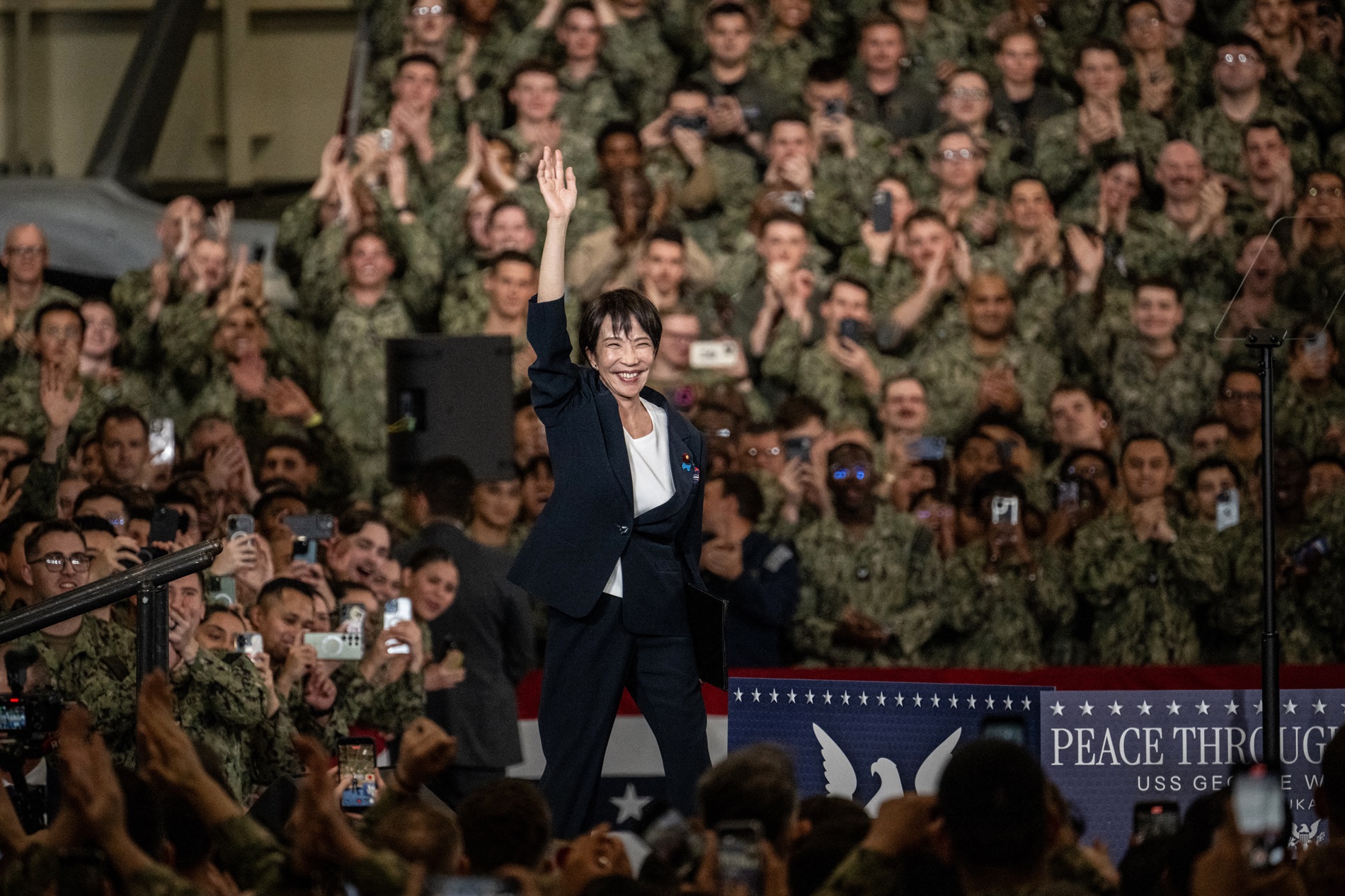
Japan-China relations are in a deep freeze that began in November when Prime Minister Sanae Takaichi suggested that Japan could intervene militarily in the event of a Taiwan crisis. Beijing responded furiously, invoking World War II, banning exports of dual-use items to a list of Japanese companies, advising citizens against traveling there, and reimposing a seafood import ban. In December, Tokyo said Chinese military fighter jets had twice locked their radar on Japanese Air Self-Defense Force aircraft. Chinese Foreign Minister Wang Yi doubled down at the Munich Security Conference in February, saying that Takaichi’s remarks “directly” challenged “China’s national sovereignty” and exposed “Japan’s unabated ambition to invade and colonize Taiwan and persistent intention to revive militarism.” On February 24, Beijing announced export bans on 20 Japanese entities with ties to the defense industry. Meanwhile, Takaichi’s landslide election victory in February suggests little near-term softening.
What lies ahead for Japan-China ties in 2026? Is there a plausible off-ramp here, or are both sides structurally locked in? What would a face-saving de-escalation even look like? How much appetite do Japanese and Chinese publics have for escalation? What are the possible consequences for Taiwan, and for U.S.-China relations?
—The Editors
Comments
Daniel R. Russel
Chinese coercive pressure on Japan was intense well before Prime Minister Sanae Takaichi’s Diet comment. Over the years, Beijing has steadily ramped up military activity around the Senkaku/Diaoyu and southwest islands, and pushed negative state-media narratives about Japan. More broadly, the Chinese Communist Party has long used claims of resurgent Japanese militarism and “historical revisionism” as an instrument of domestic mobilization and external propaganda.
However misguided Takaichi may have been to take the bait and answer a hypothetical question in the Diet, the punishment has been disproportionate to the “crime.” That asymmetry suggests opportunistic exploitation—Beijing’s seizing on a comment to advance a larger strategy.
The goal of that strategy is to demoralize and isolate Taiwan by dashing its hopes for sustained international support. By punishing Japan, China aims to deter Tokyo from explicitly linking its own security to a Taiwan contingency, warn other regional actors against expressing support for Taipei, and show Taiwan that even its closest friends will back away under Chinese pressure.
Moreover, Beijing sees Japan both as a firm U.S. ally and an extremely capable regional rival. Tokyo’s growing defense capabilities became even more worrisome with Takaichi’s willingness to more clearly link Taiwan contingencies to Japan’s own security. Xi Jinping’s November 25 call with Donald Trump seemed to indicate that the Chinese leadership also calculated it could make mischief in the alliance. Trump’s subsequent warning to Takaichi to dial it down suggests Xi had some success in portraying her as a provocative troublemaker.
The latest rash of Chinese punishment recalls the aftermath of the 2010 Senkaku trawler collision and Japan’s 2012 nationalization of two of the islands. The pattern then and now includes diplomatic freezes, suspensions of tourism and exchanges, informal trade disruption—notably rare earths in 2010—regulatory harassment, and stepped-up vitriol about Japanese “remilitarization.” Beijing casts defensive steps, such as Japan’s recently announced plans to deploy limited-range air defense missiles on a vulnerable Japanese island five years from now, as aggressive militarism in service of U.S. ambitions to contain China.
Beijing’s latest export-control listing of subsidiaries of major Japanese industrial firms represents a step-change. This moves beyond informal pressure into formalized, rules-based economic coercion tied to national security justifications. Weaponizing regulatory tools against Japanese industrial champions marks a shift from episodic retaliation to structured, institutionalized economic pressure.
As for an exit ramp, in the earlier episodes, the pressure never fully abated. Diplomatic channels eventually reopened, but there was no formal reset. Maritime incursions, propaganda intensity, and some forms of economic coercion plateaued and then normalized at a higher baseline. At some point in the future, when Chinese leaders conclude they need something important from Japan, they can choose to dial down the pressure rheostat. But while the current deep-freeze will not last forever at quite this level, the higher baseline of pressure and the structural rivalry are likely to endure.
Ryan Hass
Ever since the trauma of World War II, Japan has maintained a deliberately restrained military capacity. The country rebuilt under America’s security umbrella and relied upon active diplomacy and economic statecraft to expand its international influence. This strategy carried Japan to the present. Now, with America’s commitment to allies coming under question and China growing more assertive, a new era may be dawning.
Japanese Prime Minister Sanae Takaichi has presented herself as the right leader to carry Japan into this new era. She has channeled Beijing’s anger at her comments on Taiwan into Japanese public support for a firmer approach to China and a stronger Japanese military. After securing a mandate for her vision in February elections, Takaichi’s Liberal Democratic Party now controls a supermajority of two-thirds in the lower house of Parliament. This puts Takaichi in a strong position to advance her agenda for removing restraints on Japan’s military development.
Takaichi’s efforts to break from Japan’s past self-imposed military restraints coincide with the Trump administration’s push for allies to contribute more to their own self-defense. This is a global imperative for the Trump administration, not one with a special carve-out and exemption for Japan. Washington likely will encourage Tokyo’s growing investments in its own self-defense capabilities, believing that such investments will strengthen deterrence against any Chinese attempts to assert control over contested territories in Asia.
And herein lies the rub. Chinese officials have warned with rising intensity that Japan’s remilitarization is a threat to regional stability and potential foreshadowing of a revival of Japanese expansionism. Beijing appears trapped in its own historical narrative of Japan as a looming threat. China’s threat perceptions are not shared in the United States. For many in America’s policy community, Japan is a stable and reliable partner, a trusted friend, an entrenched democracy, and an aging society that lacks imperial zeal.
Thus far, President Donald Trump has taken a largely hands-off approach to Sino-Japanese tensions. He did not come to Japan’s defense after China unleashed its anger in response to Takaichi’s statement that a Chinese attack on Taiwan would serve as a “survival-threatening situation” for Japan. Instead, he called Takaichi after he spoke with Chinese President Xi Jinping. In that call, according to Wall Street Journal reporting, Trump advised Takaichi to “lower the volume” on Taiwan. If this reporting is accurate, it would fit a broader pattern for Trump of not wanting to take on other leaders’ problems as his own.
Looking ahead, there is a low likelihood that Japan and China will find an off-ramp in the coming months. Takaichi’s political imperatives will require her to maintain measured resolve against China. China’s political narrative will remain locked on a view that Japan is remilitarizing and thus poses a threat to regional stability. The next expected opportunity for Takaichi and Xi to meet in person will be the APEC Leaders’ Meeting November 18-19 in Shenzhen. That event may offer the next inflection point for Sino-Japanese relations.
Yun Sun
China’s relationship with Japan is unlikely to show any major signs of improvement for the rest of Prime Minister Sanae Takaichi’s term, let alone 2026. There is a historical precedent. When late Prime Minister Shinzo Abe assumed office in 2012, Sino-Japanese relations quickly plummeted due to the issue of the “nationalization” of the Senkaku/Diaoyu islands. Bilateral relations did not genuinely improve for the rest of his term. Things only stabilized when Abe accepted “third-country cooperation” with China in 2017, which Beijing interpreted as China-Japan cooperation in Belt and Road Initiative countries.
What Beijing most certainly wants is for Takaichi to withdraw her comments on Taiwan, but she has little incentive to make such a concession. Her domestic popularity is at a historical high, as was made evident in her overwhelming victory in the February general election in Japan. If anything, there appears to be a positive correlation between the harsh Chinese pushback and her domestic popularity.
In 2026, China could attempt to escalate further in a number of domains. The most extreme scenario is maritime conflict between China and Japan, but China could also stir up domestic nationalism, tighten export control measures, and expand the list of Japanese companies subject to such measures. China’s sanctions have included Japanese seafood exports, tourism, and panda diplomacy, and they might very well expand further.
Elli-Katharina Pohlkamp
Japan-China relations in early 2026 are no longer simply in a “deep freeze”: They have entered a phase of strategic hardening that is likely to define the year ahead. Both governments face strong domestic incentives to avoid appearing weak. Prime Minister Sanae Takaichi’s electoral mandate strengthens her room for maneuver but also binds her to a hawkish public image and a firmer security posture. On the Chinese side, Taiwan remains a core sovereignty issue on which political compromise is impossible. As long as Tokyo publicly links its own security to Taiwan’s defense, Beijing will treat Japan not as a neutral neighbor but as an actor positioning itself for possible military involvement.
From Beijing’s perspective, Takaichi’s comments were not an isolated rhetorical slip. They confirmed a trajectory already underway: Japan’s accelerated defense restructuring, its acquisition of counterstrike capabilities, and its expanding role along the First Island Chain. That chain, stretching from Japan’s southwest islands through Taiwan to the Philippines, has reemerged as the geographic backbone of U.S.-allied deterrence strategy. Tokyo’s reinforcement of the Nansei/Ryukyu Islands, expanded missile deployments, and deeper operational coordination with Washington signal that Japan now sees the defense of the First Island Chain as inseparable from its own security. For China, this looks less like deterrence and more like encirclement.
Beijing’s response—export restrictions targeting Japanese defense-linked entities, renewed pressure around the Senkaku/Diaoyu Islands, and sharp historical rhetoric invoking militarism—reflects both anger and calculation. China is raising the cost of Japan’s strategic shift without fully severing economic or diplomatic channels.
What lies ahead? Likely, managed confrontation rather than rupture. Takaichi’s landslide election victory strengthens her domestic mandate and reduces incentives to soften her tone. China’s leadership, meanwhile, cannot afford to appear weak on Taiwan. Both sides are locked into postures shaped by U.S.-China rivalry.
But escalation is not inevitable. An off-ramp would not require either side to reverse course. It would require reframing. Tokyo could emphasize that its Taiwan-related statements are contingency-based, constitutionally constrained, and designed to preserve regional stability rather than signal automatic intervention. Beijing, in turn, could gradually ease selective economic measures while resuming high-level security dialogues and maritime crisis management mechanisms. Neither side would admit retreat but both would signal responsibility.
Public opinion matters. In Japan, concern about China has grown markedly, and support for a stronger defense posture is real. But there is little appetite for direct military conflict. In China, nationalist narratives resonate, yet the leadership remains acutely aware of economic vulnerabilities and the risks of uncontrolled escalation. While public anger can legitimize hardline policies, a longer escalation would be controlled from the top, not fueled by mass pressure.
For Taiwan, Japan’s more explicit role along the First Island Chain strengthens deterrence because it makes Chinese military planning more complicated and risky. At the same time, it reinforces Beijing’s view that the Taiwan issue is no longer just a domestic matter, but one increasingly shaped by outside powers. From China’s perspective, this challenges its sovereignty claims and makes any crisis more sensitive and harder to control. Any incident, whether around Taiwan or in the East China Sea, would now carry faster escalation dynamics, with the United States inevitably implicated.
2026 will test whether Tokyo and Beijing can build guardrails within a fundamentally competitive relationship. The strategic rivalry is structural. Whether it becomes destabilizing will depend on how disciplined both sides remain under pressure.
Richard McGregor
The spat between China and Japan might appear to be following a playbook that has scripted bilateral disputes for about the past two to three decades: Japanese leaders make comments about wartime history and Taiwan, and Beijing responds with fulminating attacks on Tokyo about the revival of militarism and regional colonial ambitions.
The current diplomatic battle, however, is significantly different and more ominous. That is not just because of what triggered the dispute—comments made by the then new Japanese prime minister, Sanae Takaichi, about a potential Japanese military response to an attack on Taiwan.
Certainly, Takaichi said what no Japanese prime minister has in the country’s parliament before: that a Chinese attack would constitute “a survival-threatening situation” for Japan.
This was more than just a commonsensical statement about the reality of an attack on Taiwan. Takaichi used a precise form of words which would allow Japan to legally involve its traditionally constrained military in the conflict.
That has always been a red flag for China, and compared with a decade ago, Beijing has a vastly greater array of tools that it can use to put pressure on Japan.
The restrictions on Chinese tourists and seafood imports into China will have only a marginal impact. But Beijing has gone well beyond those measures.
The Chinese and Russian air forces conducted joint patrols around Japan in December, a reminder of the expanded resources that Beijing can call on in the event of a Taiwan conflict.
In late February, Beijing announced it would ban the export of dual-use items to 20 Japanese entities with the aim of curbing Tokyo’s “remilitarization.”
The prohibitions aren’t crippling, and Japan has counter measures it could use to disrupt supply chains in China, but Beijing can inflict far greater damage should it decide to.
It is Japan, though, that has seen the most significant changes in the politics of the bilateral relationship.
Within China, giving Japan a good kicking has always been a safe option inside the ruling party.
Japan, by contrast, long had a more pluralistic power balance on China, with the nationalist hawks set against a rival camp which favored engagement. These days, the engagers have nearly all disappeared from politics. They have either retired on age grounds or been marginalized by overwhelming public opposition in Japan to Beijing’s constant threats and coercion. Takaichi is the embodiment of this trend. She was mentored by the late Shinzo Abe and supports the agenda he pursued throughout his political career, in support of constitutional revision to allow Japan to field a conventional military. With her thumping election victory, helped in part by China’s relentless attacks on her, Takaichi may be closer than ever to implementing her, and Abe’s, ambition.
Finally, the other big impact on bilateral ties is Donald Trump, who cares little for allies and who is giving priority to stabilizing ties with Beijing.
For Japan, that is an existential threat which Takaichi will have to work overtime to neutralize.