


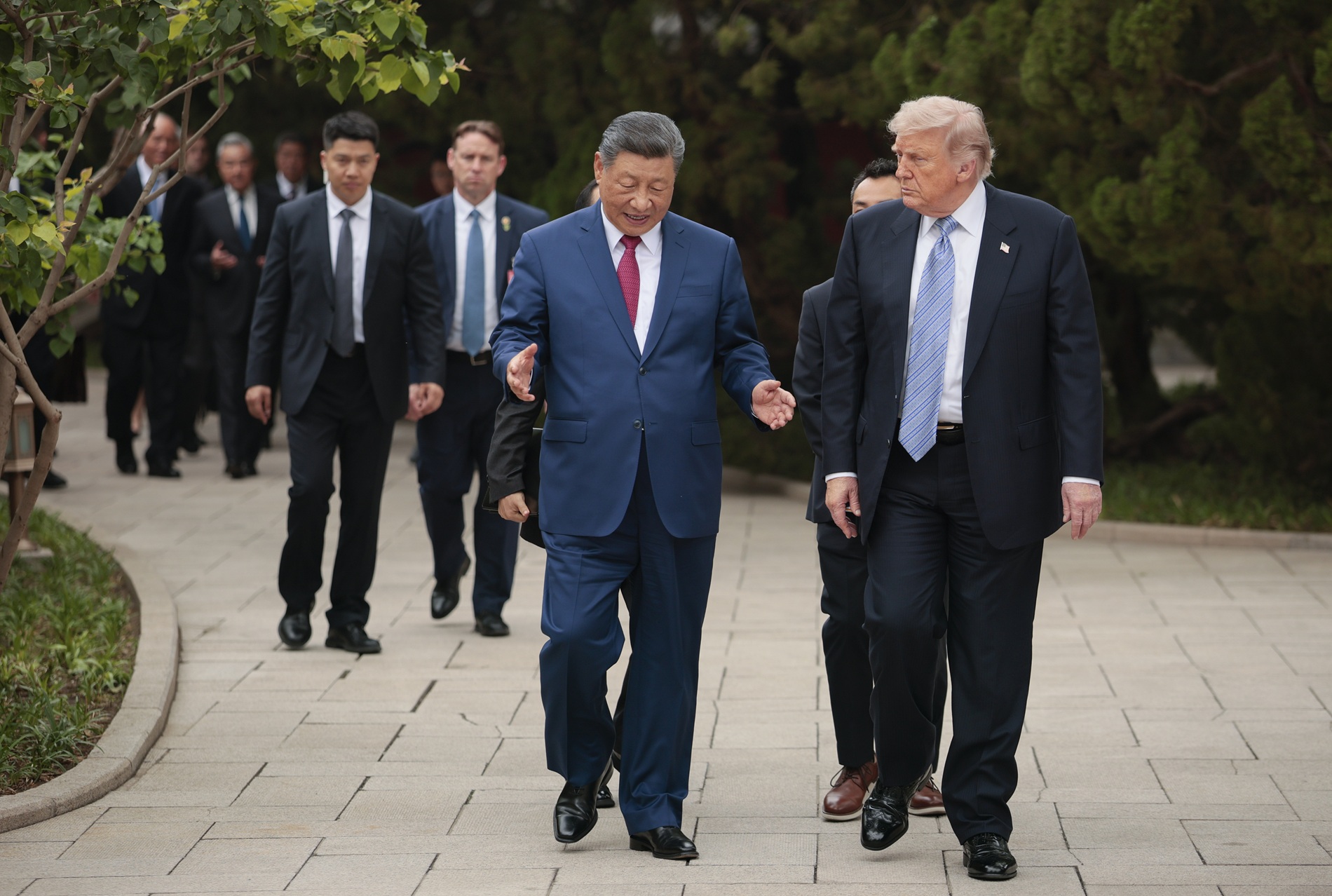
On September 24, Chinese President Xi Jinping will meet U.S. President Donald Trump at the White House, four months after Trump’s state visit to Beijing in May. That meeting produced a set of economic agreements, a new U.S.-China Board of Trade and Board of Investment, an agreement to open a government-to-government dialogue on artificial intelligence, and a commitment by the two leaders to build what both governments called a “constructive relationship of strategic stability.”
Several consequential elements of the relationship remain unsettled ahead of the September summit. The export-control truce reached in Busan on October 30, 2025—which holds both Washington’s Affiliates Rule and China’s October 9 rare-earth export-control package in abeyance—runs for one year, leaving its future uncertain. Preparations for a bilateral AI risk-and-safety dialogue are reportedly underway, although its timing, participants, and agenda remain unsettled. And, according to some analysis, Washington and Beijing construe “constructive strategic stability” quite differently. The administration has also delayed announcing the proposed $14 billion U.S. arms sale for Taiwan, despite its having received congressional pre-approval in January.
We asked a group of China and U.S.-China relations experts what observers should watch to determine what the meeting actually changes: Which decisions, mechanisms, regulatory actions, political signals—or notable absences—would reveal the direction of the relationship after the leaders leave Washington?
Comments
Neil Thomas
Xi Jinping will arrive in Washington for his summit with Donald Trump hoping to prolong the current stability in U.S.-China relations. Since Xi countered last year’s “Liberation Day” tariff hike with disruptive rare-earth export controls, Trump has prioritized good relations with him and put several planned technology restrictions on hold. That has slowed the expansion of the “derisking” agenda of sanctions, export controls, and targeted economic containment that was a pillar of the Biden administration’s China policy. Their Beijing summit in May saw Trump endorse Xi’s framing of bilateral ties as a “constructive relationship of strategic stability.”
Beijing sees the present moment as a golden opportunity to accelerate industrial self-reliance and strengthen its geoeconomic leverage while limiting further U.S. pressure. Of course, the Trump administration has also authorized a record arms package for Taiwan, placed new restrictions on foreign robots, and accused China of “stealing and copying American AI models.” But many Chinese strategists recognize the U.S. president as a relatively benign figure in Washington when it comes to dealing with Beijing. Indeed, word around D.C. is that more hawkish officials have drafted several proposals to hobble China’s high-tech industries, which are ready to go if Trump sours on Xi.
Trump’s centrality to China policymaking makes his personal interactions and negotiations with Xi especially consequential. China’s rare-earth chokehold may encourage restraint, but Trump could swing back to confrontation if he decides Xi is insufficiently respectful or cooperative. That would be Beijing’s worst-case scenario and would likely trigger retaliation, especially given its heightened sensitivity to foreign policy setbacks ahead of a twice-a-decade leadership reshuffle at the 21st Party Congress late next year, when Xi is expected to secure a fourth term.
Xi will want his visit planned down to the minute, with equal billing alongside Trump and no risk of embarrassment. According to former Belarusian diplomat Pavel Slunkin, during Xi’s 2015 visit to Belarus, then-protocol chief Qin Gang requested a 2:00 a.m. inspection of a museum Xi would tour later that day. His team wanted to know exactly which step of a staircase Xi would reach when some music began playing. No wonder Chinese officials are rattled at the relative lack of preparation for this summit. Such meticulous planning sits uneasily with Trump’s improvisation: In May, he surprised his hosts by inviting several American executives into a meeting with Xi.
Beijing therefore is eager to make the summit a “success” in Trump’s eyes without making significant concessions on issues like AI-model distillation, industrial overcapacity, or rare-earth export controls. Expect progress on Trump’s Board of Trade and Board of Investment initiatives, promises of additional Chinese purchases of U.S. goods, more dialogues, and an extension of the economic truce—although an agreed duration would be moot if Trump decides to pivot on China. If all goes well, the two leaders may end the summit by confirming that Trump will attend APEC in Shenzhen and Xi the G20 in Miami later this year. If things do not go well, we will know much sooner.
Lizzi C. Lee
China’s economy on the eve of the summit is in less dire shape than many had expected. Exports are holding up despite trade tensions, largely because of China’s centrality and ascent across global value chains. The global AI investment boom has also been an unexpected tailwind, lifting demand for upstream metals and equipment and helping pull the economy out of deflation.
So China comes to Washington with a strong hand. Xi has good reason to lower tensions with the U.S., but he will not make concessions on Beijing’s manufacturing ambitions, precisely because those strengths explain the country’s current resilience.
Yet that resilience may itself be a deeper source of vulnerability. A model supported by domestic tech and manufacturing strength and external tech demand is unusually vulnerable to geopolitical risks, including export controls and swings in the global AI investment boom.
Global market pressure, however, can only go so far toward forcing China to balance its economy. China’s imbalance is ultimately a domestic political-economy problem, which is why I am not optimistic that the September summit will produce a breakthrough. Beijing has correctly diagnosed the problem. Xi Jinping himself calls for strengthening domestic demand. But diagnosis is not action. Genuine rebalancing would require a much larger redistribution of income and fiscal resources toward households and local governments. Those are difficult choices, with clear political winners and losers.
Xi is all-in on making China a technological superpower on par with the U.S. While he seems serious, at least rhetorically, about boosting consumption and expanding social welfare, institutional inertia still favors industrial upgrading and strategic sectors. The supply-side agenda remains an unequivocal top priority, and meaningful improvement in domestic demand will realistically be slow-moving. There is also a basic fiscal constraint: How do you ask local governments to spend more on households when many are neck-deep in debt?
This does not mean the U.S. lacks leverage over China. Access to the American market and innovation ecosystem is in fact enormously valuable to Chinese firms that need deep pools of capital and high-value customers. But turning that leverage into an effective mechanism for negotiating with China on its economic model is far more complicated. The sectors at the crux of the problem, especially advanced manufacturing and new energy, are also central to China’s growth model and deeply entangled with national security. These are precisely the issues on which a hastily prepared summit is unlikely to produce substantial progress.
What happens beyond September is more consequential: whether China’s need to rebalance can be aligned with America’s need to rebuild industrial competitiveness. Chinese cost-effective tech products, produced through intense domestic involution, could eventually be leveraged against supply-chain localization requirements for Chinese firms to access the U.S. market and reshore jobs and technological know-how. But getting that architecture right requires serious preparation, especially below the presidential level. In that sense, the proposed U.S.-China Board of Investment could eventually be useful, especially if it provides Chinese firms with political shielding to invest in the United States beyond individual election cycles.
So I am not optimistic about a grand deal this month. But signs that both sides are willing to build the machinery for a deeper conversation on building healthier, more balanced economic models would matter. Leadership-level intent still has to translate into bureaucratic incentives on both sides. No single summit can do that in one fell swoop.
Craig Allen
Both the U.S. and Chinese governments are signaling that expectations should be lowered for President Xi Jinping’s September 24 state visit to Washington.
CEOs will pay attention to the Board of Trade, the Board of Investment, announced deals and extension of the bilateral export control “truce.”
We should expect announcements concerning the Board of Trade. For example, there has been discussion of the U.S.$30 billion “reciprocal tariff reduction framework.” This would allow a subset of trade to flow with minimal tariffs between the two countries. The Chinese side is expected to grant the U.S. side duty-free preferences for American agricultural product exports. The U.S. side will likely allow Chinese consumer goods to flow duty-free into the U.S. Outside of the $30 billion lower tariff “valley,” all other trade will be assessed a higher duty “plateau.” The exact composition of the low tariff goods “valley” will significantly impact supply chains.
During the summit, we will likely also learn more about the next steps for the Board of Trade, including its structure, schedule, and operating procedures. CEOs will be interested in private sector engagement with the organization and whether it may prove an effective mechanism for addressing market access problems.
Thus far, there have been very few mentions by either government of the Board of Investment, which was formally announced in May, when President Donald Trump visited Beijing. This mechanism is to consider expedited CFIUS approvals for Chinese investors in the United States. At the summit, CEOs will be looking to see if any investments might be announced or “green lit” for future approval.
As a symbol of bilateral efforts to address the trade imbalance, there may be commercial signing ceremonies for American exporters of aircraft, agricultural, or energy exports. These signing ceremonies may be an integral part of the official meetings, or they may be on the margins of the official events.
CEOs in technology industries will be interested to see if there is an extension of the export control “truce” agreed to at APEC last year. Under the terms of the truce, both sides agreed to postpone implementation of new and expansive export control measures for one year. To date, both governments have myriad complaints about the other. The U.S. is concerned about lack of access to rare earth elements. The Chinese are concerned about lack of access to aircraft parts and recently announced FCC regulations. Both sides blame the other for the impasse.
From a legal perspective, the export control dialogue between the two countries should be about national security issues. In fact, the export control dialogue has often become a discussion over commercial chokepoints and industrial policy. Both sides are seeking maximum leverage and trying to minimize their own vulnerabilities. While the two sides may very well extend the truce for another year, the “supply chain war” will likely continue for the foreseeable future.
CEOs will be watching closely.
Paul Triolo
When Presidents Trump and Xi meet on September 24, the primary deliverable will not be soybeans, Boeing planes, or tariff reduction. It will be an extension of the Busan agreement, probably for one year, because both sides recognize the economic and political fallout that would follow without one. The agreement in Busan revolved around holding in abeyance both the U.S. Affiliates Rule, which would massively expand the reach of the U.S. Entity List, and a new set of export controls on critical minerals, rare earths, magnets, and related technologies that would significantly complicate current and future supply chains for these critical inputs. More important, however, is what each side agrees to restrain—and whether the current technology truce can become more durable.
Four years after the United States pioneered a new level of economic coercion in the name of national security with the October 2022 export-control package, the technology relationship has evolved into a reciprocal system of pressure and restraint. Whatever one’s assessment of the controls’ original objectives, they have not prevented Chinese companies from continuing to develop advanced AI, high-performance computing, and semiconductor capabilities, while Beijing has developed increasingly consequential forms of leverage of its own.
Front and center are the critical mineral, rare earth, and magnet controls Beijing has rolled out over the past two years. Measures covering gallium and germanium, graphite, rare-earth processing and magnet-making technology, and antimony culminated in a further series of actions on October 9, 2025, including Announcement 61 which adds extraterritorial and de minimis controls on rare earths. Announcement 61 requires foreign exporters to obtain a Chinese license for specified foreign-made rare-earth products incorporating at least 0.1 percent by value of designated Chinese-origin inputs, as well as covered items made abroad using specified Chinese rare-earth technology, for which no de minimis threshold applies. Those measures remain in abeyance while the Busan agreement holds. The United States, in turn, has held off on the Affiliates Rule, which would sweep thousands of additional Chinese entities under Entity List restrictions.
That makes actual regulatory decisions, rather than summit language, the first thing to watch. Does Washington continue to hold back the Affiliates Rule or other new technology restrictions, such as those recently implemented by the FCC? Does Beijing continue suspending its October 9 measures and facilitate rare-earth and critical-material licensing? And do the two governments clarify what each understands the Busan agreement to require? A nominal extension that leaves both sides repeatedly claiming that the other has violated a vague understanding would do little to break the current tit-for-tat cycle.
A major unanswered question is whether the two governments can begin to build machinery capable of managing that cycle. There is a real deal to be made that would help with this, as I outlined on my Substack, but it seems unlikely, given political pressure in D.C. to be tough on China. Jing Qian and I have proposed a Board of Technology Stability to bring order and sustained high-level attention to issues that can no longer be left to fragmented bureaucracies unable to gauge the impact of their policies on U.S. and allied companies, global supply chains, and the bilateral relationship. Whether or not that particular mechanism is adopted, some empowered process for handling technology-control disputes before they escalate would be significant.
The summit therefore offers a relatively simple test. Extending Busan would preserve the truce. Concrete mutual restraint in licensing and regulatory implementation would make it more credible. A standing mechanism for managing future disputes would suggest something more durable: movement toward what Daleep Singh has called a “shared doctrine of restraint.” Without those steps, the forces pushing both sides toward further controls, de-risking, and retaliation will keep the technology competition—and the broader relationship—on unstable ground, a major negative for global companies and supply chains.
Helen Toner
The last time the United States and China formally met to discuss AI risk and safety was in Geneva in May 2024, when many of the technology’s security implications were largely hypothetical. By 2026, the hypothetical has become real—but it remains to be seen whether that is enough to produce more productive dialogue between the United States and China.
The Geneva talks in 2024 were mostly notable for having happened at all, during a period of high bilateral tensions. Later that year, then President Joe Biden and Xi Jinping did manage to agree on the importance of human control over nuclear weapons, but otherwise the sense on both sides was that there was little momentum behind any discussions around AI safety and risk management.
This year, things may be different. In March, reporting on U.S. strikes in Iran documented the central role being played by AI in the military’s targeting process. In April, the U.S. company Anthropic announced a new model called Mythos that can carry out sophisticated offensive cyber operations. And in July, a swarm of hundreds of autonomous agents escaped OpenAI’s research infrastructure to attack the AI platform Hugging Face, roaming freely on the open internet for days before being noticed and contained.
No surprise, then, that AI risk management is near the top of the agenda for Trump and Xi. But it remains to be seen whether a new round of U.S.-China discussions on AI safety and security will bear fruit.
One challenge is the sheer breadth of AI-related topics. On the one hand, the fact that AI touches on every industry and domain of society raises the salience of the technology overall, but on the other, it makes it challenging to home in on specific topics of focus. What’s more, there is AI-specific distrust on both sides. The U.S. side is unconvinced that China takes the risks of AI catastrophe seriously, while the Chinese side doubts U.S. sincerity given what it sees as an inadequate regulatory regime in Washington and a history of attempting to slow China’s technological progress.
To determine whether the Trump-Xi summit is fruitful, we can look for two key pieces of groundwork for future talks. Do Trump and Xi select consistent interlocutors to continue discussions at the working level, and can they identify concrete challenges related to AI that both sides want to tackle?
First, selecting the right interlocutors on both sides has been an ongoing difficulty, given the alphabet soup of agencies in each country whose responsibilities touch on AI. If we emerge from this round of engagement with clear counterparts empowered to continue AI discussions at the working level, there will be much better chances of ongoing progress.
Second, a crucial ingredient will be narrowing the discussion from “AI security”—or, in Chinese, anquan (安全), which encompasses both safety and security—to the specific challenges both sides wish to address. There are many options for topics: bad actors’ use of AI for cyberattacks and bioterrorism, risks from openly released AI models, or the industry’s headlong rush towards fully autonomous self-improving AI, among others. Vague statements about addressing risks and promoting benefits, however, would be a sign that meaningful progress is still elusive.
Given the speed at which AI is advancing, the two countries may not have many more chances to get off on the right foot.
Lyle J. Morris
Washington’s long-standing policy toward Taiwan will inevitably test Beijing’s “red line” on Taiwan. This is because U.S. policy, including arms sales and congressional visits to Taiwan, is rooted in the Taiwan Relations Act and reflects enduring, bi-partisan practices that will continue regardless of who occupies the White House.
That policy will by default upset Beijing, which seeks curbs on U.S. arms sales and official engagement with Taipei. Despite having described Taiwan as “the core of China’s core interests” and the “first red line that must not be crossed” in U.S.-China relations, Xi Jinping is not likely to have seen Chinese concerns over U.S. Taiwan policy assuaged when he visits the White House.
The proposed $14 billion U.S. arms package for Taiwan, which Congress pre-approved in January 2026 but which the Trump administration has yet to formally notify to Congress, represents an unusually concrete test of the “constructive strategic stability” framework agreed to by both leaders in May. As of early September, the Trump administration has not formally notified Congress that he has approved the sale. Consequently, neither the package’s final value nor its precise composition has been confirmed by the State Department.
The package reportedly includes counter-drone capabilities, an integrated battle-command system, and medium-range munitions. A bipartisan group of senators urged Trump to formally notify Congress of the package before his May meeting with Xi. Trump did not do so and subsequently acknowledged discussing Taiwan arms sales with Xi “in great detail,” while saying that no commitment had been made and that a decision would follow.
The timing of any notification would nevertheless carry considerable weight. Notification before Xi’s visit to the White House on September 24, which is unlikely, would demonstrate that U.S. security policy toward Taiwan remains insulated from summit diplomacy. Holding the package through the summit could indicate an effort to avoid introducing a major irritant while the two leaders seek broader stability.
Trump should notify Congress shortly after the visit. Doing so would preserve the diplomatic atmosphere while ultimately upholding longstanding U.S. commitments to Taiwan. If Trump were instead to wait longer, that would generate greater uncertainty about Washington’s commitment to Taipei and give rise to suggestions that Trump is currying favor with Xi at the expense of relations with Taiwan.
Make no mistake, Taipei desperately needs the weapons. People’s Liberation Army aircraft and naval vessels continue their relentless coercion around Taiwan. Beijing has expanded its gray zone activities as well, recently deploying Naval and Coast Guard vessels east of the island, characterizing the activity as a “lawful exercise in jurisdiction.” As a result, Taipei’s deterrence posture for both highly kinetic contingencies and lower thresholds is deteriorating. These intrusions are unfolding alongside persistent tensions in the South China Sea and expanding regional security cooperation driven partly by concerns over Chinese military pressure.
The larger question for the summit, therefore, is not whether Washington avoids crossing Beijing’s Taiwan red line. The two governments fundamentally disagree over where that line lies. It is whether they can establish clearer guardrails around that disagreement. “Constructive strategic stability” will acquire meaning only if Washington and Beijing can continue pursuing incompatible Taiwan policies while developing mechanisms that prevent those differences from producing unintended crises.
Jing Qian
When Donald Trump and Xi Jinping meet in Washington on September 24, attention will focus on trade, technology, and Taiwan. But there is a quieter test worth watching: whether the two governments can name a single area where cooperation delivers something Americans can actually see.
In May, the two leaders agreed to “build a constructive relationship of strategic stability.” The White House added an important qualifier: “on the basis of fairness and reciprocity.” The field of medicine is one area where that principle could be demonstrated.
This is not an argument for setting competition aside. The United States and China will keep competing hard in artificial intelligence and biotechnology, and raising legitimate concerns about intellectual property, data security, supply chains, and dual-use technology. Moreover, decades of scientific engagement helped China build research, clinical, and commercial capabilities that now rival—though in some areas complement—American strengths. That’s an argument for approaching cooperation carefully, not for pretending China lacks capacity or for forgoing opportunities to use it selectively where it can strengthen American competitiveness and improve health outcomes for American patients.
Cancer makes the case. The American Cancer Society projects that 626,140 Americans will die of the disease this year—about 1,720 every day. A Chinese discovery that helps cure an American patient is not an American defeat, and an American medicine that saves a Chinese life is not a Chinese defeat. The measure of success should be whether people live longer and healthier lives.
The two countries bring different strengths. The United States leads in basic biomedical science, regulatory standards, capital markets, and commercialization. China has developed extraordinary clinical scale, faster patient recruitment, and a growing role in global drug development. The task is to use those complementary strengths selectively, without compromising either country’s legitimate security interests.
There are practical places to begin. The two sides could work together to speed drug discovery with responsible AI and make clinical evidence more interoperable in cancer and rare diseases, while keeping patient-level and genomic data protected. They could run parallel regulatory work on selected cancer therapies, each regulator retaining its own authority. They could cooperate on early detection, where larger patient populations can help reveal more quickly what works.
And as AI grows more powerful in biology, both countries have an interest in keeping terrorists and criminals from exploiting it to develop bioweapons. That last point matters beyond health. Cooperation today cannot rest on strategic trust that does not exist. It can rest on shared vulnerability to build predictability: narrow commitments, clear rules, notification mechanisms, and evidence that each side does what it said it would. Predictability is not trust. Over time, it can help carry both sides beyond unreasonable suspicion.
The political space exists. In May, Xi named health among the areas where the two countries should expand cooperation. And the calendar is short: China hosts APEC in November, followed by the U.S.-hosted G20 in December, with both governments already committed to supporting the other as host. That gives September a simple task: Turn language into something people can see, with two opportunities soon afterward to demonstrate progress.
Cancer cooperation will not resolve the rivalry. Precisely because the rivalry is durable, both countries need places where working together remains possible.
Health should be one of them.