



The form is built to leave you no exit. An episode runs sixty to ninety seconds and ends on a reversal: the woman everyone underestimated is revealed to be an heiress, the janitor is secretly the richest man in the country, the slap lands, and the camera holds on the face of the person who will, four episodes from now, be made to pay for it. To learn what happens, you need to unlock the next episode, and then the next. Two hours are gone before you notice.
This is Duanju (短剧), or micro-drama. It originated in China, and it is fast becoming one of the most profitable entertainment industries on Earth. In 2025, it generated approximately $14 billion and reached roughly 700 million viewers, according to Chinese state media. In 2026, driven by mass-scale generative-AI production and aggressive global expansion, the industry is expected to clear $16.5 billion in revenue. As with other entertainment sectors, micro-drama has been written into the development plans of many Chinese local governments, with supportive policies attached.
Outside of China, the United States leads the international market with $1.5 billion in revenue and the industry is booming in South Korea, in India, across the Middle East, and far beyond. It is tempting to read this as a new kind of cultural export, something distinct from manga or K-pop—or, more skeptically, as the export of a business model: compared to traditional film and television, micro-drama is cheaper to produce, quicker to turn around, offers rapid market feedback, and is easy to localize. Both readings are true. Both miss what is actually being exported.
Micro-drama is indeed exporting a business model. But behind the model lies something else: a delivery system for engineered catharsis, served fast. The powerless rescued by the powerful, the poor lifted by the rich, grievances answered with satisfying speed. And such catharsis is never ideologically neutral.
Critics of the form have a name for the story it keeps telling: the “asymmetric exchange fantasy.” The audience is invited to identify with vulnerability and is then rewarded with rescue. Not the rescue of collective effort or structural repair, but deliverance by a wealthy, benevolent patron who descends to set things right. The power structure is left intact, waiting only for the protagonist to climb within it. Hierarchy is not critiqued so much as celebrated, provided it ultimately bends toward the protagonist’s relief. The values embedded in these resolutions tend to be paternal, authoritarian, and heteronormative. The fantasy never asks whether a world organized around powerful patrons is just; it simply waits for the patron to arrive and leaves everything to him. That is a politically convenient thing for a story to teach. The most troubling thing is how easily these resolutions are slotted into nearly every cultural context.
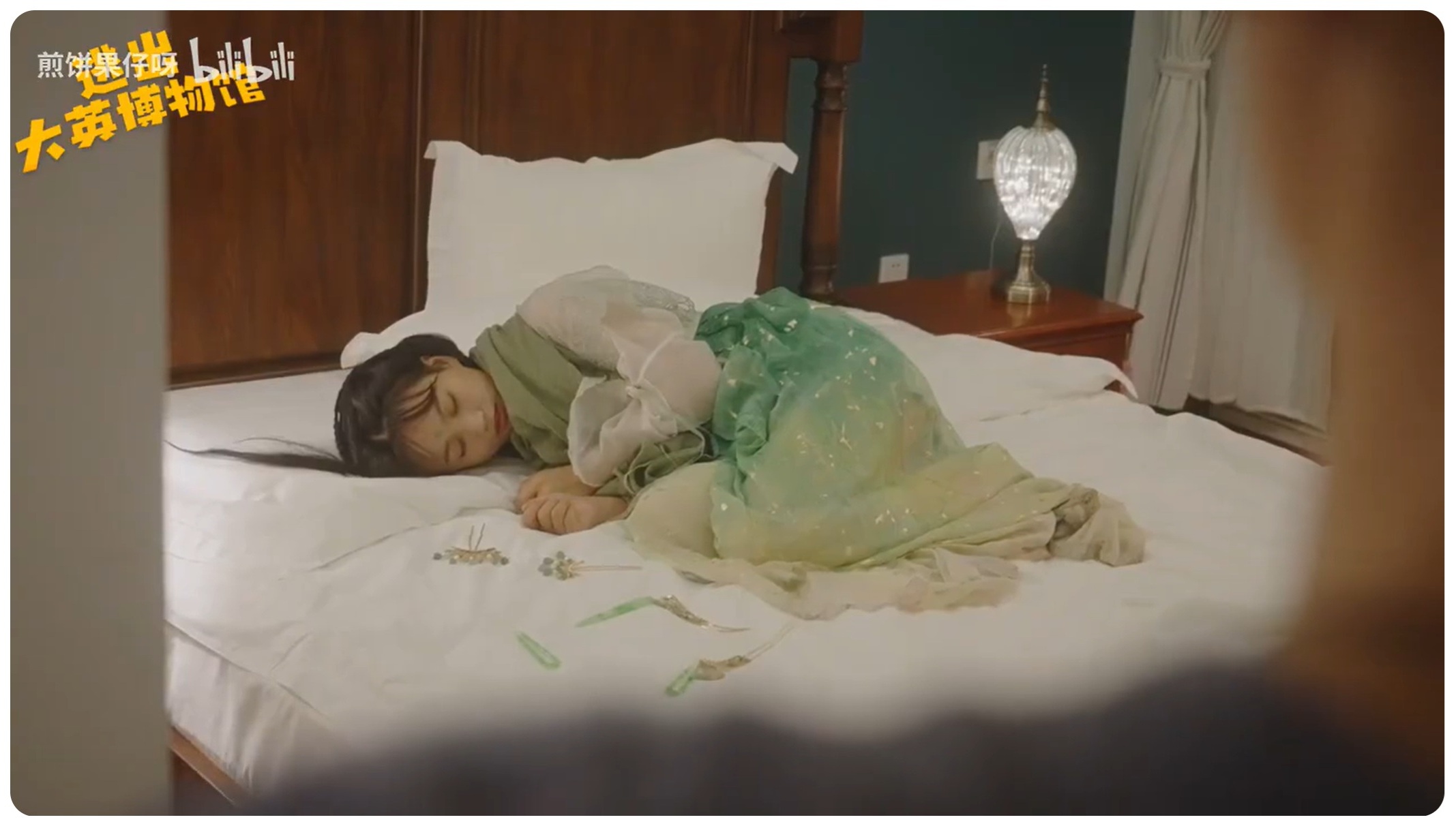
A screenshot of a trailer for Escape from the British Museum.
Back in China, where the industry originated, the state has built a system in which the industry polices itself. In June 2026, China’s National Radio and Television Administration, the country’s top media regulator, launched a campaign against vulgar, harmful, and pirated micro-dramas, targeting eight categories of offense: material harmful to children, suggestive scenes, the flaunting of wealth, distorted views of marriage, feudal superstition, violent revenge, sensationalist titles, and copyright violations. But the regulator did not draw the red line itself. Earlier this spring, Hongguo, the country’s leading micro-drama platform, had already pulled more than 20 thousand titles on those grounds. The regulators expect platforms to self-regulate and enforce compliance internally, effectively assuming part of the regulatory function themselves. Platforms therefore act as both gatekeepers and enforcers: reviewing content before release, screening for violations such as prohibited uses of generative AI and copyright infringement, and conducting their own regulatory checks before the state formally orders rectification. Creators have learned to anticipate too, gravitating toward the themes the state is known to reward. In 2023, when the industry was still in its early rise, Escape from the British Museum stoked nationalist feelings with the story of a Chinese journalist who helps a jade vessel—personified as a young woman—find her way home. Because a lost artifact’s return to China dovetails so neatly with the “rise of a great power” narrative the Party-state has worked to cultivate, the production drew praise by name from major state media as an act of spontaneous patriotism. No one had to commission the loyalty. The incentive structure produced it.
The result of this capture is a narrowing of what a micro-drama can be about. It is never quite a work of art; it is a catharsis machine designed by the state, distributed by the platforms, and built to convert the idle attention of ordinary lives into consumerism. A daughter cast out by her family discovers she is an heiress. A dismissed employee returns as the company’s new boss; the polished boots she wears as she runs through the rain and the gold-rimmed glasses he wears on his return are both available through the platform’s shopping links. As the domestic market reaches saturation, Chinese platforms are extending the audience’s obsession with micro-drama into e-commerce, turning every emotional twist into an impulse to buy whatever the heroine is wearing. Each episode now embeds direct shopping links to identical earrings, dresses, or accessories, shifting the object of consumption from content itself to physical commodities.
Nothing throws micro-drama’s logic into sharper relief than the industry it is displacing. China’s micro-drama market now generates more revenue than the country’s box office—a shift due in part to longstanding problems in the film industry, including censorship. What gets made in China’s film industry depends as much on capital and political connections as on the audience demand reflected in box-office returns. Against that, micro-drama is cheaper, faster, and frictionless to monetize in a digital economy. To some degree, it remains an open, fair game: production teams without formal training can now use AI to generate and test storylines quickly, tracking engagement data to learn exactly what keeps an audience hooked. It is indeed state-captured, but hyper-capitalist at the same time.
Micro-drama is not the first Chinese digital cultural product to make inroads overseas, and the repetition of this trajectory reveals a broader pattern. The video-game industry charted the course first: a period of regulatory vacuum and abundant capital fueled explosive growth; the state then intervened with tighter controls; and as the domestic market became constrained and uncertain, firms turned outward. Once foreign markets demonstrated commercial viability, the government adopted a position of conditional support, promoting international expansion while holding clear regulatory and censorship lines. Micro-drama is following a similar arc, though its outward movement has been driven less by regulation than by saturation at home.
What travels along that path, however, is fundamentally different. A game like Black Myth: Wukong exports cultural content, demonstrating that even a flattened version of Chinese mythology can spark curiosity about the traditions and culture it draws from. Micro-drama, by contrast, exports less of a recognizable cultural product than a scalable digital business model whose cultural content is often deliberately ambiguous. Its localized vampire-and-werewolf adaptations of the familiar Chinese micro-drama trope—the “domineering CEO falls for me” storyline—operate in the opposite direction from Wukong: they obscure their Chinese origin, letting audiences consume the fruits of a Chinese mode of cultural production without ever recognizing it as Chinese.
This is why micro-drama is hard to classify as soft power in the manner of manga or K-pop. Rather than cultivating attraction through a visible national or cultural identity, it disseminates production logics, narrative formulas, and consumption habits. Its obvious shortcomings, like contrived plots, over-the-top characterization, crude production, and, increasingly, AI generation, have done nothing to dampen the appetite for it. As Tommy Harper, a former film producer who left Hollywood for the micro-drama business, puts it, these new studios are not competing with Netflix. They are making a different product.
In China, micro-drama viewership cuts across every demographic. You will find retirees and burnt-out white-collar workers hunched over their phones, squeezing in episodes between errands, commutes, and lunch breaks. The habit did not originate with micro-drama, though. The earlier short-video era had already trained users to consume complete narrative arcs in under three minutes. In the beginning, micro-dramas were often embedded within those existing short-video ecosystems: some scrolling Weibo or Douyin might click, almost inadvertently, on a Hongguo link.
In the U.S., the micro-drama platform Quibi launched in 2020, and then quickly shut down. Unlike Hongguo, Quibi adopted a conventional streaming model, charging a flat monthly subscription fee of roughly five to eight dollars upfront, before the viewer had seen anything. It failed—undone by unclear market positioning, the absence of social mechanisms, and, perhaps more obliquely, the black-swan shock of the pandemic.
The same product has since arrived under a very different logic, through apps like ReelShort, FlickReels, and DramaBox. Rather than requiring an upfront commitment, these platforms give away the opening episodes for free and monetize suspense itself: audiences pay incrementally, episode by episode, at each cliffhanger—sometimes spending up to $80 per month—to find out whether the heroine finally gets her revenge.
Apart from the different monetization model, when micro-drama crossed into the American markets, it carried its emotional architecture intact and found an audience hungry for it. In the United States, the genres that top the charts are still billionaire romances, revenge arcs, and alpha-male fantasy, but with local skins—werewolves, vampires, supernatural romance—grafted on. Unlike in China, where viewership splits fairly evenly between men and women, these dramas have found their largest following among 25-45-year-old women.
From Our Flash Marriage: Mr. Fu’s Secret Identity to The Double Life of My Billionaire Husband, a romanticization of male protection and rescue that, whatever its cultural specifics, rhymes unmistakably with the structure micro-drama has refined. It is tempting to file this under the “trad-wife” revival, another postfeminist fantasy of submission and protection. But that reading is too clean. Micro-drama does not sell domestic submission so much as a contradiction: hypergamy alongside the heroine’s absolute emotional centrality, revenge against the neglectful man alongside her eventual romantic enclosure by him. The genre is engineered to probe human nature, and nobody wants a trade-off. That refusal, not submission, is what the audience is paying for.
Overseas micro-drama is no longer merely a derivative of Chinese culture, or even just a Chinese business model. Different habits of consumption, different commercial logics, and different institutions have turned the micro-drama—Chinese in origin—into an industry of micro-drama all its own abroad.
But the continuity beneath that divergence is the more unsettling point. The machine the Chinese state found so readily amenable to nationalist sentiment is the same one American algorithms fill with a different emotional charge. In both cases, it yields a similar engineered effect: a structured catharsis that produces the conviction that rescue is imminent, that the right, powerful figure will eventually arrive, and that systemic change is unnecessary so long as benevolent patrons intervene, be they theocratic or political leaders, business magnates, or tech moguls.
The catharsis may have been refined in its contemporary form within Chinese production contexts, but the desire it mobilizes appears far more universal. Once governments, technology firms, and financial capital fully enter and scale up this industry, that accelerated, engineered catharsis will be available to any real-world patron it is aligned with. Audiences will still believe that ordinary people can mount their counterstrike against the wicked in the span of a minute and a half. Only in that iteration, the narrative will no longer offer a reversal for the protagonist.