


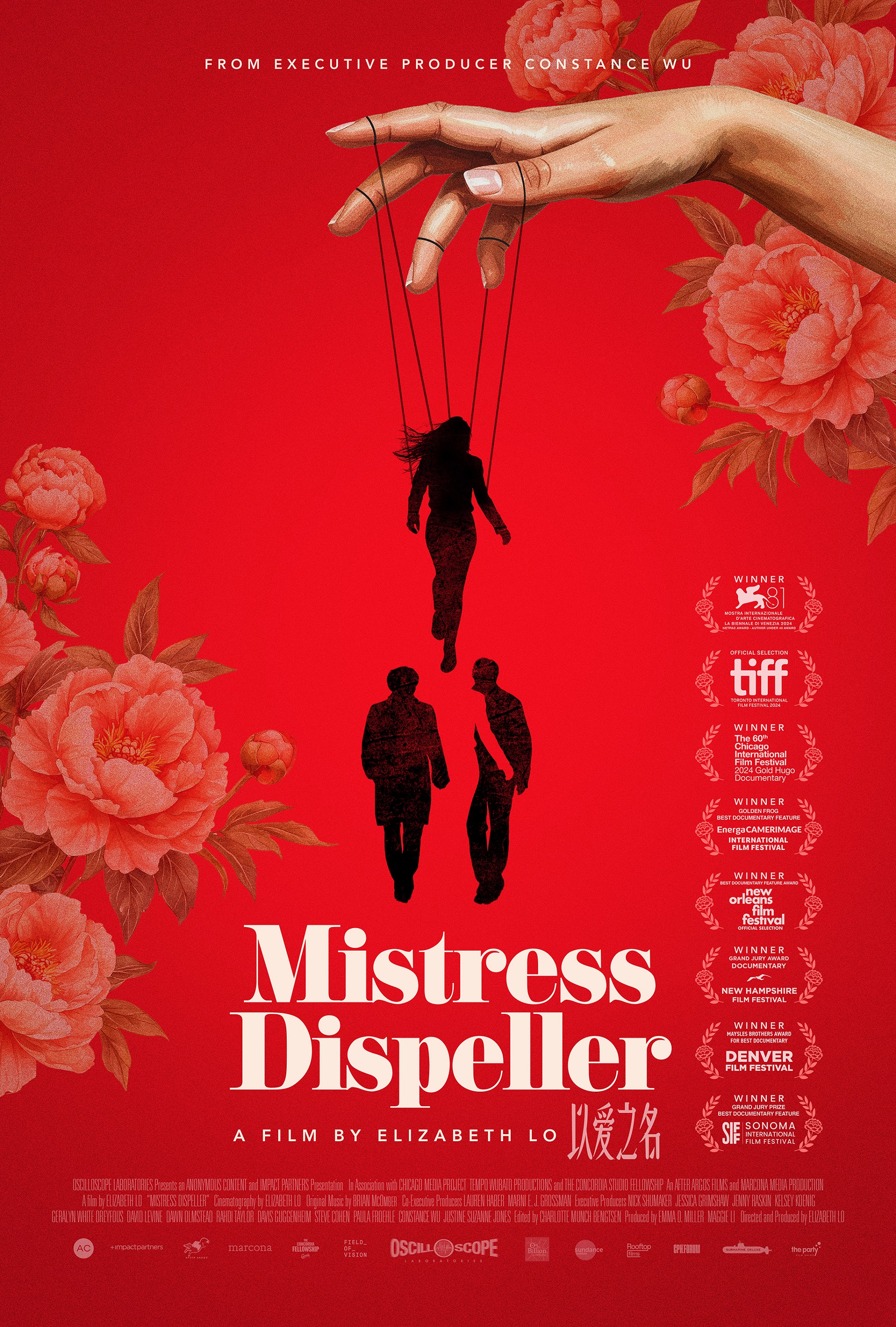
The new documentary feature film Mistress Dispeller probes the unraveling and redemption of a marriage at breathtakingly close range. Director Elizbeth Lo follows Teacher Wang, a professional “mistress dispeller,” as she counsels a middle-aged wife undone by her husband’s infidelity and unspools a covert plan to rid them of his lover. The film is currently playing at the IFC Center in New York through October 30. ChinaFile’s Susan Jakes spoke with Lo about how she made the film. Their conversation has been edited for length and clarity.
Susan Jakes: How did you come to make this film?
Elizabeth Lo: After making my first feature documentary, Stray, which was set in Turkey and follows the perspective of stray dogs as they wander through Istanbul—that was such a revelatory experience for me to get to know a culture that was so different than my own—I knew that I wanted to set my second feature-length documentary in mainland China. As a Hong Kong citizen, mainland China is both foreign but also really close to my own heritage. I wanted to use the documentary as a way to explore this culture and country that’s so vast and so relevant to my own life. . . I had spent quite a lot of time in mainland China, but documentaries take you into a culture in a way that you can’t experience as just a normal, regular person without a camera.
I thought exploring love would be a really interesting way to get to know the country. And I had re-watched Zhang Yimou’s Raise the Red Lantern, in which [a character played by] Gong Li marries as a fourth wife into a patriarch’s family, and has to navigate the pressures of that.
And I thought it would be really interesting to pose the question of what it is like to be a woman navigating society today, and transpose the spirit of that film to contemporary China. So I was researching mistresses in contemporary China, and that’s how I came across the mistress dispelling phenomenon.
How did you find out about it?
I was researching mistresses in China and I came across articles about mistress schools. . . But then by the time I had asked my producer, Maggie, to look into this, they had all been shut down. But when I asked her to look into mistress dispellers, those actually existed, and there were plenty of them. And I remember at first thinking, you know, this could only be a fiction film when I read about it in the news, because access would be so difficult for a subject matter that’s so enshrouded in shame and secrecy. But Maggie was able to find real mistress dispellers for us to meet in our scouting trip to China, and Teacher Wang [the film’s main character] was the only one who, on day one of the scouting shoot, was able to get us access to film a husband, a wife, and a mistress who are all part of the same case, at its tail end. I was so moved by even the husband’s perspective, because he was crying at this table with Wang, that it really changed the focus of my film. It became much more inclusive, and I wanted to make it about, sort of, how people deal with the pain of being in a marriage, and also figuring out the problems of when love fades or when desire fades. And so that was really the impetus for making the film: To compassionately look at all three angles of a love triangle.
So that couple was not the couple that appears in the film?
No. We ended up following Teacher Wang for three years, hoping the whole time to be able to capture and authentically document a case from beginning to end. We filmed with at least six other couples in those three years who are not in the film. Mr. and Mrs. Li [who appear in the film] came in the third year, and [their story] was filmed over the course of four months. It took us so long to finally get because it’s just really difficult. There were always pieces of the love triangle missing, or people would drop out midway through filming. And we would, of course, respect that decision.
My producer Emma Miller and I were very conscious of how to stay ethical when deception is such a big part of the mistress dispelling process. [Initially] the husband and the mistress couldn’t have known what Teacher Wang’s role was in their lives, and so they had agreed to be in a film just broadly about modern love in China, and that’s what they had agreed to participate in.
Let’s back up a bit. So you first got Teacher Wang to say that she would kind of broker your relationship with her clients?
Actually, to alleviate the burden on her, we initially tried to cast ourselves for potential clients that we could bring to her and say, “Hey, we got their permission to film with them. Can you now fix their problem?” But what we found when we did that was those strangers, you know, wives or mistresses who had no idea who Wang was or her capabilities, they didn’t have the trust that her real clients had for her, and trust and faith in her work is such a big part of her effectiveness. So it just didn’t work. So then we were like, okay, we need to only rely on Wang’s incoming organic pool of clients and see. Out of hundreds of cases, usually it would be a handful who would agree [to be filmed]. And of those handful, it would really depend on the character of those people and whether they could compel you to feel sympathetic to each of their plights.
I guess Mrs. Li knew what you were filming, or understood that you were filming about mistress dispelling?
Yes, but actually by that point, as a backup plan we had filmed so many different other love industries in China, because we weren’t totally sure if we could get access to make a film about an individual story.
What are some other love industries?
We filmed a lot of matchmaking companies. We filmed with dating coaches who help young men. And then we filmed with divorce lawyers, because we thought maybe this would be the end of the process. We also even filmed with BDSM rope play communities in Shanghai. We were looking for textures and tangents around love and desire that might be able to bolster our story. So those were all the different tangents we went on in the event that we would not be able to get as deep access as we hoped to build this Rashomon around a love triangle.
By the time we got to Mr. and Mrs. Li, we had actually filmed with [Mrs. Li’s] little brother who had been a male mistress two years prior to production, and we had filmed with him as he was getting dispelled by Teacher Wang himself. And so two years later, when his older sister comes to him with her problem, he says, I have a great solution for you. You know this film crew are lovely, and then Teacher Wang is also a magician who will make your problem go away. So with that pre-existing vouch of approval and relationship with us through a trusted relative, Mrs. Li was on board.
Why do you think she wanted to be filmed?
We asked her, and it actually appealed to her altruistic side. Teacher Wang said to her, you’re struggling so much in private, and so many women struggle in private with this domestic issue, but if you share your struggle publicly, you may be able to help other families navigate with this situation. You can see her temperament in the film. She’s a brave, strong woman who’s very kind at the end of the day. And that really appealed to her, and I think that’s why she participated.
How did you film Mr. Li (the cheating husband) and his mistress (Feifei) without their knowing what was happening?
We didn’t have contact with them at first, it was Teacher Wang’s business partner who also kind of works in psychology who approached them, separately, and asked whether they would be part of a production that was about love and China—that’s what they [initially] agreed to. And our interactions with the wife, the husband, and the mistress were intentionally kept to a minimum because Wang didn’t want [us] to inadvertently sort of spill the beans to them or reveal too much to them and disrupt her mistress dispelling. At the end of the process, once everybody completely understood what Wang did in their lives, we traveled back to China and showed a cut of the film to each of them separately to sort of get their blessing and offer them the opportunity to reconsent to being a part of the project.
How do you understand why Mr. Li and Feifei were willing to be in the film?
With Mr. Li, I think he felt compelled to because of his wife. He knew that his marriage was struggling. So I think partly to save his family, he felt being a part of this project that his wife wanted to be a part of would help.
But with Feifei, we asked her at the end why she had agreed to be in this, and why she had stuck with it even as the relationship was falling apart. And what she said was so striking to me. She said that she thought that the film was going to be a gift from the husband to her, a document of their love story in which she was the central character. And she kept staying because she wanted to know how their love story would end or continue. She wanted to know what would happen. So I think, on a very deep level—and we don’t know what was said to her off camera by her lover—she didn’t think that she would lose to the 55 year old wife, and so that’s partly why she kept staying and wanted to see it through, because she didn’t believe that the relationship would come to an end.
When we started talking you said you knew you wanted to film in China. Did you think of yourself as making or having made a film that is about China or Chinese society?
People always ask me, could mistress dispelling [work] in the West or, you know, internationally, this business itself? And I’m of two minds. I do think on one hand, infidelity is universal. It’s a human condition. But I do think there is something culturally specific to mistress dispelling and why it thrives in Asia. I think that has to do with this difference between a culture which prioritizes the collective over the individual, the greater good of the family and keeping the family, preserving the family unit, versus in the West, a more individualistic culture where pursuit of your own personal happiness is paramount.
And that’s why mistress dispelling works, because in the West, I think if you found out your spouse was cheating on you, divorce would be almost the first resort. Actually a divorce lawyer said to me, “this plays like science fiction. I cannot believe that these scenes are taking place.” And also, a lot of men in the West will ask me, “why did the husband choose to stay? I don’t understand.” Whereas in Asia, it was never a question in the husband’s mind that he would leave his wife, because even if having a mistress is more socially acceptable, leaving your wife would make you human scum.
And yet divorce rates in China have risen dramatically in recent decades.
I think mistress dispelling is sort of a symptom and a response to enduring patriarchy. But also it’s a way that women, contradictorily, are empowering themselves to reassert fidelity within their own homes and reassert control in their families and demand fidelity. And I also think the way that at least Teacher Wang goes about solving a case and approaches conflict resolution does feel Asian to me in that it’s not directly confrontational, it’s very indirect, and it it’s trying to seek a harmony where everything is sort of simmering under the surface, but you’re allowing every person in the conflict to emerge unscathed.
Maybe one could say that it’s China, how innovation and the entrepreneurial nature of this industry collide with pragmatism and preservation of family in a way that allows the mistress dispelling phenomenon to thrive there. But I think as ethically murky and dubious as this profession can be, that there is something redeeming and beautiful about resolving a conflict in this way, in which nobody’s screaming. The cost is that there’s no accountability and no confrontation ever. But I do think there’s something really beautiful about an alternate mode of conflict resolution. I don’t know if that’s specific to China. The reason why I was drawn to this subject matter was not because it represented China, necessarily, but that I knew as a Hong Kong citizen to go and make a film in China in this day and age where there’s so much anti-Chinese sentiment in the West that I wanted to pursue subject matter that wasn’t going to further alienate China from Western audiences.
And so few documentaries that have gotten exposure in the West have explored just middle-class, ordinary people’s domestic lives in contemporary China. A love story involves universal emotions, and that was part of why I was drawn to this subject matter, as a person who is very conscious of what stories we tell that come out of China, that are consumed in the West, and what that does to the psyche in the West about China. So to me, the story of love and betrayal—even though there’s a strange profession that is handling it in a slightly different way than it would be handled in the West at the heart of it—these people, what they’re going through, it’s super universal. And that’s what drew me.