


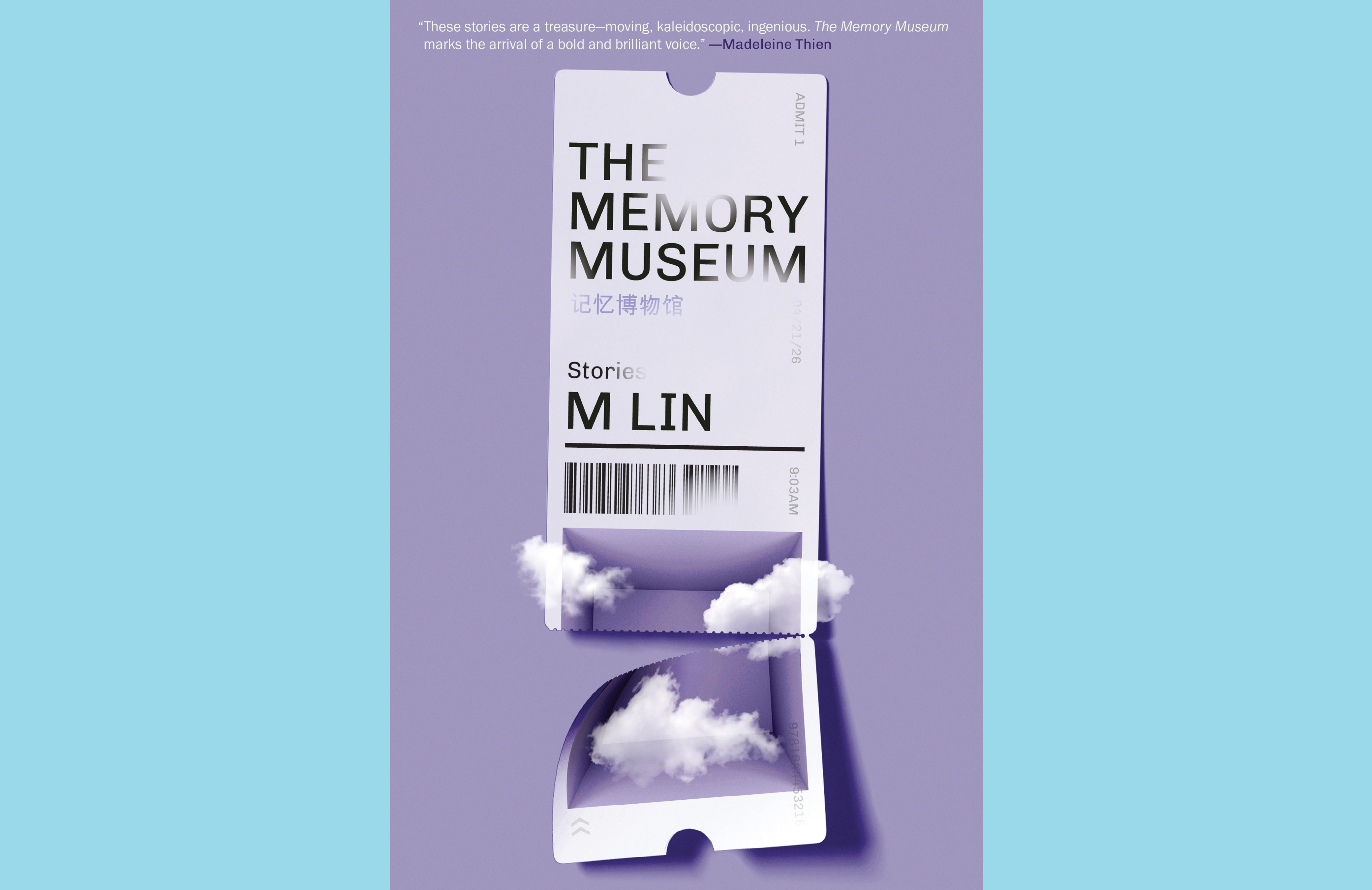
A few months ago, a book with a slightly torn ticket on its lilac cover began emerging on my Instagram feed. A small, faint Chinese translation of the title and the author’s last name, Lin, hinted it had something to do with China. I was intrigued because the cover had no trace of red, no stars or dragons, cranes or bamboo that scream CHINA!
The Memory Museum, 记忆博物馆, is a collection of nine short stories by New York-based writer M Lin. Some stories felt so real they read like nonfiction. They are, in a nutshell, about the collective experience of the generation of urban Chinese women who came of age in the late 1990s and early 2000s.
I had never read a book like this—about us—in either Chinese or English. It would not have passed censorship in China. Yet it’s nothing like the English-language literary fiction about China I’ve read in the past, which tends to be set in periods more familiar to the West, such as the Cultural Revolution. Some of the most established writers from China, Ha Jin and Yiyun Li for instance, write out of complicated political and personal relationships with a China distant from the one I have lived in. Reading The Memory Museum felt like reading my own life. It was almost alarming to find myself and my friends, our memories, feelings, and choices, laid bare like that.
The Memory Museum contains some of our most defining experiences of the past few years, a period of time marked by drastic changes in politics and society in both China and the U.S., with a pandemic wedged in between that split our lives into before and after, here and there.
In “Magic, or Something Less Assuring,” a young couple’s marriage is strained by the lockdowns in Shanghai during the Covid-19 pandemic. They travel to Morocco together after the lockdown lifts. Both educated in the U.S. and once madly in love, Ting and Sibo fight relentlessly over internet censorship, the Hong Kong protests, the bullying of a female comedian, and the algorithms big tech companies use to exploit workers. Ting stops loving her husband, determining that Sibo has become a “Little Pink,” a moniker for young nationalists. She wonders if it’s their country that has changed. “But to blame the government or a certain population for their divorce was a stretch, and a dissatisfactory one at that,” Lin writes.
As a journalist, I have written about some of these issues and events that break Ting and Sibo’s marriage. I’ve also covered relationships torn apart by politics. Often the challenge has been writing the “nutgraf,” the standard newspaper device for putting a story in larger context. In her stories, Lin spares little ink on political undercurrents, which form only the ambiance of the love and longing of her protagonists. She sometimes refrains from translating Chinese phrases and words sprinkled throughout her stories. It feels like a signal that I am the intended reader of the book.
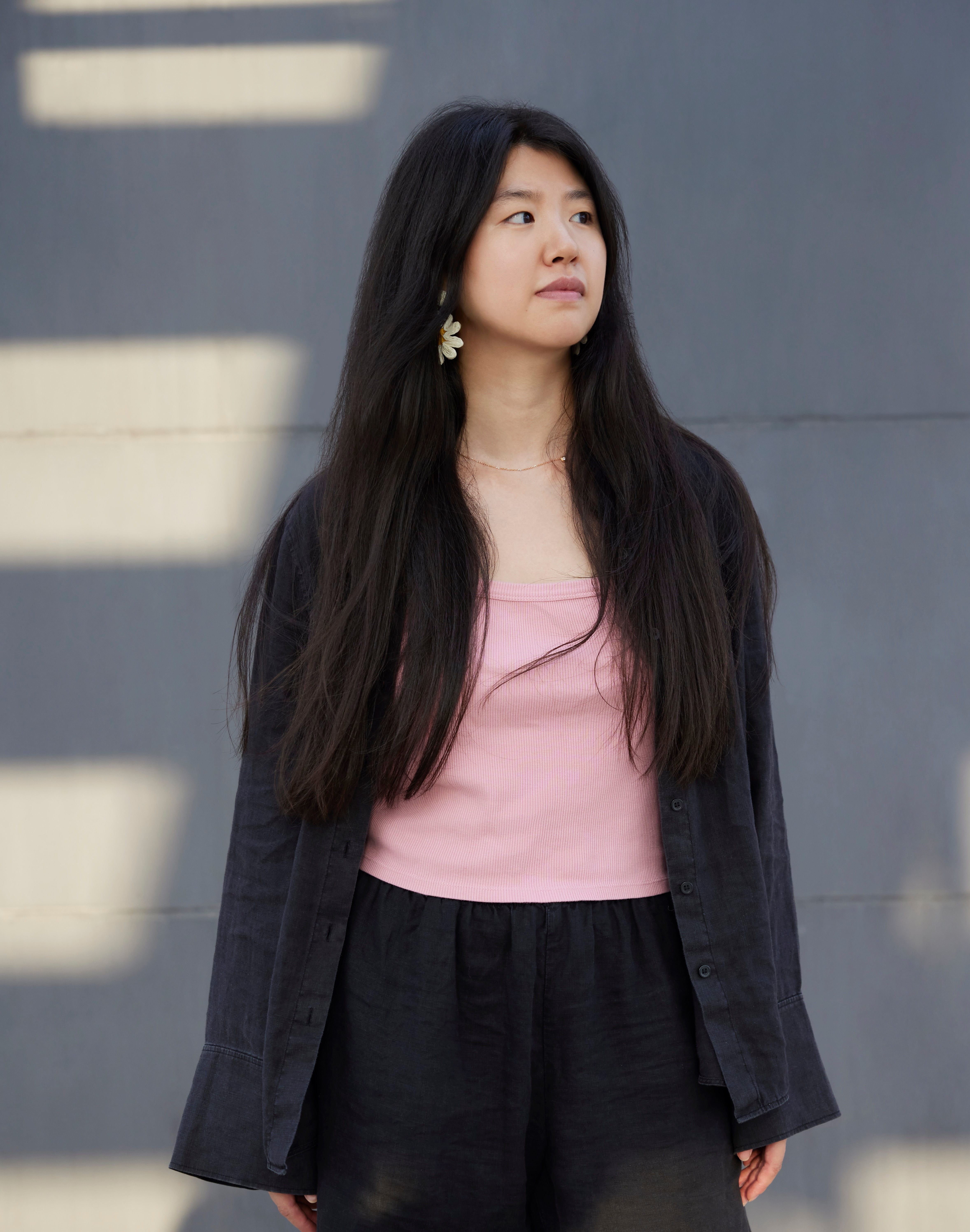
The author M Lin.
“I first and foremost write for readers who are like me, who can read both Chinese and English,” Lin told me when I asked her about translation. “I want them to have the deepest understanding. I don’t want to alienate them.”
Lin, born in Beijing and living in New York, doesn’t mind alienating the readers who might frown at the unfamiliar characters. For someone who instinctively explains and translates our country, our people, and our language for work, it is both inspiring and heartwarming to know Lin made a conscious decision I didn’t have the luxury to make myself. I’m also grateful that my contemporary is writing in English about the lives we’ve lived and are still living, in a way that doesn’t make me feel explained to.
One of my favorite of Lin’s stories explores women artists’ reckoning with their relationships to art and motherhood. Another one follows an elderly woman from Beijing as she recounts her visits to her father’s ancestral village in the barren lands of northwestern China, encountering both the warmth of home and the unsettling chasm between the urban and the rural lives, the educated and those deprived of education.
What moves me are small background details. A four-year-old girl, Caicai, likes watching Chibi Maruko-chan, a Japanese animated series following the family and school life of a mischievous 9-year-old girl set in the 1970s, which I also grew up watching. The mushroom-shaped container of Haiermian face cream whose sweet, creamy scent I can still remember. The rum raisin Baxy ice cream that was also my favorite. The Jay Chow lyrics that I can hum along to even when they’re translated into English. The references to our childhood and teenage years feel especially tender as the world we knew disappears, as room for expression narrows, economic ground shifts, and borders close in everywhere. They recall a time when we were intensely curious about the outside world, hopeful about our future, and unaware of how lucky we were.
I also smiled at a Beijing taxi driver who addresses Yuchen, an artist in her early 30s who has just returned home from the U.S., endearingly as guniang (“lass”) before prying about her marital status, an embodiment of what I love and hate about China, the ratio of which depends on how long I’ve stayed away.
Even if such specific details may not resonate with the average reader, this book offers a slice of today’s China full of human texture that’s underrepresented in English-language literature and media coverage. Lin’s prose captures a specific generation of scholars, writers, and artists who grew up as only children in their families, attended prestigious schools in China and the U.S., are fluent in both languages, and perhaps find they belong to neither.
“I couldn’t truthfully say if I was more of an alien here or there. Beneath my longing for home, there was always a simmering dread,” the art history Ph.D. in “Lucy” muses on a flight from New York to Shanghai. “And when it was time to return to New York for a school year, the same cocktail of conflicting emotions would again monopolize my hours, stretching me in opposite directions. It was as if home were always elsewhere, and so was life.”
The art history Ph.D. could be my friend. We are a relatively new phenomenon, a product of China’s economic boom and globalization. We were exposed to family wealth and different lifestyles, values, and education systems that no other generation in China has experienced. Many of us went to the U.S., U.K., Canada, and Australia for college in the 2010s. Some of us wound up studying arts, humanities, and social sciences instead of the most obvious and popular STEM majors.
In an alternate universe, we might have become the movers and shakers of China’s cultural industries, much like the Hong Kong filmmakers who studied abroad and returned in the 1970s to launch the New Wave. Instead, we are more like the screenwriter in “Tough Egg,” who has failed to sell a screenplay about a woman who abandons her son. She struggles to interest producers in another script about women traveling to the U.S. to freeze their eggs. She lives with her parents who care more about whether she can produce them a grandchild than about her professional aspirations. They can’t comprehend that her freelance work is an actual job.
Reading perhaps the most explicitly political story in The Memory Museum, about the White Paper Protests of 2022, I noticed myself reluctant to engage with a text filled with raw emotion. Part of it was resistance. I knew this story is more likely to be picked as an excerpt of the book than others. Part of it was that I wasn’t ready to revisit the pandemic years, which bring back painful memories. It was during the pandemic, confined in her New York apartment, that Lin, who studied film in the U.S. and had written mostly screenplays, turned to fiction writing, telling stories that felt true to what she and many Chinese people were experiencing.
The stories I find less convincing are those that confront China’s divide head-on. In other words, the stories not about people like us. The affair between a middle-class accountant in Pittsburgh and her massage therapist and the petty theft by migrant workers in Kunshan made me wonder whether I lacked the imagination to inhabit lives so different from my own or whether the characters themselves didn’t quite come alive.
When I asked Lin about her approach to creating the migrant worker characters, she said she’s read books and seen films. Growing up alongside her own rural cousins made her comfortable imagining the lives of the less privileged, and she tried her best to depict them. “At this point, I don’t know anyone from this class who could read in English and verify [what I’ve written],” she said. “If one day someone tells me, ‘You’re wrong about this or that,’ I’ll just have to accept it.”
Lin shares my frustration about the lack of diverse narratives in English-language literature and media coverage about China. “They believe we are miserable. But we also live our lives,” she said when we talked about how non-Chinese people seem to imagine life in an authoritarian country. “Both can be true. Like women everywhere, we also think about whether we want to become mothers.”
To that, I thank Lin for capturing a glimpse of real life and for not looking away. I hope to see more of our peers’ writing and art that fills the void between the crazy rich Asians and the immigrants growing up in laundromats and restaurants, between the traumas of the Cultural Revolution and the grand narratives of China’s rise and fall.