Chinese Web Users Aren’t Blaming Detained Journalist for Market Panic
on September 3, 2015
China’s stock markets have been in free-fall for some time. Now, so is a financial journalist who had the temerity to write about them.

China’s stock markets have been in free-fall for some time. Now, so is a financial journalist who had the temerity to write about them.
“When the Chinese people and the Chinese nation were in peril, the United States came to the rescue and asked for nothing in return. The U.S. never occupied a single inch of Chinese territory, never reaped any particular reward.”
Lianchao Han is a Visiting Fellow at the Hudson Instititue, working on the Future of Innovation Initiative. He worked in the U.S. Senate for 12 years, serving as legislative counsel and policy director for three active U.S. Senators, responsible for legislative strategy in the areas of federal budget, taxation, Social Security, and economic policy.
Since the device’s release in May, estimates show that over 1 million of the watches have been sold in China.
When African policy makers scan the globe in search of inspiration on how to structure their economies, that search often leads to Beijing. Not surprisingly, African leaders look at what China has done over the past 30 years where it went from being a poor, isolated agrarian country to a modern urban economy that is now the world’s second largest.
Hans van de Ven did his undergraduate studies in Sinology at Leiden University, then went to Harvard University for his PhD in modern Chinese history, followed by a UC Berkeley Postdoctoral Fellowship. He has been at Cambridge University ever since. His most recent book is Breaking with the Past: The Maritime Customs Service and the Global Origins of Modernity in China (Columbia University Press, 2014). Van de Ven's first book, From Friend to Comrade: the Founding of the Chinese Communist Party (Berkeley: University of California Press, 1991), was awarded the Philip Lilienthal Prize of the University of California Press for best first book in Asian Studies.
A British Academy Research Readership made it possible for van de Ven to spend three years away from teaching. One of these he spent as a Visiting Scholar at the Academia Sinica in Taiwan. More recently, he was a Fellow for a year at the Johns Hopkins—Nanjing University Center for US-China Cultural Exchange. Van de Ven also is Guest Professor at the Department of History of Nanjing University and a Fellow of the British Academy.
In light of the September 3, 2015, mega military parade held at Tiananmen Square in Beijing both to mark the seventieth anniversary of the end of Second Sino-Japanese War in 1945 and to acclaim the achievements of Xi Jinping, China’s Chairman of Everything (for the Chinese media logorrhea related to the parade, see The China Story Dossier), we offer the following article from

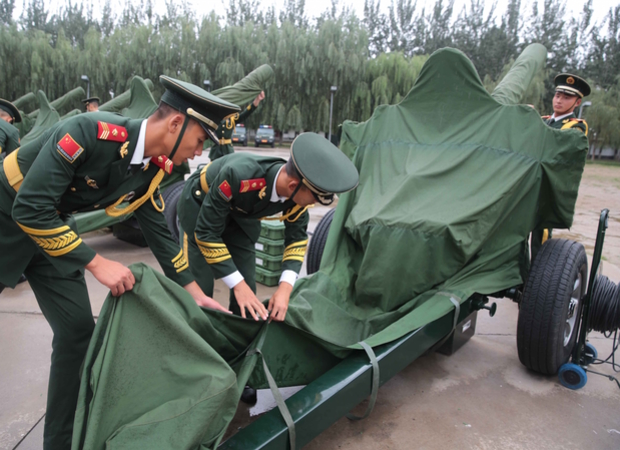
On September 3, China will mark the 70th anniversary of its World War II victory over Japan with a massive parade involving thousands of Chinese troops and an arsenal of tanks, planes, and missiles in a tightly choreographed march across Tiananmen Square. China’s leaders call this display of power “The Commemoration of the 70th Anniversary of Victory of the Chinese People’s Resistance Against Japanese Aggression and World Anti-Fascist War.” What is the meaning of this event and why have China’s leaders invested so much in executing it? —The Editors