ChinaFile recently published “Trains: A Chinese Family History of Railway Journeys, Exile, and Survival,” by Zha Jianying, the journalist and author of some of the most memorable recent books on contemporary China and particularly Chinese culture. This is a lightly edited, abridged transcript of a conversation between Zha Jianying and ChinaFile Editor-in-Chief Susie Jakes and Editorial Fellow Jeremy Goldkorn.
ChinaFile: Trains opens with a joyful, cinematic scene of you as a kid, a tough girl who becomes “number one train hopper,” the champion amongst your peers of hitching rides on trains leaving the Beijing railway station. This took place not too far from where you lived, near the Beijing railway station. What is in that neighborhood now? Can you describe the way it was when you were a kid?
Zha Jianying: When I was hopping trains, I was in Beijing Elementary School, a neighborhood school close to where my family lived. Right now, that area east of Jianguo Gate has become full of expensive high rises. It’s sort of a golden area for a lot of companies, and an upscale kind of neighborhood. But back then in the 1960s, my family first moved there because my father was a research fellow for the Academy of Social Sciences. And the Academy had four buildings in that neighborhood surrounded by all kinds of factories and workers’ dormitory complexes in the area. The school that I entered one year after the Cultural Revolution began, which was the time when the [college] entrance exam was abandoned, was the neighborhood school. So my schoolmates were predominantly factory kids.
One of the factories in the neighborhood was [attached to] the Beijing railway station. We could see it from my family’s balcony. This was a workshop for trains. When they come back from a long journey, they need checkups. So the railway tracks happened to be right in front of our school gate. And often in the afternoon, when we finished a day of very boring classes—at that point during the Cultural Revolution, a lot of it was just boring political studies—all of us would get very excited by the passing trains, which would be passing right in front of our school gate at a reduced speed. Most of the kids would rush to the train, but just look or shout at it. But a smaller group, mostly boys, would try to hop onto the train because you can jump up if you aim at grabbing one of the handlebars outside the train.
You can then ride the train. I was pretty much the only girl among that group. I was tallish and sort of a tomboy, so I was pretty good at it. And therefore, that’s what I did. I developed some kind of reputation. These boys would see me coming on the playground and they would sing this sort of ditty about me that rhymes in Chinese.
蹲班生,查建英!
扒火车,第一名!
Class squatter, Zha Jianying!
Number One, Train hopping!
It was kind of a mocking ditty to make fun of me for being tall and doing something boys do. But, you know, I was kind of happy that I got a grudging admiration for train hopping by these mostly factory kids, kind of tough boys. But the “class squatter” part of the ditty was about my being tall. I looked like I’d been held back by a grade, which was true because when I was supposed to get into grade one, it was the year the Cultural Revolution broke out. And so everything broke down and they didn’t have any admission. So as a result, I entered grade school when I was almost eight. I was among the tallest in my class, and among the girls by far the tallest.
Years later, after you have been writing for many years, you begin to find out the story of your grandfather in whose life trains played a very important role. In “Trains,” you write about his boarding a train to take a ship back to China. He leaves his French wife and child on the platform, never to see them again.
Boarding that train back to China sealed his fate. Do you see his returning as a real choice or was it coercion? Could any young Chinese man of his generation have resisted the telegram he received from his family saying falsely that his mother had died and that he needed to come home for the funeral? He didn’t know it was in order to get him to marry a chosen Chinese bride, he thought his mother had died. Could anybody like him really refuse that kind of request without becoming permanently estranged from his family?
That is a good question. Why did he answer that telegram? My grandfather belonged to that generation of the early kind of Republican, an era between the old and the new. That generation of educated Chinese, they were caught between their duty to the family, to their ancestral home and country, and they were also fired up by a sort of sense of a mission to build a new China through knowledge from the West. That’s why my grandfather went to France to begin with, but he was the oldest son of a landed gentry family in Hubei, which basically instilled in him a deep sense of filial duty.
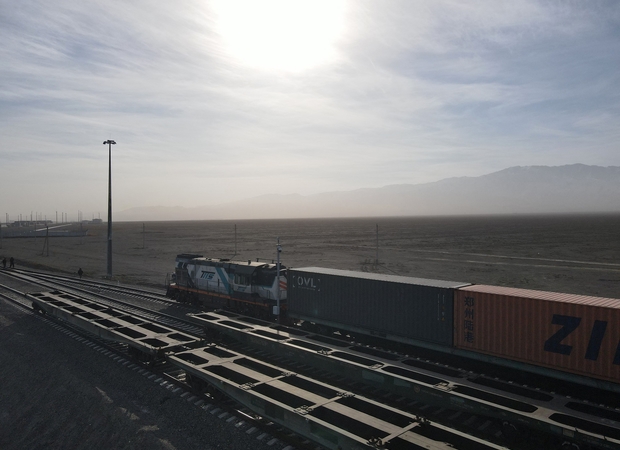
Zha Jianying Every morning, I crossed a stretch of railway tracks on the way to my school. The tracks lay less than a hundred meters from the school gate, and a train often appeared in the late afternoon just as we were discharged. Sometimes it was a freight...
During those 10 years, when he left as a 17-year-old young man and spent a longer than expected time in France, getting his degree, partially funded by family money, and partially by working in French factories, he was part of this famous movement, a work-study program. He survived that by working hard and studying hard. A lot of the students became radicalized because of the lack of funding. They just went into communist revolution, most of them did not really finish their degrees. And the radicals would be more prone to abandon the old culture. Some of the people like that may not have been so deeply caught in the call of family duty, but not my grandfather. He was a nerdy kind of kid, good at studies. He found his calling as an engineer. Part of it was studying, and railway building, things like that. And the other part was that he felt guilty. During the time he was in France, I think he was gradually Westernized by a whole set of more modern values, liking French culture, and he met a French woman who was the daughter of his landlord. After he got his degree, he was working as a young engineer, married to a French woman, with a baby girl. I think he was very ambivalent about breaking this news to his parents. He was taking his time. His family did not know why he took so long [to come back to China], and they wanted to rush him back, and he seemed to be just not coming back. So they came up with this plan to trick him, knowing that he’s the kind of son, he’s kind of Chinese older son for whom not returning for your mother’s funeral would be on his conscience forever. That’s just not something someone like my grandfather would do.
Have you ever attempted to find your grandfather’s descendants in France?
For many years after I knew about this, I felt almost guilty by proxy, that my grandfather abandoned his wife and his own daughter in France. I felt a little bit ashamed about asking into this, what his French wife and daughter did afterwards, do I have French cousins, French aunts, things like that.
But besides my feeling ambivalent about looking them up, what am I going to say? Hi, I’m the granddaughter of so-and-so who abandoned your grandma? But besides that, it’s not my fault, but he’s my grandpa, right? And I have this weird sense of affinity about what he did. But anyway, another factor that would make this whole process tricky was that like many of his contemporaries, he was changing names.
He was born with a given name and family name. And then he changed his name to Liu Xin—the family name stayed the same, but Xin means “new.” He just decided he would take a new name and the name literally means new. And there’s no way for me to know for certain which name he used on his marriage certificate.
What do you make of his decision to maintain his French habits in China? The Omega watch, the fountain pen, French books, and even those mantou buns that you described that were really some kind of fusion bread between a Chinese steamed bun and a croissant that he was secretly making with butter?
I think it wasn’t a decision, it was a habit. After all, he went to France when he was 17, still part of one’s formation period. And he stayed there for 10 years. And he was embedded in his studies, and then he stayed in a French house and he married a French woman. So he really became a kind of immigrant . . . The French way of living was apparently quite attractive to him. But he kept many of [these habits] secret. Bit by bit, I learned he had the Parker pen and this watch and he had a camera, he had a dark room, he developed film in his own house, and he baked and he made sausages.
And he danced. He loved to dance. This was one of the details I learned from my aunt, she said, “our father loved to dance, but our mother had bound feet.” From the late Qing to the early Republican period, in middle class, respected families, the women still bound their feet. She only took the bindings off when my grandfather sent a letter from France knowing this was going to be his future wife, saying no, I don’t like bound feet. But still she wobbled as a result of the binding. And she couldn’t really dance.
But you yourself as a child when you spent time with him, you never saw any of this residue of him having lived in France?
No, the first time I found out that he had a past in France was when I tiptoed into his room when he was visiting my parents’ house in Beijing. This was during the late part of the Cultural Revolution. I was curious about what he was reading. When he went out for a walk, I went [into his room] and saw he was reading these bilingual pamphlets. At that point, I didn’t even know what it was. I knew it was a foreign language on one side. The other side was Chinese. These were Cultural Revolution pamphlets about Mao and People’s Daily editorials. There was a series of them. But on the left side of the pamphlets my grandfather had, there was a foreign language. I didn’t know if it was French or English, and I asked my mother. That was the first time she told me about his past in France. And very soon after that, she told me that when she was a girl, this was actually an open secret in the family, my grandmother and all the children knew about his French marriage. It wasn’t hidden among them when they were young. And she told me one of the vivid images she carried in her mind, because my grandfather told her in great detail about that train station farewell, how they parted and his French wife was holding this baby girl and waving this white scarf until they disappeared and none of them knew this was going to be forever.
This was really shocking to me.
You also write a lot about your Uncle Lusheng, who tracks a trajectory from romantic revolutionary to being horribly persecuted as a rightist. There are parallels with your grandfather’s story of being an idealist and then winding up very disillusioned. Do you see this as a kind of a generational curse?
The journey of disillusionment happened with a lot of Chinese, but most bitterly with the educated Chinese, what we call intellectuals, because they’re the ones who carried this sense of mission about using their knowledge to build a modern China, to build a stronger China. They believed that communism was the answer. In the earlier part of this Trains series, I describe a period where a lot of different ideologies were tossed around in China, like anarchism, like the group of anarchists in China who sponsored the work-study movement in France which my grandfather was a part of. But that road was not taken. It did not win the day. The October Revolution won the day, and so the intellectuals thought that was the way. And the communists had a very strong popular support. The intellectuals willingly accepted this ruling party as the one which would unify the nation. Throughout so many political campaigns, the intellectuals were targeted and still they went along with it, hoping against hope that somehow this is part of the price for their past guilt—like being a part of the bourgeois, being part of the elite privileged class—they have to go through this, in order to achieve the ultimate goal of a stronger China. But I think that disillusionment deepened more and more after the anti-rightist campaign, the Cultural Revolution.
My uncle was just one of the many who started out with this very naive idealism. My uncle faked his age when he was just 15 or something, trying to join the so-called volunteer troops to fight in the Korean War. And then later, when he was still a very young man, during the 1957 Anti-Rightist Campaign, by submitting some very mild critical suggestions about the army—he was a young officer at that point—he was persecuted, stripped out of the army, sent to a farm where he more or less spent 20 years, and it ruined his life. Later, he became mentally deranged. A lot of it had to do with the shock of the political campaigns and family trauma and all this.
You argue in the fifth part of the piece that China’s historical traumas have created an obsessive focus on stability and prosperity over liberty and that this seems to be something that is just an inherent part of Chinese culture now.
But there are other countries with traumatic histories—Germany, South Korea—that have chosen different paths. Is there something that makes the Chinese case different, this obsessive focus on historical trauma? Or, to put the question another way, are you maybe casting an orientalist gaze on your own country?
I am not sure what you mean by orientalist?
In the West there is a stereotype of Chinese people being willing to put up with any political indignity because of something essential to Chinese culture. I’m wondering, particularly given the context of the United States right now, where many people seem more than happy to completely compromise their principles in order for a little bit of prosperity and stability, is this a China thing, or is it just human nature?
I’m completely aware of the stereotypes about the Chinese national character. But that’s not what I’m trying to portray. I think it’s a lot more complex and layered than that. What you just cited, the examples of Germany and South Korea, both went through war and trauma, and colonization in South Korea. They come out of it differently because, not because their race is different, I don’t think it’s a racial factor, it’s a political system. They both became democracies. Whatever flaws in democracy in those two countries, they both went through a deep political change post-war, post-colonization. They both had to go through a deep national soul-probing, of coming to terms with the dark past. [In Germany it was with] their own internal crimes, like the Nazi crimes against Jews. It took them some time, but they went through that process. And in South Korea, they fought a long war, which even today you can see that legacy again in their attitude towards Japan about the war crimes. And then their own internal dictatorship. They went through a long period of American-supported military, authoritarian rule for the sake of economic growth. And the South Korean economy grew very fast. Still, they did not stop there. They pushed very hard for democracy, for political reform, and they became a democracy. You might add to that Japan. There’s another Asian culture, right? Both Korea and Japan were, by the way, heavily influenced by Chinese Confucian culture, but they became politically modern nations.
Not China. China had the unfortunate reality of picking communism from Russia, from the Soviet Union, and sort of under the cloak of Marxism, has retained a lot of its own feudal ways; its own authoritarian tradition was not changed under communism. So the political system did not really change. Okay. And so.
People here in the U.S. are scared of China in terms of AI and all this, but politically, it’s a dinosaur. Citizens have no right to vote, no right to free speech. You compare the current problems of the two countries, it’s two different animals, apples and oranges. In the long run, no matter how long it takes for Americans to go through this horrible, horrible, horrible period—and a lot of us are quite anguished about this, and it may take a long time—it’s not comparable to what China is. China has high speed rail, but going where? People are just economic animals. They have no rights. All of the Chinese middle class, they do everything by their cell phone. Their life is so convenient, so comfortable. But they’re all scared shitless. No intellectuals dare to say anything contrary to the Party-state. These officials are following Xi Jinping’s cue, they’re no different from the court eunuchs of the past. This is just a modern extension of the Qing dynasty.
This is not a conclusion I arrived at easily or happily. I’m not happy to see my homeland in this state. It’s like a wealthy desert. The food is better, I agree. The food is better.
Why did you choose the railway as the central metaphor for this piece?
In the beginning, I really was just thinking that it was time for me to write about my family history. And I wanted to start with my grandfather because I thought his journey as an abortive immigrant has a lot of echoes with my own life. Making sense of his life is almost like making sense of my own life. So I started with details of my own childhood train-hopping, and that metaphor and image of him saying goodbye to his French wife and daughter, both have to do with trains. But as I dug into it more, I realized trains are a very apt metaphor, both in terms of this particular family history and as sort of a central metaphor for China’s journey of modernization. Building trains was a dream for China, for the Chinese, starting basically soon after the Opium War, and the First Sino-Japanese war in 1894-1895. Japan learned a lot from China in the imperial past, and suddenly China was defeated by its own pupil. And then it looked closer and realized that the Japanese had done so much better with their adoption of Western knowledge. And China focused on railways because they are a sign of a certain stage of industrialization. [The railway was] born together with the modern cinema. Films about railways added to this mystique about railways and trains symbolizing a modern age.
So the great reformists of the late Qing and early Republican period all strongly advocated for the building of railways. And then later, Sun Yat-sen, the first president of Republican China, as soon as he stepped down as president, he became the general director of railway-building. In his major work, something called “Jianguo Fanglue,” a “Plan for National Reconstruction,” is a vision of building a grand national railway system that would connect all parts of Chinese territories and speed up all these other subsidiary industries, like steel production, coal mining . . . everything would be connected.
Of course, he never got to realize that plan. But my grandfather as a young man [took part in] railway-building. His hometown in Hubei happened to be an ancient site for coal mining, and so building the railway started in that area. All this made me realize that this is a ripe metaphor for China’s journey of trying to modernize the country.
And then of course, I started with my own childhood train-hopping and traced back to my grandfather leaving France, and my grandmother’s suicide. That was a crucial event that I discovered a long time later. At the time, suicide was such a shameful act in China, even though it became more common during the Cultural Revolution when a lot of suicides were triggered by political persecution and trauma. But it was a sort of shameful act. The families often tried to hide it because there would be a stigma carried by the surviving family members as a sin, as a crime. The Cultural Revolution code of language for this kind of political suicide literally means to “sever yourself from the people.” In my family’s case, it happened to be a suicide on the railway.
I was reading Anna Karenina shortly after I discovered how my grandmother killed herself. I couldn’t help thinking about how as a woman, you throw yourself under a train, when you’ve completely lost hope, you do this kind of act almost like a self-mutilating protest, because the word “train” was also used in a certain way in the Chinese language. When I was growing up during the Cultural Revolution, it was a culture full of loudspeakers shouting about the train of the times, the locomotive of history . . .
Could you have written “Trains” in Chinese?
I never thought of it because if I write it to be published on a Chinese platform, I have to censor myself, which is one of the main reasons I became a U.S. citizen in 1992, post-Tiananmen. It really made me realize if I want to write without censorship, I would have to write in English. Until recently, all my unabridged writing in Chinese was published only in Hong Kong.
Do you feel like writing in English changes what you would say in other ways? Or are you really just kind of finding English ways to express what you would have said in Chinese or translate in some way from Chinese?
I feel like you’re always kind of the same person, but I know that some writers feel like there are certain things they can express in the language of their exile that they can’t express in their native language.
After many years of writing in English, I really don’t think I’m translating in the literal sense. I’m thinking in English when I write in English. However, clearly Chinese is my first language. I was a Chinese language major until I came to the U.S. as a post-graduate. My whole college education was majoring in Chinese literature and language. So English always felt like a second language to me. And when I write in English, I’m very much aware I’m writing for an audience where I can’t assume that they know certain things about China like I do when I write in Chinese for a Chinese audience.
I do feel the constraint of writing or speaking to an audience for whom [China] is a foreign topic. I have to put in a lot of [explanations] in the text, whereas in Chinese, I can assume. Secondly, I am aware I have a smaller audience in English because, as my agent reminds me, the average American really doesn’t care that much about China. This is just not their issue. Whereas Chinese readers are interested in anything about China, but they’re also more interested in America and the West.
In recent years, I’ve decided I’m fed up with Chinese censorship. I’m going to just focus on writing in English with my limited time and energy.