


The opening of a bookstore rarely makes international headlines. But when JF Books, known in Chinese as “Jifeng” (seasonal winds), opened its doors in Washington, D.C. on September 1, 2024, the news was covered around the world, from The Washington Post and The Economist, to Der Spiegel in Germany and The Straits Times in Singapore. The stories spoke of repression and rebirth: Founded in Shanghai in 1997, Jifeng was a cultural landmark in the Chinese metropolis for two decades, but was forced to shut down in 2018 when its landlord refused to renew its lease, most certainly due to pressure from the authorities. Six and a half years after Jifeng’s last day in China, the store’s signature green logo lit up again, this time on the other side of the Pacific. Nestled in the historic Dupont Circle neighborhood, it’s a welcome addition to the literary scene in the U.S. capital, and stands out for its selection of Chinese-language books and events on Chinese politics.
I grew up in a provincial city far from Shanghai, and moved to the U.S. in 2009 for school. The first time I had heard about Jifeng was when news of its closure reached the other side of the Pacific, and I only realized the bookstore’s influence when reports of its reopening in D.C. flooded my social media feeds. A familiar narrative threads these accounts, where Jifeng is presented as another victim of the Chinese government under Xi Jinping, its demise emblematic of the waning of civil society in China, and its resurrection in the U.S. a validation of the virtue of Western democracy.
Several reports rightfully place Jifeng in D.C. among the flurry of Chinese diasporic bookstores and publishing houses that have sprouted in recent years, in cities such as Tokyo, Chiang Mai, Paris, and San Francisco. Since the start of the Covid-19 pandemic, a growing number of Chinese people have moved abroad to escape the sluggish economy and suffocating politics at home. These immigrant literary ventures do not just fulfill the desires of bibliophiles but act as incubators for their aspirations for the homeland.
As I read through these stories about Jifeng in Western media, I felt inspired, but I was left with more questions than answers. Unlike most other Chinese diasporic bookstores, Jifeng had a storied past in the home country that spanned two decades. The image of Jifeng from recent news reports is that of a dissident in exile, but Jifeng had not operated underground or sold banned books during its decades in China. For years, the store in Shanghai had enjoyed positive publicity in state media and occupied prime real estate in the heart of the city. And, despite financial and political challenges, independent bookstores remain a part of China’s cultural landscape to this day, more than eight years after Jifeng closed down. So how did the former pride of Shanghai run afoul of the authorities? Was it only that a red line had shifted, or had Jifeng changed as well? Was the new store in D.C. a replica of Jifeng in Shanghai? And how was this new immigrant business navigating the deteriorating political environment in its adopted home?
For several months over the past year, looking for answers to these questions, I visited Jifeng in D.C. and dug into archival materials from China. I spoke with its current owner and past and present staff and customers. The story that has emerged is far richer and more complex than what I had anticipated. The rise, demise, and rebirth of the legendary bookstore embody decades of political and economic developments in China, and its transpacific journey lays bare the unruly contours of language and identity. I find myself in awe of the people who have made Jifeng into what it is, while I lament the contradictions the store has exposed about cultural production under capitalism and authoritarian politics. Across the widest ocean and against the test of time, where might a Chinese person read and speak freely?
* * *
“It is here that the spirit of underground reading during the Cultural Revolution, as well as hopes for a different kind of China in the 1980s, can stubbornly grow again,” wrote Yan Bofei in 2017 about the bookstore he had founded 20 years before. Jifeng first opened its doors in 1997 by a subway station, where over eight thousand titles were crammed into a 40-square-meter space. Yet, Yan harbored a grander vision: the books Jifeng carried “contained as complete a world of ideas as possible for its time,” he wrote.
Born in Shanghai in 1954 to a family of Communist revolutionaries, Yan was four years old when his father was persecuted in Mao Zedong’s anti-rightist campaign. A decade later, as a teenager at the height of the Cultural Revolution, he was among millions of educated youth relegated to the countryside, and spent nine years in a village in Inner Mongolia. He snuck in reading between farmwork, and exchanged thoughts in letters with other sent-down youth across the country. The titles he consumed in stealth included books on the socialist experiment in the Soviet Union and Cuba, as well as novels by Balzac and Tolstoy. As Yan told the financial magazine Caixin in 2018, at a time when despair drove many in Yan’s cohort to suicide, books were lifesaving; the smuggled pages opened to an escape hatch, signaling that another world was possible.
After Mao died in 1976 and the spell of political fanaticism broke, Yan went to college and worked briefly as an engineer in Wuhan, before returning to Shanghai for graduate studies in philosophy. He received his Master’s degree from East China Normal University in 1987, and stayed in his hometown to work as a researcher at the Shanghai Academy of Social Sciences. Reform and Opening policies had ushered in a period of unparalleled dynamism and intellectual ferment. Students and scholars debated everything from political theory to poetry at book clubs and other private gatherings. In 1985, Yan and his friends also started a monthly cultural salon in Shanghai. The coveted gathering attracted both local professors and foreign guests.
The decade of possibilities came to an abrupt and bloody end on June 4, 1989. As tanks and machine guns cleared out Tiananmen Square, the violent suppression of the pro-democracy movement also crushed the aspirations of those Chinese intellectuals who identified with the long historical tradition of scholars advising the state, and felt duty bound to guide the country toward a more liberal future. Disillusioned with the system, they retreated from public life. Many of Yan’s colleagues at the Shanghai Academy of Social Sciences moved abroad, or chose money-making over scholarly pursuits. As Yan put it in the 2018 interview with Caixin, “anyone who could leave left.”
The continued liberalization of China’s economy despite political regression compounded the cognitive dissonance. In the same Caixin interview, Yan said he and his fellow scholars felt “a loss of language” in the early 1990s: What they had learned from academic texts could not describe the changes they were observing, which was especially frustrating for those who wanted their research to have practical value. The new consumer culture nevertheless provided an alternative path for civic-minded scholars like Yan. Under new state directives, private capital was allowed to re-enter the tightly-controlled “ideological sphere” of media and book publishing, and fund content production and distribution. In other words, ideas could be packaged into a commodity and compete in the marketplace.
When the first metro line in Shanghai began operation in 1995, Yan quit his job and opened a string of newspaper stands at the stations. In 1997, he spotted an empty lot next to the train’s Shaanxi Road stop, and Jifeng was born. The poetic name, which invokes the cyclic nature of events, was suggested by Yan’s wife, who happened to be reading a popular book called Chengshi Jifeng (The Seasonal Winds of Cities) about Beijing and Shanghai. The store name would prove more apt than either of them could have imagined.
For his new venture, Yan took inspiration from history, in particular the Shenghuo (Life) Bookstore in Republican-era Shanghai. In the first half of the 20th century, Shanghai had been China’s print capital. International settlements in the coastal city offered a modicum of political protection, as well as ample opportunities for trade and investment. Hundreds of bookstores, many with their own publishing houses, flowered in the foreign concession zones. They translated Western science and philosophy for a Chinese audience, published a variety of native authors, and at one point produced over 90 percent of the country’s textbooks and educational materials. Weathering Japanese raids and domestic upheaval, the booksellers of Republican-era Shanghai skirted the Nationalist government’s censorship demands and debated the political functions of literature.
Founded by the writer and editor Zou Taofen in 1932, Shenghuo stood out among its peers for being the most important producer and distributor of Marxist literature of its time, according to the Chinese Communist Party. Operating as a private business, the bookstore kept close contact with the Communist underground in the 1930s and ’40s and promoted leftist ideas in Nationalist-controlled regions. Hundreds of books published by Shenghuo were banned by Nationalist authorities, who also shut down Shenghuo branches and arrested many of its employees. Instructed by the Communist Party’s leadership, Shenghuo merged with two other progressive bookstores, Dushu and Xinzhi, to form Sanlian Joint Publishing in 1948, shortly before the Communists defeated the Nationalists in the Chinese Civil War. The joint press has continued as a major state-owned publisher in China today.
After the Communist takeover in 1949, the remaining bookstores in Shanghai were collectivized or subsumed by state-owned entities. For the next few decades, the state-owned Xinhua bookstore system monopolized the distribution of books in China, until private bookselling was permitted again in the era of reform and opening. When Zili Bookstore opened in 1983, it made a splash as the first privately-operated bookstore in post-Mao Shanghai.
Jifeng recognized its place in this interrupted lineage. Yet, when Yan referenced Shenghuo in media interviews, like the one with Caixin, and in his own writing, he did not mention Shenghuo’s revolutionary mission or leftist politics but its ethos of service to its customers. Two of Jifeng’s bestsellers in its first year were The Road to Serfdom and The Constitution of Liberty by the Austrian economist Friedrich Hayek, a fierce defender of the free market and limited government. I wonder how Zou might have felt about Jifeng—his dying wish in 1944 was to join the Chinese Communist Party—but the twists were no more ironic than a nominally socialist state espousing privatization. As the country shed its collective past to embrace global capitalism, ideas that had been discarded during the Communist Revolution as stale and decadent became fresh and desirable again.
Despite the success of his business, Yan remained a scholar at heart. Jifeng was his way of continuing the work of enlightenment by making use of consumer culture. The store eschewed excessively commercial titles and took pride in its selection of serious books for patient readers. In 1998, a skating rink next door went out of business, and the 900-square-meter space became the new home for Jifeng. Yan signed a 10-year lease, and reached out to the local women’s federation to hire workers impacted by layoffs at state-owned enterprises. In his speech to Jifeng employees before the store opened at the expanded location, Yan once again invoked Zou’s mantra that Shenghuo should embody “the spirit of service,” and told Jifeng’s staff to treat all customers with equal respect. “As far as I’m concerned, a smelly and sweaty migrant worker is no different from a well-dressed university professor,” Yan said. The well-meaning reminder nevertheless betrayed a class bias.
The bookstore benefitted from its location at a busy subway station. Some of Shanghai’s most iconic department stores were steps away, and the offices for the city’s newspapers were just around the corner. Wang Daohan, who served as the mayor of Shanghai in the early 1980s, became a regular customer at Jifeng. As Hong Kong’s first chief executive after the handover, Tung Chee-hwa stopped by Jifeng daily when he visited Shanghai. The hospitable space became a favored meeting spot for the city’s intellectual elite, but its doors were open to anyone with a curious mind. A dear friend of mine who grew up in Shanghai was a high school student in the early 2000s. He took the train across the city to visit Jifeng every week. As several friends from Shanghai told me, Jifeng was also a popular spot for dates. Between shelves of books, hearts and minds expanded like flower bulbs after rain.
Jifeng was “a shift key between commerce and culture,” Zhang Hong, a professor at Tongji University in Shanghai, wrote in an essay. The bookstore opened up “a small spiritual space in the middle of a dense material jungle,” where one could harvest both “Häagen-Dazs and Habermas, cappuccino and Calvino.”
* * *
The forces of commercialization loosened Chinese authorities’ grip over culture and enabled the creation of independent bookstores like Jifeng, but the market soon exerted its own pressures on the publishing industry. In a 2002 article, Yan cautioned against the onslaught of capital, and called on private bookstores to stay true to their purpose and independent character. In 2004, a new manager took the reins at Sanlian, the state-owned publishing house that traced its roots to Shenghuo and its sister stores. He prioritized profit over quality, made personnel decisions based on favoritism over competence, and ignited outrage among Sanlian’s workers. Many veteran staff members of Sanlian voiced their discontent and, in an unprecedented move, China’s independent booksellers joined the protest against the management of the state-owned firm.
Four of China’s preeminent independent bookstores, including Jifeng, initiated a public letter, which was signed by an additional 38 private booksellers. Written in classical prose that evoked petitions by Confucian scholars to the imperial court, the letter recounted Sanlian’s illustrious past and current crisis, and emphasized the importance of books for national rejuvenation and public enlightenment. “Though we sell books for a living, we also take promoting culture as our duty,” it read, and cited a classical Chinese idiom: “Our fates and Sanlian’s are linked like lips and teeth. Without one the other would be left out in the cold. How could we not speak up?”
“He who destroys Sanlian is a villain among all under the heavens,” the letter continued. Three months after its publication, the manager at Sanlian was reassigned.
The campaign to protect Sanlian became a galvanizing moment for independent bookstores in China, who were able to leverage the power of the market to place pressure on the state. By the early aughts, the development of commercial media and the formalization of China’s legal system had enabled a new wave of civic activism to take shape despite the country’s authoritarian politics. Instead of the grand narratives of democracy and modernization that had dominated discussions in the 1980s, public intellectuals in the new century shifted their focus to more concrete issues related to their areas of expertise. Private booksellers who saw themselves as more than merchants were part of the cohort. Encouraged by their success with Sanlian, China’s independent booksellers established a professional association and advocated for policy changes in the publishing industry. But stonewalling from the authorities extinguished any glimmer of hope. A few years later, the association was forced to disband. “The system cannot be reformed from within, especially on matters concerning the ruling ideology,” Yan recalled in an essay.
One of the key issues the private booksellers’ association pushed for was pricing control. At the time of the Sanlian letter, Jifeng was at the height of its commercial success, operating from eight locations across Shanghai, and e-commerce was still a nascent industry. Their market positions would soon reverse. Unable to afford the steep discounts from online retailers, physical bookstores increasingly resembled display stands for publishers.
In 2008, the original 10-year lease at Jifeng’s main location on Shaanxi Road was up. The metro company that owned the property demanded a 20-fold increase on rent. The price was not excessive compared with other tenants in the area, but it would drive Jifeng out of business. On September 10, Wenhui Daily, a leading newspaper in Shanghai, reported on Jifeng’s rent crisis on its front page. Over the next few days, every major outlet in Shanghai followed up on the story. The imminent closure of a beloved bookstore garnered media attention from cities as far away as Beijing and Guangzhou. Supporters of Jifeng mobilized online. “A metro station should not only have Häagen-Dazs and no Habermas” was their slogan, invoking the German social theorist to defend what they saw as a manifestation of his idea of a “public sphere.”
“When the metro passes Shaanxi Road, the thought of Jifeng brings a smile/ When you’re away for work, the only place you miss in this city is Jifeng,” a user with the name “Little Turning Bell” wrote on the social media forum Douban. “Without Jifeng, Shanghai would sink instantly into a third-tier city!” The post went viral. The stirring language evinced a shared anxiety among the people of Shanghai. As author Yang Dongping detailed in his bestseller Chengshi Jifeng, the title that had inspired the name for the Jifeng bookstore, the residents of Shanghai worried that beneath its cosmopolitan glamour, their city, unlike Beijing, lacked an ancient history or venerable culture. During the Mao years, much of Shanghai’s proud Republican heritage had been banished as bourgeois excess, and the city was remade into a model of socialist production. Now its rapid economic development brought enviable wealth, but left little space for its residents to connect let alone reflect. Jifeng filled a void. “Is there really no space for a few ‘small’ bookstores in a city as ‘big’ as Shanghai?” asked an article on East Day, a state-owned news website in Shanghai.
“We have spent too much time talking. Let’s take action to defend the environment we live in!” Little Turning Bell wrote at the end of her post. Yan dissuaded the supporters from their plan to demonstrate at the subway station. “These youth are so lovely,” he wrote years later. “Their generation has grown up in affluence, under the guise of a rootless liberal economy and a concealed past. . . Their natural sense of justice is straightforward. They have not yet developed a fear of the authorities.”
In the end, it was the authorities that saved Jifeng, albeit temporarily. Officials in charge of the publishing industry negotiated with the state-owned metro company, and the latter agreed to lower the rent hike from twenty-fold to two-fold. Jifeng survived, but just barely. As sales continued to decline, it closed down branches and stopped paying its shareholders. In 2012, when the new lease expired, the company was over seven million yuan, or around one million U.S. dollars, in debt. This time, the public was more restrained. As Yan recalled in the Caixin interview, in contrast to the idealism in 2008, a different voice had entered the fray four years later: “Habermas is certainly important, but there is a price to be paid to preserve Habermas instead of letting Häagen-Dazs take its place. Must the metro company shoulder the cost? To coerce and judge a business in the name of culture is unfair under market principles.”
* * *
When he met Yu Miao in late 2012, Yan knew he had found the perfect successor. Two decades Yan’s junior, Yu grew up in an academic family in Shandong province. He was a high school senior in the spring of 1989, when he followed coverage of the protests at Tiananmen and watched local university students march in solidarity. That fall, he moved to Shanghai for college, and became a successful entrepreneur in the years that followed. Since the late 2000s, Yu had been active in philanthropy and public interest projects. He took part in disaster relief efforts after the 2011 Yushu Earthquake in Western China, and helped establish a foundation for rural education. A lover of literature, he was also a longtime Jifeng customer.
The bookstore unloaded some real estate it had used as an office to pay off debt, and Yu raised three million yuan among friends. Back in 2011, the Shanghai Library had approached Yan about an empty space on its basement level, right outside the entrance to a metro station. Unlike the metro company, the library did not have a for-profit mandate, and the shared focus on books made the space a natural fit for Jifeng. After closing down the original Shaanxi Road store, on April 23, 2013, World Book Day, Jifeng reopened at its new Shanghai Library location. For the first few months, the new store featured a fresh produce section that sold fruits and vegetables. As Yu explained to me in an interview, the products were sourced from another business of his, a direct-to-consumer grocery delivery platform, but the experiment at Jifeng yielded few buyers, and the produce section was later converted to sell stationery.
Convinced that Jifeng could not replicate its earlier financial success, Yu had a different goal in mind: to turn the bookstore into a vibrant public square. The new store was slightly smaller than the Shaanxi Road location, but it featured a much larger area for events. Over the next few years, it hosted hundreds of author lectures, panel discussions, film screenings, and other activities.
Most of Jifeng’s events were free of charge. For a short while, the store was awarded subsidies from the government, and Yu was able to pool additional funds from friends who supported his vision. As Yu told me, Jifeng under his leadership should have been a nonprofit, like the current location in D.C., but Chinese laws are notoriously stringent in this regard. It was very difficult to register or operate a civil society organization in China, so Jifeng remained a company, and Yu made its generous patrons into shareholders, though, as Yu acknowledged in his interview with me, few were expecting returns on their investment.
Yet, Jifeng’s status as a business that sold books was what allowed it to host events in the first place. In a country where public gatherings are tightly controlled, commercial establishments are nevertheless granted leeway to organize activities to promote their merchandise. The nature of the book as both a commodity and a carrier of ideas makes bookstores one of the few places in China where public discussions can take place without seeking prior approval. Consumer activities provide cover for civic discourse.
On a late September day in 2016, a long line had formed outside Jifeng an hour before the event was set to start. Over three hundred people poured into the store. It took the speaker considerable time and effort to inch his way through the crowd and onto the stage. The occasion was a screening of a documentary on the French philosopher Michel Foucault, followed by a Q&A with the director, a professor from Beijing who had originally made the amateur film for his classes so he could play the recording instead of giving lectures. The esoteric experiment was not intended for a popular audience, but it found one at Jifeng. Over the years, Jifeng’s main clientele had shifted from scholars and students to the city’s white-collar workers. Outside the gated campuses of academic institutions, the bookstore was where the new urban middle class could congregate for intellectual nourishment.
In media coverage of the Foucault documentary screening, the location was identified only as “a certain bookstore in Shanghai.” After a period of relative tolerance, China’s government had tightened its ideological grip, and the crackdown on civil society intensified after Xi Jinping took the helm in 2012. As Jifeng’s profile grew as not just a tasteful bookseller but a venue for public discourse, its name also slipped into risky terrain. Officials demanded the cancellation of some talks, and increased their surveillance on the store. A handful of state agents became regulars at Jifeng events: Yu could recognize them by face. But he and his staff were undeterred.
“We believed firmly that so long as the bookstore was still under our control, we did not want to turn it into something we didn’t like,” Yu told me. Tim Weston, a professor of Chinese history at the University of Colorado Boulder, described the “stimulating experience” he had when discussing his book at Jifeng, which stood in sharp contrast with the tense environment at another event in Shanghai, hosted by a state-owned bookshop. When the celebrated author Murong Xuecun spoke at Jifeng, an audience question touched on a politically sensitive subject. Murong turned to Yu: “Manager Yu, is it appropriate for me to talk about this here?”
“Teacher Murong, since you’re already here, you should not worry so much,” Yu spoke softly, but everyone heard him.
* * *
While its reputation as a public square grew, Jifeng was still a bookstore, with customers all over China. People who lived outside Shanghai could purchase books from Jifeng online and also by mail order. Writing in Jifeng Diary, an online chronicle published on the store’s WeChat channel, the staff recounted sending books to elderly customers in places as far away as Inner Mongolia and Heilongjiang, China’s northernmost province. Retirees also brought their self-published volumes to Jifeng, on subjects ranging from theater theory to computer science. Chinese laws are strict about buying or selling self-published books, and Jifeng abided by these rules. As Yu told me, such books were gifted to Jifeng by the authors, who only wanted their writing to meet an audience. Instead of placing the self-publications for sale, Jifeng would just keep the books or give them out for free among friends.
In the summer of 2016, Jifeng organized a field trip, inviting its readers to visit the addresses of Republican-era bookstores in the city. The staff selected a dozen stores, all of which were prominent in the first half of the 20th century, but few traces of their former existence remained. Yet, as Jifeng told its readers in a newsletter, even if only a rusted street number was all that’s left, the signage had been “imbued with meaning because of your gaze,” reflecting “the love and respect for books.”
Less than two years after the tour, Jifeng would also disappear from the map. Like many of its Republican-era predecessors, the reason for its closure was not financial but political. When Shanghai Library informed Jifeng in April 2017 that its lease would not be renewed, the official reason was “to prevent the outflow of state capital.” Bureaucratic banality concealed the true aims of the state. Nine years after the government helped Jifeng with its last landlord, it was now using commercial real estate to carry out a political execution. In the eyes of the authorities, it seemed, the bookstore was no longer a cherished cultural landmark or even a business that could live and let die by the rules of the market, but a looming ideological threat that must be eradicated.
If the officials had hoped that Jifeng would not publicize the news of its imminent demise, they had grossly miscalculated. Instead, the bookstore invited the world to witness its funeral. On April 23, 2017, four years to the date after its reopening at Shanghai Library, Jifeng announced its upcoming closure. A giant glass wall was erected at the entrance of the store. The top of the wall displayed the number of days it had left. It started at 283. Readers were encouraged to leave notes on postcards and paste them to the wall. The staff took the death sentence as permission to unleash their creativity. They organized more events, including a 20-year retrospective series and performance art festivals, and published an essay collection on Jifeng’s 20th anniversary, Echoes of the Wind.
The bold defiance was met with heightened hostilities from the authorities. The Shanghai municipal government’s cultural law enforcement unit designated Echoes of the Wind an illegal publication. As Jifeng’s employees wrote in the store’s online diary, uniformed officers visited the store four times a day to take photos. Event plans were disrupted by unexpected fire drills or power outages. It seemed every conceivable government agency, from public security to taxation and customs, had found its way to scrutinize Jifeng. After finding listening devices at the store, Yu and the staff would sometimes move discussions to a book cafe nearby. The name of that cafe was 1984.
For months, Yu sought a new location for Jifeng. Money was not a problem, but no one would rent to him. He had picked up rumors about Jifeng’s alleged crimes, but he needed to hear directly from the authorities. So he wrote a letter to Han Zheng, the Party secretary of Shanghai who would soon move to Beijing to serve as vice premier. A week after the letter was sent, security officers came to speak to Yu.
The talk lasted four hours. The officers cited a long list of the bookstore’s offenses: It was in touch with too many “sensitive individuals” in Shanghai. It displayed books on democracy and feminism too conspicuously. It alluded to official pressure when announcing the cancellation of events. Jifeng was “a base camp for liberal intellectuals” and “a fortress for color revolution,” so the charges went.
“Think of this as a scene from the novel 1984,” an officer told Yu at the end of their conversation.
When the countdown on the glass wall flipped to “1,” over three thousand postcards had been collected. One of the notes, signed by “Orwell,” imitated the style of the Sanlian letter. “He who destroys Jifeng is a villain among all under the heavens,” it read.
It was January 30, 2018. That night, Yu had organized a small party at the store. Invitees were warned by the authorities not to attend, so some sent their wives and kids instead. Others arrived anyway. The catering company Yu had booked said its vehicle had an accident en route and could not make the delivery.
Scenes from that unforgettable evening were captured in a YouTube video, “The Last Two Days of Jifeng Bookstore.” At the start of the video, Yu receives a notice that the shop’s water and electricity will be shut off for “equipment maintenance” at 5:30 p.m., just a few minutes away. He announces the “unprecedented” situation to customers. He has barely finished speaking when the lights go out. People turn on the flashlights on their cellphones. The staff bring out candles. Customers ask how they can be of help, and fix strings of decorative lights along the shelves. Someone starts to play the piano. Another picks up a guitar. Yu invites the group to dance. The crowd sings “Auld Lange Syne” and “Blowin’ in the Wind.”
The party Yu had planned became a vigil. Courage from Jifeng’s staff and solidarity from the customers transmuted the authorities’ petty cruelty into the stuff of legend. The people in the video are so lovely. Many appear heartachingly young, without a trace of cynicism. I smiled as I watched them on screen, and then I wept. I grieve for the bookstore I never visited, and the country I never got to know. I empathize with the people at Jifeng, but I also envy them. My recollections of bookstores in my youth are confined to the state-owned Xinhua branch in the provincial city I grew up in, and a small foreign language shop nearby that sold old American magazines and secondhand volumes. As a teenager in the aughts, I caught glimpses of citizen activism from news reports, but my sole focus at the time was to find a way out. The first independent bookstore I set foot in was the Seminary Co-op in Chicago, after I moved to the U.S. in 2009 for graduate school.
Having never lived in Shanghai, I did not even know about Jifeng until after it had closed. As I piece together fragments from the archive, I feel like a child standing on the tracks after the train has left. She listens intently to the lingering echo, her eyes trailing the whirling patterns of dust. She tries to picture the roaring engine and raucous cabins, and faces full of anticipation and longing.
* * *
In the video about Jifeng’s final two days in Shanghai, a young man in a plaid shirt plays the guitar. The power is still out. People hold up flashlights around him. He sings in the dark. The song is Li Zhi’s “The Square,” a tribute to the victims of Tiananmen: “Now this square is my burial ground/ This song will be your elegy.”
The mainland-born journalist Annie Jieping Zhang, who now runs Nowhere Bookstore in Taipei, with branches in Tokyo and the Hague, published a 2013 conversation between Yan and Liu Suli, founder of the Wansheng (All Sages) Bookstore in Beijing, which was established in 1993. Both Yan and Liu stated plainly that, had it not been for the crackdown at Tiananmen, they would not have gone into the book trade. In other words, the bookstores are the children of Tiananmen Square, just like Chinese people my age or younger, our lives having been profoundly shaped by the events of 1989 and their aftermath. Founders like Yan and Liu believed that selling books was one way to preserve the flame, and that commercial ventures could benefit the public and popularize liberal thought. As Yan said in the conversation, in the early days of Jifeng, he had no doubt that in the book industry, “the value of ideas equals the value of the business.”
Four years after their 2013 dialogue, Yan and Liu spoke together again on the state of independent bookstores in China, this time at Jifeng, 43 days before its closure in Shanghai. They were joined by Xue Ye, who had co-founded the Sisyphe bookstore in Guizhou in 1993, and the panel was moderated by Yu. During the discussion, Yan pointed out two ways for a physical bookstore to survive financially: It can attract venture capital, or become the “lipstick” for big capital by collaborating with the state or private developers. As an example of the former, when Jifeng was struggling with mounting debt at the Shaanxi Road location, One Way Street Bookstore in Beijing faced its own rent crisis. It tried crowdfunding and was able to raise nearly a quarter of a million yuan in just one day, but real relief came in late 2013, when the store received the equivalent of 10 million U.S. dollars of capital investment from a Shanghai-based private equity firm. Renamed One Way Space, the former independent bookshop has evolved into a full-fledged lifestyle brand whose products include tea and luggage.
Without acquiring venture capital, a bookstore can sustain itself by becoming “cosmetics for big capital,” Yan said at the panel. As e-commerce continues to squeeze traditional retail, real estate developers have recognized bookstores as an effective way to attract customers. In other words, Habermas and Häagen-Dazs do not have to compete for space; the former can help bring business to the latter. Blessed with favorable rent and subsidies from the government, physical bookstores are enjoying a renaissance in some parts of China. The new crop of trendy shops are often less known for their selection of books than their novel branding and exquisite decor. Influencers and tourists flock there for photo-ops, seeking a cultured backdrop in the new attention economy. Xianfeng Bookstore (Librairie Avant-Garde) in Nanjing, founded in 1996, decided to remove its iconic storefront logo in 2025, reportedly because swarms of visitors taking selfies there was disrupting its business.
The discussion among Yan, Liu, and Xue, the three pioneers of independent booksellers in China, exposed a paradox. While Liu pointed out the government’s unequal treatment of state-owned versus private bookstores that continues to favor the former, he also acknowledged the need for official intervention to control pricing. It echoed comments Liu made in the 2013 dialogue, when he claimed the socialist experiment and a poor regulatory environment after market reforms were to blame for the challenges independent bookstores in China faced. But then, is the solution more or less free-market capitalism?
Contrary to the wish that market liberalization begets political freedom, material considerations can compound political constraints. Xu Zhiyuan, a co-founder of One Way Street, reckoned in an essay that his status as a public intellectual could hurt his company. “I’m ashamed of my cowardice,” Xu wrote. He recognized the Chinese society he’s a part of in the Hungarian writer Miklós Haraszti’s The Velvet Prison: “a place where artists and intellectuals crowded under the banner of nationalism and were rewarded with official approbation, popular acclaim and material benefits,” so long as they self-censored and refrained from confronting the regime.
“At any stage, Jifeng could have made different choices to extend its life,” Yu told me. The store could have compromised and stayed open. It could have cooperated with the government and received more benefits like subsidies and positive press coverage. “But, at the end of the day, I was the person making the decision and, as far as I was concerned, there was no other choice.”
After Jifeng was shut down, Yu found out that he could no longer be the legal representative or register as a shareholder for businesses in China: Authorities from the commerce bureau told him he had been blacklisted. He relocated to the U.S. for graduate school, where he wrote a lighthearted blog called “A Middle-Aged Dad Studies Abroad.” In early 2022, Yu’s wife returned to Shanghai to visit family. After the city’s Covid-19 lockdown was lifted that summer, she was stopped at the airport and prohibited from leaving the country. Officials told her that she would be free to go if Yu came back for questioning. They claimed that Yu had written articles critical of the Chinese government while in the U.S., and that they were able to match the IP address of the offending web posts to Yu’s.
After months of public advocacy and behind-the-scenes effort, in May 2023, Yu’s wife was finally allowed to return to the U.S. Reuniting with her was a huge relief for Yu, but his prospect of returning to China had become elusive. Being severed from one’s homeland, like losing a loved one, alters one’s sense of reality. As we spoke, Yu described the surrealness of exile; it is a feeling I also know well. You envision your future based on your own experience, Yu said. You might have heard of a different path and glanced at the scenery along its way, but you never imagined yourself walking it. Until one day, because of a single decision, like taking over a bookstore, you find yourself racing ahead on a path of no return, living a life beyond your wildest expectations. Yet, in retrospect, the divergence did not happen by accident. Every step in your past has led to that moment.
In late 2023, at a gathering among friends, one of them suggested Yu could reopen Jifeng in the U.S. “The moment the idea was spoken, the moment it materialized as words that floated in the air, it resonated with a hidden desire,” Yu told me. Less than a year later, Jifeng was reborn. Yu signed a 10-year lease, just as Yan had done in 1998.
* * *
Four days after its grand opening in Dupont Circle, I visited Jifeng for the first time. The instant I stepped through its glass doors, it felt like I had been teleported back to China, not the country I knew, but one I imagine it can be. The shelves in the front were stacked with books on imperial and Republican-era China, collections by popular authors, and works of political theory. A section was dedicated to books about Hong Kong, next to volumes on Tibet and Taiwan. My colleague Eric Schluessel, who was teaching at George Washington University at the time, was excited to find the Taiwanese edition of his book, Land of Strangers: The Civilizing Project in Qing Central Asia.
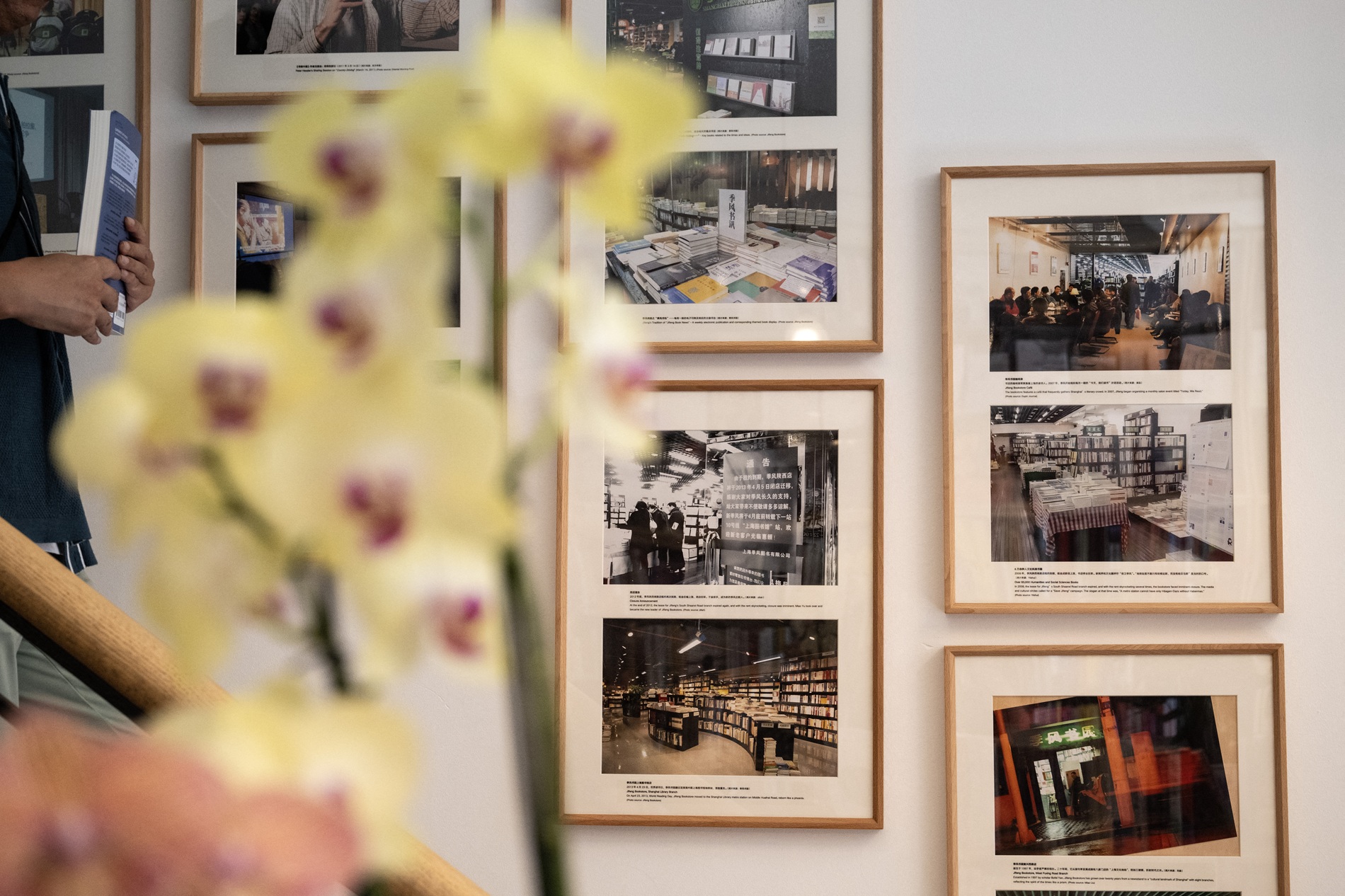
A narrow stairway led to the second floor, stocked with Chinese and Western classics. Framed photos of Jifeng in Shanghai lined the wall next to the stairs. A tall mirror hung by the bottom of the steps. It’s covered by postcards from the 283-day countdown. One of them read: “Till we meet again.”
Since then, whenever I find myself in D.C., I make time for Jifeng. During my first visit, the store still showed signs of being a work in progress—some of the shelves were not fully stocked, and boxes crowded a corner. It has been heartening to watch the place mature and become more expressive. In its first year, Jifeng in D.C. hosted over 80 events including author talks, poetry readings, and a documentary festival. It launched an online store that can ship to anywhere in the world outside mainland China, as well as a Chinese-language podcast called JF Pod. Jifeng also has plans to branch into publishing, with one or two titles by overseas Chinese authors expected in the fall of 2026. The store has expanded its inventory to 12 thousand titles, among which 70 percent are in Chinese, sourced from publishers across Sinophone regions and diaspora presses.
Thoughtfully organized by theme and category, the books speak to Jifeng’s political mission. Titles critical of authoritarianism are placed front and center. With the exception of the economist Jin Keyu’s The New China Playbook: Beyond Socialism and Capitalism, there are few works in support of the Chinese system. When I asked Yu about this notable omission, especially when compared to what Jifeng used to carry in Shanghai, Yu said the store in D.C. is only one fifth the space of its last location, so they need to be more selective.
One shelf in the back of the first floor is dedicated to titles from Greenfield Bookstore in Hong Kong. Featuring dissident authors like Fang Lizhi and Liu Binyan, forbidden topics like the Tiananmen Square massacre and other atrocities perpetrated by the Chinese Communist Party, and more risque subjects like the private lives of Chinese leaders, these books can no longer be sold openly in the former British colony. In July 2026, Hong Kong police raided Greenfield and another independent bookstore in the city and arrested their staff on charges of selling “seditious” materials. Two weeks later, Greenfield announced that it would close after its current lease expires, turning the last page in its 50-year record.
Being able to place books banned in China on the shelves at Jifeng prompts “a sense of release, a feeling of freedom,” Yu said, while acknowledging that one still needs to be discerning about the quality of such works. Selling them is also a business strategy: to meet customer demand and to distinguish Jifeng from bookstores in mainland China. Compared with those who grew up in a free society, readers from the mainland have a different motivation for buying books, Zhang Jieping, whose Nowhere Bookstore supplies Jifeng with titles published in Taiwan, told me. “They recognize they have blank spots in their cultural memory, and they have a hunger to fill the void,” she said. But desire can slide into fetishization. “We do not want to commodify taboo,” Zhang added. For people newly out of China, learning to venture into the forbidden is a rite of passage—I still recall the tingling sensation of emancipation I felt when I typed into Google “Tiananmen, 1989” for the first time, shortly after I arrived in the U.S. Over a decade and a half later, I recognize that was only a first step. An excessive focus on seeking out what has been censored allows the censors to map the terrains of inquiry. So long as the red line lingers in one’s consciousness and distorts one’s view, a part of oneself remains imprisoned in the old country.
At a store that features books on China or by ethnic Chinese authors, a section in the front stands out for its focus on Eastern Europe and the former Soviet Union. As Yu explained, these titles “reflect our aspirations for the future”: a longheld wish that China could democratize and learn from the experiences of former Soviet-bloc countries. It’s a wish he shares with Yan, and Jifeng in Shanghai also had books on political transition in Eastern Europe on prominent display.
”But China is no longer socialist. Do lessons from former socialist states still apply?” I asked.
Yu laughed and said it’s true the path China is on today has no precedent, but the history of democratic transition, whether from communist totalitarianism or other forms of dictatorship, can always kindle the imagination, and literature on the former Soviet bloc is especially rich. Jeffrey Wasserstrom, a professor of Chinese history at the University of California Irvine, pointed out that lessons from Eastern Europe are not limited to critiques of communism; often, it’s about persevering in seemingly hopeless movements. Wasserstrom had visited Jifeng in Shanghai, and spoke at its D.C. location about his new book, The Milk Tea Alliance: Inside Asia’s Struggle Against Autocracy and Beijing. In it, pro-democracy activists in Thailand and Myanmar took inspiration not only from the 2019 protest in Hong Kong, but also from more distant figures like Václav Havel and Nelson Mandela.
I have also sought solace and strength from the writings of Havel and Mandela. Yet, I worry we are denying ourselves a deeper understanding of the past and present if main takeaways from complex struggles are reduced to the moral courage of individual leaders, lest we forget the regimes Havel and Mandela fought against were on opposite sides of the Cold War. China’s economic rise and authoritarian descent have dispelled the myth that marketization entices democratization—the story of Jifeng encapsulates the failed promise. Reading about Eastern Europe while in China is both historically relevant and a maneuver against censorship, where discussions about other countries are granted more leeway. Continuing that focus here in the U.S. is nevertheless limiting: It perpetuates a Cold-War myopia that glorifies Western liberalism and views authoritarianism as inherently alien. As a matter of fact, Havel himself warned against the West’s self-congratulatory stance in his 1984 essay, “Politics and Conscience.” The Czech dissident contended that the binary alternatives of capitalism and socialism “are no more than two different ways of playing the same game, proffered by the anonymity of power. As such, they are no more than two diverse ways of moving toward the same global totalitarianism.”
* * *
In addition to titles on Chinese history and politics, as well as novels by esteemed Sinophone authors, bestsellers at Jifeng in D.C. also include ancient classics like Sun Tzu’s The Art of War, the I Ching, and Tang Dynasty poetry. The store carries a wide range of Asian literature in English translation, and has expanded its selection of bilingual children’s books by popular demand. Compared with its previous locations in Shanghai, the new Jifeng serves a much more diverse clientele. Customers of Chinese and Taiwanese descent are especially delighted to find such a fine representation of their cultural heritages in the U.S. capital. April Cheng, a Taiwanese-American student at Georgetown University, works as a media manager at Jifeng. She had not known about Jifeng before, but “when the bookstore started in D.C., it was such a huge hit in the Taiwanese community,” she said in a video posted to Jifeng’s YouTube channel.
During our conversations, Yu emphasized the need for Jifeng to assimilate into the local D.C. community, and the efforts and progress are visible inside the store. Yet, I cannot help but sense a tension among the stacks, between weighty volumes that expose the darkest episodes in Chinese history and governance, and ethnic offerings that carry a whiff of exoticization and commodify elements of Chinese culture. For readers who have never experienced China as an oppressive homeland, where might their political interests lie?
Shortly after Jifeng opened in D.C., Yu’s phone rang. The caller was a man named George Tsui. Born in 1950 in Yu’s home province of Shandong, Tsui moved to Hong Kong as a toddler and emigrated to the U.S. a decade later. Heir to a successful restauranteur, Tsui worked at his family’s Peking Gourmet Inn outside D.C., while his passion lay in writing and journalism. He had recently moved and no longer had space for his book collection. Yu could have it for free under one condition: take all or take none.
Yu arrived at Tsui’s estate with a truck. It took three days to pack over two hundred boxes of books in both English and Chinese. Some of them are on sale at Jifeng, while the rest are still being cataloged. The former includes an autographed copy of George H.W. Bush’s 1987 autobiography, Looking Forward. Established in 1978, the Tsui family restaurant was a favorite of Bush’s; the Secret Service had demanded a bulletproof window be installed by the VIP table. Originally priced at U.S.$499 and now discounted to $299, the Bush book is one of the most expensive items at Jifeng.
Most of Tsui’s donations are in the used-books section in the basement. The shelves are packed with well-loved copies on subjects ranging from slavery to the Chinese Exclusion Act, from the Pentagon Papers to Watergate. A significant number of titles are on Black history. Tsui told me the Civil Rights Movement is one of his primary interests, and another is Supreme Court cases.
The very term “Asian American” was coined by campus organizers in the late 1960s as part of a transnational struggle against racism, militarism, and colonialism. Many U.S.-based activists at the time, including leaders of the Black Power Movement, were galvanized by the socialist revolution in Mao’s China and identified with its professed vision of a world free from imperial domination and capitalist exploitation. Years ago, when I was still new to the U.S. and living in Chicago, I came across speeches by Fred Hampton, the former chairman of the Illinois chapter of the Black Panther Party. I was struck by his references to Mao. The Cultural Revolution was raging in Hampton’s time, and I wondered how much the Panthers knew about the calamities Mao had inflicted on his people.
Yet, perhaps Hampton could have developed a more nuanced understanding of the political reality in China if he had more time. He was 21 years old when he was assassinated in his sleep by members of the Chicago Police Department with help from the FBI in 1969. I have kept his story close as it reminds me of the cost of speech in the so-called land of the free, the perils of projecting one’s wishes on a foreign government, and the unfinished business of liberation.
Outside the secondhand section and other than volumes on government theory, there are few titles on U.S. politics at Jifeng, and the subject is rarely featured at the store’s events. But the topic is unavoidable. Speakers including Wasserstrom and NPR journalist Steve Inskeep alluded to the Trump administration when talking about state oppression in China. The presence of National Guard troops and ongoing ICE raids in the district have inevitably led to worries. Last summer, a Chinese woman came into the store, looking anxious. She had lost touch with her two daughters in New York and feared they had been taken into immigration custody. She knew little English, but managed to find her way to D.C. She was standing outside the White House by herself, holding a sign for help, when an American customer of Jifeng’s spotted her and suggested she seek aid at the bookstore.
Jifeng shared her story in its newsletter the following week. “Our hearts ached. We worried for her, but we also felt nervous: We are only a bookstore after all. We are not equipped to verify the facts or intervene in such a serious situation.”
During our most recent conversation, Yu shared his concerns over the worsening political environment here in the U.S. The restrictions on free expression have not affected Jifeng directly, since talks at the store are mostly about China, but rising Sinophobia could paint any Chinese-owned business as a potential “target,” Yu said. Jifeng’s record in standing up to the Chinese government might ease some suspicion, but as I also know firsthand, no amount of “dissident street cred” could completely shield a Chinese person from racist paranoia that casts anyone of Chinese heritage as a potential agent of a hostile foreign power.
As crackdowns on immigrant communities intensify, bookstores have emerged as an important site of resistance. From California to Minneapolis, booksellers organize grocery deliveries to people too afraid to leave their homes, and offer “Know Your Rights” trainings to immigrants and legal observers. When I asked Yu if Jifeng has similar plans, his response was cautious. I felt bad for broaching such a wretched subject with someone whose wounds of exile are still fresh, whose status in this country is also precarious. By pressing Yu with these questions, I knew I was also seeking answers for myself. What I had selfishly wished for was to either hear an absolution that I should prioritize my own safety and fighting one authoritarian regime is enough, or receive an affirmation that committing to a distant struggle while abandoning the fight where one lives is hypocritical, and no one is free until everyone is free.
“Historically speaking, people emigrate for safety and stability,” said Zhang of Nowhere Bookstore in Taipei. “But now there’s chaos everywhere, and anti-immigrant sentiment is often at the heart of such chaos.” She empathized with Yu’s dilemma. Neither Nowhere in Taipei nor its branch in The Hague have taken part in local political campaigns, and its branch in Tokyo is still grappling with the new conservative government and deteriorating Sino-Japanese relations. As Zhang told me, sometimes caution is necessary to protect immigrant staff, but the cost is continued alienation from the local community. The struggle is embodied in the name of her bookstore. As stated on its website, “Our English name, Nowhere, is a play on words: when we have nowhere to go, may we find a way to be now here—present, grounded, and together.” To leave the homeland is to “gain the sky and lose touch with the ground,” a popular Chinese saying goes. Where, then, might the diaspora’s political aspirations take root?
* * *
For Jifeng’s first newsletter in 2026, Yu recounted the past year at the store and invoked the Czech mathematician and activist Václav Benda’s notion of a “parallel polis.” In a 1978 essay, originally published in samizdat, Benda proposed the idea of building alternative structures that can operate outside the official system, supplement it, and gradually influence it. A parallel polis includes not just an underground “second culture,” but also a “parallel structure of education and scientific and scholarly life,” a “parallel information network,” a “parallel economy,” and “parallel political structures.” If spontaneous acts of resistance are like “a cluster of flowers,” vulnerable to “the killing winds of totalitarianism,” Benda explained in 1988, a parallel polis is “a trench” that can only be destroyed under concerted assault from the state, and can survive by constantly conquering new territory.
In his seminal piece, The Power of the Powerless, Havel endorsed the idea of establishing parallel structures. He cautioned that the effort must not be interpreted as a form of isolation or escape, but “as an act of deepening one’s responsibility to and for the whole.” Benda concurred: a parallel polis cannot exist in “elitist exclusivity”; all tasks involved in creating it are “connected with the renewal of the national community in the widest sense of the word.”
Jifeng’s work in Shanghai may be seen as part of an attempt to build an alternative polis, but what is the role of an immigrant bookstore in the ambitious project of national renewal? Whose nation? “A bookstore may be small, yet it resembles a slowly growing polis—one with alleys, squares, windows, and light pouring in. Here, individuals release their experiences, pains, curiosities, and inquiries into the air, where their echoes resonate softly among the pages,” Yu wrote in the bilingual newsletter. I struggled to parse the metaphor. In an email, Yu explained that the “parallel polis” Jifeng refers to “does not seek direct confrontation with anyone”; its goal is to “preserve a space where serious thinking and discussions can take place,” build community, and “maintain positive imaginations for the future.”
Compared with Yu’s reserved response, others in the Chinese diaspora have been more direct about their political intentions. “Let me set aside modesty for a second: When we go back to the motherland, we will be seeds for the first cohort of citizens!” Zhao Guojun told Deutsche Welle last year. A former civil servant and activist in China, Zhao moved to Tokyo in 2022 and opened L’Étranger Books, taking its name from Albert Camus’ famous novel. Over the past few years, Japan has emerged as a favored destination for new Chinese émigrés, who appreciate its geographical and cultural proximity to the homeland. Sinophone bookstores and publishers have sprouted in the Japanese capital. In addition to L’Étranger, both Nowhere and One Way Street have set up shop in Tokyo, alongside the publishing firm Dudaoshe (Yomimichi) that aims to “preserve some valuable manuscripts for the world of simplified Chinese.”
Dudaoshe’s publications are also sold at Jifeng, including three volumes by the late historian Fu Guoyong. Born in 1967, Fu had been jailed for taking part in the Tiananmen movement. He spoke at Jifeng in Shanghai in 2011, on the centennial of the revolution that toppled the Qing empire. His final book, issued by Dudaoshe, is called “Remaking China from Tokyo.” It’s set at the turn of the 20th century, when thousands of Chinese intellectuals journeyed to Japan to study or seek political refuge. They established journals and publishing houses, and translated volumes of Western political thought from Japanese into their native tongue. Many of the titles made their way to China through bookstores in Shanghai. Patriotic Chinese students debated the paths their country should take in person and on the page; some rallied around a new exile named Sun Yat-sen, the future first president of the Republic of China.
In an episode of JF Pod featuring Wu Lei, a Chinese human rights lawyer now in exile in Japan, the host mentioned that friends had said “there seem to be Sun Yat-sens everywhere in Japan today.” The parallels may be evident, but historical analogies only go so far. Sun was plotting armed rebellions. The frequent allusions to the founding father among a segment of the Chinese diaspora are not so much about carrying out similar pursuits today; rather, his name is raised to convey a collective yearning, a wish that the current Chinese regime could be like the Qing in Sun’s time, when the end was nigh.
A focus of Sun’s activities in Japan was raising money. Funding shortages strained his mission. Revolutionary camaraderie splintered under the weight of finances. However lofty an ideal must contend with material conditions. Both Yu and his wife have been working at Jifeng for free, but the store’s expenditures still exceed revenue from book sales. Yu told me Jifeng was able to break even in its first year thanks to donations and some grants, which made up about 40 percent of the store’s income. Dozens have enrolled in Jifeng’s tiered membership program, priced at U.S.$29 or $99 per month, and the store also receives one-time donations through its events, which are usually free and open to the public. Yu explained that he could have made Jifeng in D.C. a for-profit business, to focus only on book sales or selling tickets for events, but his vision for the store has always been for it to be a public space, which means it deserves and needs public support.
Much as I identify with Jifeng’s mission and hope for its success, I find myself skeptical of its revenue model: In a tough economy like the present one, how long can a bookstore survive on largesse? A bookstore, even a public-minded one like Jifeng, is not a library or a commune. Its primary purpose manifests as bourgeois consumption, where books are a commodity. I am reminded of the “smelly and sweaty migrant worker” Yan invoked in his speech at Jifeng’s grand opening in Shanghai in 1998. I wonder how many of these workers, who formed the backbone of China’s economic rise, actually walked through the doors of Jifeng in Shanghai, and if any of them would be able to visit Jifeng in D.C. and participate in its vision for a different, freer China. For a space that imagines itself as building a “parallel polis,” surely there exist alternatives to selling books that can facilitate the gathering of people and the free exchange of ideas? Lasting liberation is not simply freedom from an authoritarian government, but also freedom from all forms of oppression: that of borders, of economic disparity and social hierarchies, and of market forces that exploit and exclude.
“Jifeng was forced out of China for political reasons. It would be a greater tragedy—and irony—if it’s later forced out of the U.S. for financial reasons,” said my friend from Shanghai, who used to visit the store every week. When I shared these concerns with Yu, his response was resolute: “I never wavered over finances when Jifeng was in Shanghai, never mind here in the U.S.” Committing to a venture in a foreign land requires more deliberation and careful planning, Yu continued. “It’s a weightier promise than the ones made at home.”
On the eve of Jifeng’s last day in Shanghai, when guests sat around a table illuminated only by candlelight, one of them referenced a line from the Leonard Cohen song “Anthem”: “There is a crack, a crack in everything/ That’s how the light gets in.”
“That’s also how Jifeng, the seasonal wind, gets in,” the guest said. Six and a half years later, Yu included this line in his announcement of Jifeng’s return. The song is part of Cohen’s 1992 album The Future, composed against the backdrop of seismic shifts in the 1980s, from protests at Tiananmen to the fall of the Berlin Wall. The Canadian artist was less sanguine about the end of the Cold War, but he also expressed his love of America, “the real laboratory of democracy.”
Both Wasserstrom and I are fans of Cohen, and the quote from “Anthem” came up during our conversation on Jifeng. “Two other lines I think really matter are the pair at the beginning of that verse,” Wasserstrom said. “‘Ring the bells that still can ring/ Forget your perfect offering.’”
Founded by a scholar steeped in Marxist literature, who nevertheless followed the boom and bust of the market, Jifeng has been carried on by an entrepreneur who turned the commercial venture into a public interest mission. The bookstore has always reflected the paradoxes and shifts in the societies it’s a part of, and risen above present circumstances to envision a better future. Jifeng’s two decades in China added a resounding note to the chorus of the country’s economic transition and political vicissitudes; its story in the U.S. is just beginning to unfold.
A bookstore does not hold all the answers. It cannot resolve all the tensions between cultural value and capitalist iniquity, between an authoritarian homeland and an increasingly repressive new abode. It cannot bridge every division between neighbors who think differently, or between people who hail from a common heritage but call opposing nations home. It cannot fulfill every demand from diverse readers, who seek a piece of themselves among the shelves and project grand wishes on a tiny bookstore. What it can do is shine through the cracks in official narratives and establishment power, and ring the bells that still can ring.
When the history of our time is written, there will be a place for bookstores like Jifeng. In the months I have been working on this piece, I came across many stories from both Shanghai and D.C., but there is one I keep returning to. Last year, an older white man walked into the store. He wanted books in Chinese, a language he does not understand. He worked for an organization that provides aid to incarcerated people, and one of his clients is a Chinese woman. Yu helped him pick out a few titles. They did not know the woman’s preference, so they included volumes in both traditional and simplified Chinese. A few weeks later, the man came back for more. Instead of having him pay for the books, the store let him borrow them. He could exchange the previous volumes for new ones after the woman had finished reading. The man became a regular at Jifeng.
I do not know anything about the woman he has helped, her name, age, where home is for her, or what has kept her behind bars. What I do know is that because of Jifeng and the community it has become a part of, she has the company of books. I hope the pages lift her spirit beyond her confinement, and bring the heart a little closer to home.