Boeing to Sell 300 Jets to China Firms, Set Up China Plant: Xinhua
on September 23, 2015
Boeing Co is becoming the first U.S. firm to clinch a business tie-up in the country since Chinese president Xi Jinping began a U.S. state visit.
Boeing Co is becoming the first U.S. firm to clinch a business tie-up in the country since Chinese president Xi Jinping began a U.S. state visit.
About 100 people protesting against human rights abuses in China greeted President Xi Jinping in Seattle.
Fredrich Kahrl is a Managing Consultant at Energy and Environmental Economics (E3), a San Francisco-based energy consulting firm. He advises energy developers, utilities, operators, and regulators on critical economic and engineering issues in the electricity and gas sectors. A Mandarin speaker, he has worked on energy policy issues in China for a decade, and he has written extensively on the challenges facing China’s electricity system. He holds a Ph.D. and M.S. in Energy and Resources from the University of California, Berkeley, and a B.A. in Philosophy from the College of William & Mary.
Jim Williams is Director of the Deep Decarbonization Pathways Project for the U.N. Sustainable Development Solutions Network, headquartered at the Earth Institute, Columbia University. Since 2005, he has been Chief Scientist at the San Francisco consulting firm E3, where he has advised on many aspects of energy technology, planning, and regulation for government and industry clients. In 2007, he led E3’s analysis for California state agencies on implementation of AB 32, the state’s landmark climate policy. He was lead author of an influential 2012 article in Science that analyzed California’s path to reducing Greenhouse Gasses (GHGs) 80 percent below 1990 by 2050, and subsequently has been closely involved in the analysis underlying Governor Jerry Brown’s announcement of the state’s commitment to a 40 percent reduction by 2030. In 2014, he led a research team from E3, Lawrence Berkeley National Laboratory, and Pacific Northwest National Laboratory that conducted a similar analysis for the entire U.S., “Pathways to Deep Decarbonization in the United States.” A Mandarin speaker, Jim was until recently Associate Professor of International Environmental Policy at the Monterey Institute of International Studies, where his research interests included the technical and institutional challenges of decarbonizing China’s power sector. Jim received his B.S. in Physics from Washington and Lee University, and his M.S. and Ph.D. in Energy and Resources from the University of California, Berkeley.
China hoped Australia would ‘stay committed to not taking sides on issues concerning disputes over sovereignty’.
Fei Teng received his bachelors degree in Mechanical Engineering and Applied Mathematics from Tsinghua University in 1998, and his MSc and Ph.D in Management Science in the School of Public Policy and Management at Tsinghua University in 2003. Teng finished his postdoctoral research in France in 2004. He is now an associate professor in the Institute of Energy, Environment, and Economy at Tsinghua University. He is also a lead author of the Intergovernmental Panel on Climate Change Fifth Assessment Report, Working Group III. He is lead author on the Second and Third China National Assessment Report on Climate Change, and a member of the drafting team for several key national documents, including the National Plan on Climate Change and the White Paper on Climate Change. He served as an advisory expert for China’s negotiation team under the United Nations Framework Convention on Climate Change for many years. He is also member of BASIC (Brazil, South Africa, India, China) expert group in BASIC ministerial meetings since 2011. His research interests include climate policy, international climate regimes, consumer behavior in energy consumption, and energy modeling.
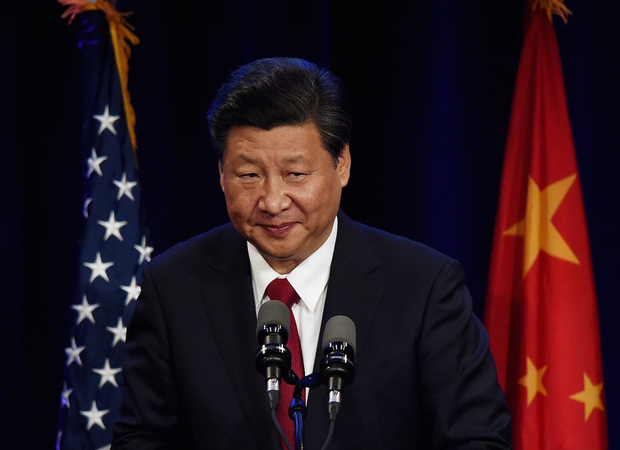
Xi Jinping did something unusual, almost unheard of, for a Chinese President: He cracked a joke. In public.
China’s President Xi Jinping addressed an audience of more than 700 American businesspeople in Seattle on Tuesday evening on the first stop on his first state visit to the United States. Regular ChinaFile Contributors who watched the speech offer their reactions below. —The Editors