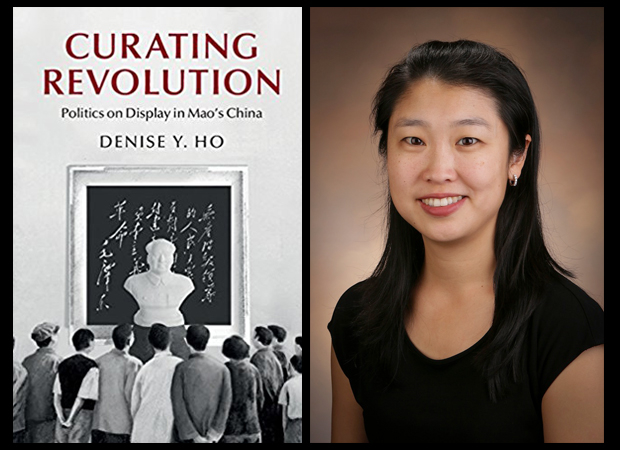
Curating Revolution

Cambridge University Press: How did China’s Communist revolution transform the nation’s political culture? In this rich and vivid history of the Mao period (1949-1976), Denise Y. Ho examines the relationship between its exhibitions and its political movements. Case studies from Shanghai show how revolution was curated: museum workers collected cultural and revolutionary relics; neighborhoods, schools, and work units mounted and narrated local displays; and exhibits provided ritual space for ideological lessons and political campaigns. Using archival sources, ephemera, interviews, and other materials, Ho traces the process by which exhibitions were developed, presented, and received. Examples under analysis range from the First Party Congress Site and the Shanghai Museum to the “class education” and Red Guard exhibits that accompanied the Socialist Education Movement and the Cultural Revolution. Operating in two modes—that of a state in power and that of a state in revolution—Mao era exhibitionary culture remains part of China’s revolutionary legacy.

Related Reading:

The Double Helix of Chinese History and Its Powerful Leader,” Denise Y. Ho, The Japan Times, March 20, 2018

Fifty Years Later, How Is the Cultural Revolution Still Present in Life in China?,” ChinaFile Conversation, ChinaFile, April 19, 2016

The Cultural Revolution at 50 — A Q&A with Four Specialists (Part Two),” Alexander C. Cook, Los Angeles Review of Books, March 2, 2016

The Cultural Revolution at 50: A Q&A with Four Specialists (Part One),” Alexander C. Cook, Los Angeles Review of Books, February 24, 2016

Chairman Mao’s Everyman Makeover,” Denise Y. Ho and Christopher Young, The Atlantic, December 19, 2013

Author’s Recommendations:

The Gender of Memory, Gail Hershatter (University of California, 2014)

Anyuan: Mining China’s Revolutionary Tradition, Elizabeth Perry (University of California, 2012)

The Temple of Memories, Jun Jing (Cambridge University, 1996)
More Annual Report Training; Registrations in Jiangsu, Zhejiang, and Guangxi

Ministry of Public Security WeChat Posts—March 2, 2018

Following the lead of the Beijing Public Security Bureau (PSB) Foreign NGO Management office, the Shanghai PSB Foreign NGO Management Office held a training on how to complete annual reports for 2017. In attendance were representative and financial staff from the 86 foreign NGOs that have already registered or are in the process of registering representative offices in Shanghai. The training covered how to fill in required information, such as scope of work as well as financial sources and expenditures. Ministry of Civil Affairs officials and certified accountants were also on hand to answer questions about the non-profit accounting system.

China’s Radical Plan to Limit the Populations of Beijing and Shanghai

In the weaving alleys of Shanghai’s Laoximen district, swathes of residential buildings sit empty. The historic area in the heart of the city is being slowly demolished, and many residents have already abandoned it, leaving behind rows of traditional terraced houses with boarded-up windows and demolition signs on the doors.

China Vows to Open Its Markets Further in Response to Trump’s Tariff Threats

China responded to the threat of a massive package of tariffs from the United States by vowing Tuesday to further open its own markets to foreign trade and investment, while warning that a trade war between the two nations would hurt both sides.

What Is the Significance of China’s #MeToo Movement?

A ChinaFile Conversation

As the #MeToo movement has swept America, it has also made waves in greater China. On the mainland, the most widely publicized incident involved Luo Xixi’s allegation in a January 2018 Weibo post that her professor at Beihang University, Chen Xiaowu, sexually harassed her over a decade ago. The allegation lead to Chen’s dismissal. Since then, Chinese women have organized at least 70 open letters to universities and have posted some of their stories of sexual harassment on social media, with the #MeToo hashtag attracting over 4.5 million hits on Weibo. The government has tried to suppress some of this, blocking the #MeToo hashtag and deleting posts, and China’s social media movement has had difficulty moving “offline,” as it has outside of China. Nonetheless, some Chinese officials have acknowledged that sexual harassment is a problem and are discussing how universities and government agencies should respond. Hong Kong women have similarly been taking to social media to air their grievances.