


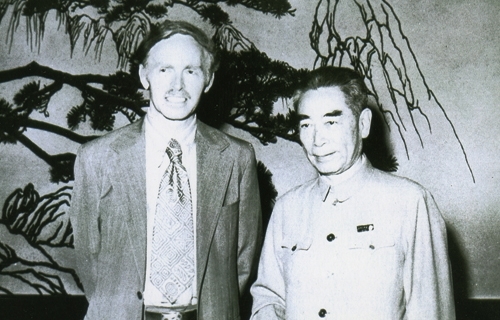
Jerome Alan Cohen (July 1, 1930 – September 22, 2025) was a renowned American lawyer who was one of the foremost foreign scholars of Chinese law. After studying law at Yale, Cohen embarked on a career in constitutional law, clerking for Supreme Justices Earl Warren and Felix Frankfurter before beginning to teach law at the University of California, Berkeley. But at the age of 30 he pivoted, beginning to study Chinese language and the People’s Republic of China’s (P.R.C.’s ) legal system. After the resumption of diplomatic relations between China and the U.S. he became the first American lawyer to practice in China.
I wouldn’t get to know him until many years later, by which point he was not only the reigning authority on the subject but the beloved mentor and champion of generations of Chinese lawyers, scholars, and activists.
Jerry was tall and athletic and he put his stature to work for other people. There seemed to be almost infinite room under his wings. During my years in Beijing as a reporter in the early 2000s—a highpoint for U.S.-China cooperation on Chinese legal reform and the start of what would become known as the Rights Defense Movement—he was not only a trusted source but a regular dispenser of advice on people to meet, stories to pursue, and how to start a day properly (swimming, walks, orange juice).
His energy too seemed boundless then, and it still felt that way years later, listening to his tales from the ski slope, watching him lead discussions at NYU's U.S.-Asia Law Institute or at the Council on Foreign Relations, trotting alongside him for a brisk morning walk in Central Park, and fielding his late-night emails about the many pieces he wrote for ChinaFile. I appreciated the balance he struck, between a clear-eyed and often sharp critique of the way China often turned the people trying to improve its legal system into its victims, on the one hand, and an unshakeable belief in the benefits of contact and cooperation in pursuit of a fairer China and a better world.
In 2010, I was lucky enough to be in the audience for a series of autobiographical lectures he gave at Yale Law School around his 80th birthday, touching on different parts of the P.R.C.’s and Taiwan’s legal development, and the major roles he had played in both. The lectures were not short. But Jerry’s intellect and the ebullience held us rapt for hours. He had the best stories and he kept up telling them at the dinners that followed. We’d still be there listening long after the plates were cleared.
Because he was such a master of telling his own story, we’ve assembled links to some great examples, which you can find at the bottom of the righthand margin of this page. We hope you’ll peruse them alongside these recollections and tributes from colleagues, students and friends.–Susan Jakes
Comments
Thomas Kellogg
Realism and optimism can sometimes push us in opposite directions: Too often, a hard look at the world shows points to the limits of what can be done. The optimist, on the other hand, may overlook the present’s grim intractability in order to preserve hope for the future. Jerry was one of the rare people who was both clear-eyed about the current state of play in China, and also unfailingly optimistic about reforms to be implemented, activists to be released, better roads to be taken.
This rare combination made him both an insightful interlocutor—he had a way of getting to the heart of the matter when it came to legal reforms in China, or lack thereof—and also a wonderful colleague: He was always bursting with ideas, seeing options and possibilities the rest of us, too quick to cynicism, would miss. It also made him a great teacher: His lectures were always packed, often with visiting experts there to weigh in and to listen. I counted myself lucky to be included every time Jerry asked me to sit in on one of his classes. I came away wiser, always getting much more than I gave, and the post-class dinner conversation was not to be missed.
I like to think that Jerry’s tireless advocacy on behalf of imprisoned rights lawyers, activists, and intellectuals sprang in part from this notion: Imagine what these talented and committed people could do, if only the Party would let them out of prison to do it! He could always spot potential, not just in situations, but also—especially—in individuals.
Jerry’s scholarship will live on for decades to come. I still assign the Introduction to his monumental documentary study (co-authored with his friend and colleague Hungdah Chiu), People’s China and International Law. In roughly 20 pages, they tell the story of China’s engagement with international law over three hundred years, from the start of the Qing dynasty up through the first two decades of the People’s Republic. Like much of his scholarly work, that section can be profitably read by students new to the field and longtime practitioners alike.
Jerry’s public-facing writings form an equally important part of his legacy. Over the years, he produced a steady stream of op-eds, commentaries, and book reviews that are a treasure trove of insight and analysis. Take, for example, Jerry’s 2008 piece “China’s Reform Era Legal Odyssey,” written for the much-missed Far Eastern Economic Review. In five brisk pages, Jerry offers a historically-informed overview of China’s legal system. His conclusion is spot-on: For all of the very real progress made, judges, prosecutors, and lawyers remain hobbled by a lack of true independence from the Party. One could hardly do better in the search for a snapshot of the legal system, 30 years into the Reform era.
Future generations of Chinese law scholars will read Jerry’s prolific writings, and they can even watch some of his lectures and interviews online. But, sadly, they won’t be able to meet the man himself. Jerry’s personal style—his wit, his warmth, his vitality, his concern for others, and his abundant joie de vivre—was central to his life and his work. He loved corny jokes, and could quote snatches of Romantic poetry. An incredible raconteur, Jerry saw the humor in life, and could recall scores of moments when the great and the good got caught in unguarded candor or plain old bad luck. Dinner table anecdotes drew from a cast of thousands, ranging from Zhou Enlai to Edward Kennedy, from Ai Weiwei to Annette Lu Hsiu-lien.
Few can claim a legacy as impressive as Jerry’s. He helped found the field of Chinese law study in the United States. He played a role in the re-start of U.S.-China relations during the Reform Era. And he helped countless individuals, both professionally and personally. As we enter a darker period for U.S.-China ties, his accomplishments remind us to persevere, to stick to our own first principles, and to maintain our own strand of realist optimism.
Nicholas Bequelin
Jerry stood tall. He was, in fact, tall. That, along with his bold-yet-tasteful way of dressing, his resounding baritone, and his tennis-devotee handshake, struck anyone introduced to him with an aura of confidence, ease, and authority. But just as quickly, the whole room seemed to recede as he leaned slightly, enveloping his interlocutor in a disarming mix of warmth, curiosity, and empathy: “Where are you from?” “What do you do?” What often followed was a cheerful personal anecdote to establish a connection, a word of encouragement (“This is very important work you are doing”), or a promise (“Do you know so-and-so? No? I’ll introduce you”). When most of us say such things, they come out as conversational pleasantries. With Jerry, well, he made people feel truly seen—no matter their station in life, where they came from, or, with uncommon credit to a man of his generation, their gender.
And just like that, he would draw back an invisible curtain and invite the audience back into the moment. For of course, there was always an audience around Jerry. There were anecdotes, jokes, and stories—told many times, to be sure—and yes, he relished the attention. But Jerry was not a mere raconteur delighting in the sound of his own voice and being the center of attention. No. His object was to foster an atmosphere in which a diverse group—differing in background, knowledge, experience—would feel comfortable coming together to grapple with the important question discussed that day.
He directed his authority, both personal and scholarly, not at enforcing his viewpoint or showing off the brilliance of his intellect—which is undisputed—but at drawing the most from those in front of him. Anyone’s contribution was valued, no matter how small, if it helped the discussion, shed a different light, or raised a difficult problem.
Jerry also stood tall because he had no qualms about confronting injustice. People often say that he “cared about human rights,” but I don’t think that’s quite right. Jerry did not care for abstract notions of rights or what some international rights covenant prescribed. He cared about individuals, their circumstances, the injustices they faced, and whether the legal system could remedy or prevent them. In this, he was closer to human rights practitioners than jurists—for we practitioners tend to doubt that the law alone can ever outweigh power. . .
Throughout his career, Jerry stood out for defending victims of injustice. He took on not only powerful governments—South Korea and Taiwan under dictatorship, and of course China—but also “well-intentioned” colleagues and institutions at home who sought to moderate or dissuade him from his efforts. Growing up in pre-war New Jersey, where some beaches were off-limits to Jews like him, did not exactly inculcate blind reverence for arbitrary “rules.” If the law was unfair, if the system was faulty, if the judiciary was unjust, it had to be changed.
“How could Jerry be so outspoken and yet still treated by the Chinese government as an esteemed guest and a ‘friend of China’?” a colleague recently asked. It’s a good question. The reasons for the “friend” part are easy enough to chalk up: his celebrated meetings with Zhou Enlai and other historical leaders, his foundational role in China’s legal reforms, and his service as an unofficial channel between the U.S. and China. But there was also plenty in the debit column: op-eds, visits to dissidents, Chen Guangcheng, as well as legal cases against Chinese entities tied to high-ranking officials. In the end, I believe the answer is that no matter how blistering his criticisms could be, he never ever looked down on China.
The law, for Jerry, was never some abstract idea but a matter of human affairs. And human affairs are messy, complicated, and conflict-ridden. Law is one way to make them better, yet it is also a vast, imperfect machinery—difficult to design and harder still to operate. There was no reason why law could not improve human affairs in China, even under one-party rule—and so, no reason to look down on the country. In the end, this may best explain why the doors there remained open to him.
Harold Hongju Koh
I first met Jerry Cohen in the spring of 1975 when I was a senior at Harvard College. At the time, I was applying to be a first year student at Harvard Law School, and Jerry was the acknowledged master of East Asian Legal Studies, the field I was hoping to enter. He was, to be frank, scary: totally self-assured, supremely knowledgeable, yet cheerful and upbeat. He spoke with reverence of his own time as a student at Yale Law School, a school about which I knew little at the time. I saw him just one more time during my Harvard Law School years in the late 1970s. He was heading off for a great adventure: the opening of Paul Weiss’ law office in Beijing.
East Asian lawyers I knew spoke of him with reverence and awe. Over the years, we became friendly, and then friends. He settled in at NYU Law, and when I was Assistant Secretary of State for Democracy, Human Rights, and Labor in the Clinton Administration, I consulted him on constructive approaches to building the rule of law in a rapidly changing China. When I became Dean of Yale Law School in 2004, Jerry warmly congratulated me and urged me to take his alma mater in a more global direction, which it has done by building a leading China Law Center.
In April 2012, as Legal Adviser to Hillary Clinton’s State Department, I found myself in the U.S. Embassy in Beijing with Chen Guangcheng, the blind Chinese activist “barefoot lawyer” who had launched a daring escape from house arrest in his home village in Shandong province, and had somehow made it to the outskirts of Beijing. I advised Secretary Clinton that it would be lawful for the United States to admit Chen to the U.S. Embassy there, even though Secretary Clinton and hundreds of other senior American officials were scheduled to arrive in Beijing a few days later for the historic U.S.-China Strategic and Economic Dialogue. As Jerry later recounted in his autobiography Eastward, Westward: A Life in Law, I suggested to Secretary Clinton and Kurt Campbell, our Assistant Secretary for East Asian Affairs, that we call Jerry to see if Chen could be admitted to NYU’s then-nascent Shanghai campus. We thought that he and his family could live there safely, and he could continue his work, while he recovered from the medical injuries he had incurred while escaping. NYU’s visionary president, John Sexton, and Jerry as director of the U.S.-Asia Law Institute, heroically and immediately extended Chen an invitation to be a Visiting Scholar at the Institute.
From that point on, Jerry became a crucial intermediary in a hair-raising two-week saga that is recounted in Jerry’s own book as well as Secretary Clinton’s memoir Hard Choices. After first agreeing to leave the U.S. Embassy to go to NYU Shanghai, Chen changed his mind, and decided he wanted to go abroad. While the Strategic and Economic Dialogue ensued, our team negotiated Chen’s fate with our People’s Republic of China counterparts, until finally Beijing announced that Chen could apply for permission to go abroad, which was quickly granted. In mid-May, Jerry welcomed Chen and his family to NYU and arranged for his stay at a spacious faculty apartment in the heart of the NYU campus. That was just one day after my own son graduated from Yale College and the end of an emotional roller-coaster for me. I reflected on the similarities between Jerry, an American lawyer who had the vision to spend much of his life in Asia, and my own late father, Kwang Lim Koh, a Korean lawyer who had the vision to spend most of his life in the United States.
Best of all, the grueling shared experience finally made me and my hero, Jerry Cohen, brothers in battle. After that, we embraced whenever we saw each other, and I was thrilled to be able to honor Jerry with this story at a conference held shortly thereafter at his U.S.-Asia Law Institute. Most important, thanks to Jerry Cohen, Chen and his family escaped imprisonment and got a new start in America. Jerry deeply touched so many lives, including Chen’s and mine, and gave to all of us from his enormous well of wisdom and humanity.
Donald Clarke
I first encountered the name of Jerome Cohen when I was a student in China in the late 1970s. In the spring of 1978, in the Canadian Embassy library in Beijing, I serendipitously ran across his pathbreaking work (modestly billed “a preliminary inquiry” by the publisher), The Criminal Process in the People’s Republic of China, 1949-1963: An Introduction (1968). I was immediately taken by the way he told his story through a wide combination of sources, including a rich collection of stories gathered from émigré interviews in Hong Kong. I was so inspired that I began to collect articles from the Chinese press on the then-incipient efforts to construct the post-Mao legal system, and wrote my first long-form essay in Chinese on the subject a year later.
Meeting him in person in Tokyo in 1980—like so many others, I was on the receiving end of his generous willingness to spend time with young people with no previous connection to him—I found him (it hardly needs saying) even more inspiring in person. And as with so many others, he was instrumental in my decision to eventually go to law school and make a serious study of Chinese law.
I like to think that Jerry was lucky that when he set out to study the Chinese legal system, China did not have a well developed system of courts and reports of appellate decisions. Jerry had proven his ability to handle such materials masterfully both in law school and as a Supreme Court clerk; why not keep doing what you do well? But China did not cooperate, and instead forced him to look at what was really happening on the ground through extensive interviews. The result was not just his 1968 book, but a model of how to do Chinese law scholarship that has enriched the field.
Many have commented on how much Jerry did for them and others. I echo those comments. But the meaning of his life extends beyond that. It includes the inspiration he provided to others to emulate his model of generosity and thereby to enrich the lives of still others, in an ever-widening ripple. Many people probably don’t even know that they owe the guidance and mentoring they received from someone to that someone’s just trying to follow the example Jerry set in their own case. Jerry lives on in a very real way in the people and institutions he fostered over the years. Can one have a better legacy?
Carl Minzner
Being a guest speaker at one of Jerry’s roundtables was an unforgettable experience. He wouldn’t let you ramble. Nor slide into academic jargon. Nor even make your prepared remarks. Instead, with his bright, kind eyes crinkling above his white mustache and omnipresent bow tie, he would immediately lay into you with the big questions—how you became interested in law, how you became interested in China, and what you thought about where things might go. He wanted your life story, not your talking points.
Jerry did not live in a black-and-white world, populated with abstract concepts such as “America” or “China.” His was painted in radiant colors, filled with vibrant people and memorable interactions. He was never happier than when he could recount an anecdote about meeting Zhou Enlai, or learn how a Chinese rights activist got her start and why she continued even in the face of official persecution. For him, those weren’t just disconnected stories. They were part of a long fascinating narrative about the trajectory of developments in China that—with his deep belief in the long moral arc of the universe—just had to eventually go in the right direction.
His curiosity was boundless until the end. I distinctly remember his saying within the past year: “What really offends me about death is that I won’t be able to see how it all turns out.”
And through it all, he remained optimistic. Maybe that is what starting to study China in 1960, seeing it spiral downhill into the Cultural Revolution, and witnessing the absolute nadir of Sino-U.S. relations gets you. Many would become cynical after witnessing such a catastrophe, but for Jerry, it did the opposite. Having seen the absolute bottom, he knew that change was always possible, that recovery was never out of the question. Life is long. Anything is possible.
Margaret Lewis
“Come work with me. I’ll find money.” If just about anyone else had said this, I would have taken the safe route of returning to a law firm with the promised clerkship bonus. But this was Jerry.
In the summer of 2005, I packed up a truck, drove to New York City from San Diego, and embarked on a project that eventually became our book Challenge to China: How Taiwan Abolished Its Version of Re‑Education Through Labor.
I had already worked closely with Jerry while a law student at NYU, but our Taiwan project cemented a professional partnership. My life would have been dramatically different but for Jerry’s intervention at a key moment as well as for his enduring mentorship.
Stories like this have poured forth since Jerry’s passing on September 22. But for Jerry, would X have occurred? And not in a “butterfly effect” kind of way. The “Jerry effect,” born of his ingenuity, generosity, and persistence, brought momentous, direct contributions to people’s lives.
For me, the Jerry effect meant that I turned my focus to criminal justice in the People’s Republic of China and Taiwan. But for Jerry, I do not know when, or even if, I would have gone to Taiwan. I remember sitting in the tea house of the Grand Hotel in Taipei as Jerry recounted his meeting there in 1968 with Generalissimo Chiang Kai-shek and Madame Chiang. When asked the Generalissimo’s stock question about what could be done to improve the Republic of China, Jerry resisted the urge to tell him to end the military dictatorship and, instead, suggested that the talented legal historian Chang Wejen establish a project at Academia Sinica. This led to decades of invaluable work by Professor Chang and his team collecting, preserving, and analyzing historical documents.
As a morning person, I always appreciated Jerry’s embrace of breakfast meetings. He would stride into the Grand Hotel’s restaurant and, instantaneously, bananas would appear. Jerry had impressed upon the restaurant staff the importance of bananas with his cereal. You would have thought with his distinguished bowtie and furrowed brow that he was explaining a pressing issue of international concern. But then his characteristic wink and puckish grin would puncture the solemnity.
A parade of Taiwan’s legal luminaries joined us for those breakfasts overlooking the hotel’s gardens. Not only did these meetings give me a window into Taiwan’s history, but the personal accounts also conveyed the pivotal role Jerry played in helping so many people, especially during the dark days of Taiwan’s martial law.
While Jerry thankfully never had to save me from a perilous situation, his influence on my life has been profound, and my gratitude is immense. By extension, the Jerry effect has meant that Taiwan is also central to my family. My kids are growing up with Taiwan as part of their lives. But for Jerry, they would not know the beauty of Alishan or the joy of a Taiwanese mango. And I can only begin to imagine how else these experiences will change their lives. But for Jerry. . .
Xu Zhangrun
Jerome Cohen enjoyed the longevity of a truly righteous man, however, following an extended illness, he has now left us. His passing truly marks the end of an era. In what seems like another age, years ago Jerry Cohen, our master, ventured to this distant land of China to contribute his talent to the opening of that door, hopeful of being able to propagate the rule of law for the sake of broader public benefit.
For Jerome Cohen, the idea of legal rights was always grounded in a respect for basic human rights. He was motivated by a spirit of decency and his efforts were crowned with initial success. Those early years contributed to a better future for countless people although, ultimately, they were unable to challenge the immobility of totalitarian habit. The failure, however, was not that of Jerry Cohen, rather it was part of the larger Chinese tragedy, one that has seen the repeated frustration of universal values. For those of us mired yet in this reality, to see him now depart adds to our profound sense of loss. In his wake, we continue to face this sorrowful state of stagnation. As a land that was at the pinnacle of the world [that is, the U.S.] is itself enamored of autocracy—something celebrated by tyrants worldwide—our already bereft state is further exacerbated by incredulity.
Since 2020, Professor Cohen resisted the challenges of the passage of time and remained energetically engaged in writing projects; he even found time to write about my plight on six separate occasions. He also advocated on my behalf even though (or because) he knew exactly what fate had in store for me. He excoriated the regime for its shameless persecution of me. And more importantly, he pinpointed the flawed logic behind their machinations while identifying the crux of our troubles in the context of our lived reality. His concern for the state of the law in China was consistently framed by an unflinching advocacy for the rule of law itself. For he knew that if true justice is impossible we are all reduced to a state of banditry. Fully aware of the punishment that would be meted out to me, Professor Cohen invited me to teach at the U.S.-Asia Law Institute, which he had founded at New York University. It was a heartfelt act of generosity offered to me at a time of pressing need, a helping hand extended to a likeminded colleague on the other side of the world who was submerged in iniquity. His generosity was a practical recognition of our shared humanity. This venerable professor was not only a teacher of stature and an unwavering champion of substantive exchange between West and East, he was also an outstanding humanitarian whose real-world actions were a practical expression of his ideals.
In all of its vastness, the world is yet a very small place. It is by the pursuit of goodness, both for oneself and for a multitude of others, that one can find solace in life, thereby being able to tolerate and fully appreciate all that existence has to offer. Human nature, for all of the wickedness of the human heart, also contains an imperishable core of sublimation and decency. It is as eternal as the sun, the moon, and the stars themselves, and it shines with enduring ferocity. This is why, despite our physical frailty, even when confronted by a sea of troubles, countless people will advance undaunted. This too is my own experience, one that I know Professor Cohen understood, encouraged, and applauded.
Fragile, too, are even the wisest among us. Looking into the great expanse of heaven and surveying the boundless vistas of earth, even though each advance is but an inching step forward, as I record here my mournful celebration using this most fragile medium, I remain deeply grateful for the bounty of learning that Professor Jerome Cohen bequeathed to us all. A member of my spiritual family has departed. I hail his memory even as I tearfully grieve over our loss.
Translated by Geremie R. Barmé. The post was originally published on China Heritage.
Teng Biao
In the summer of 2006, Jerry visited Beijing, and I invited about 15 lawyers to join him for dinner. Gao Zhisheng was among them, and we all sensed that he was already on the road to prison. Jerry advised Gao to slow down, as we discussed strategies for the weiquan or “rights defense” movement, then in its early stage. Jerry had already given immense support to the blind activist Chen Guangcheng and in the case of Sun Zhigang—an incident later seen as the symbolic beginning of the weiquan movement. He warmly praised the efforts by Xu Zhiyong, myself, and others who tried to use existing legal channels to promote the rule of law in China. For decades, he poured tremendous passion into supporting Chinese human rights defenders. Every time we met, he asked me about the latest situation of Chinese lawyers and prisoners of conscience.
Even before I was born, Jerry had begun studying Chinese law and politics. Later, he played a decisive role in reviving legal institutions from the ashes of the Cultural Revolution and Mao-era lawlessness. He was the godfather of the study of People’s Republic of China law in the West—a mentor of mentors. No one did more than Jerry to advance Sino-U.S. exchanges in legal education and the legal profession. When I co-initiated “Chinese Human Rights Lawyers Day” in 2016, I persuaded the other organizers to establish the Award for Advancing Rule of Law and Human Rights in China and to present the inaugural honor to Jerry.
One question he often asked himself was whether engagement with China was truly worthwhile—could it really make a difference? I criticized engagement policy that ignored human rights and democratization, which too often amounted to appeasement, and I called instead for “principled engagement.” That, in fact, was exactly what Jerry embodied. Without self-censorship, he persistently raised human rights issues.
In 2007, Jerry was appointed as an honorary professor at the China University of Political Science and Law. In his acceptance speech, he earnestly urged the university leadership to protect teachers—“trouble-makers” like me—from pressure from the authorities. I was in the audience that day, deeply moved. His model of “critical engagement” should continue to inspire scholars and policymakers who now wrestle with questions of confrontation, decoupling, and appeasement.
After being banned from teaching, disbarred, abducted, and tortured repeatedly, I fled China in 2014 and continued my research and activism in the U.S. Jerry cared not only about my safety but also about my career. In 2015, he invited me to be a visiting fellow at the U.S.-Asia Law Institute at NYU, which he founded and greatly shaped through his contributions. We held discussions every week, and most of the time he personally served as the moderator. He was humble, humorous, sagacious, with immense intellectual curiosity and a deep commitment to humanity.
He empathized deeply with the suffering of humanity, yet he never yielded to darkness. Jerry applauded the courage of Chinese activists and dissidents, condemned Chinese Communist Party leaders who trampled human rights and suppressed freedom, and never lost confidence in the Chinese people.
One time when I nearly fell into depression, Jerry told me that most of my pain was inflicted by myself. His kindness and understanding pulled me out of despair and showed me the power of inner peace. He patiently wrote recommendation letters for me, responded to my emails almost instantly, and invited me to countless panels and discussions. He wrote a preface to the book that I’m still working on.
In 2020, Jerry and I co-taught a seminar, “Law, Justice, and Human Rights in China,” at The New School, and the course attracted nearly 1,000 registrants. Later, we co-authored an article on two competing visions of China’s political future—Xi vs. Xu. Last year, Jerry welcomed my seven-hour interview of him at his home, spread over two sessions. His wisdom, humor, compassion, and optimism were all unforgettable. When the photographer and I suggested he take a break, he smiled and said, “I can speak another four hours.” Upon the request of the China Journal of Democracy, a quarterly I co-established and he passionately supported, I also conducted an academic interview with Jerry, and his analysis of China’s Party-state and legal system was thought-provoking.
Our final collaboration was published in July 2025, marking the 10th anniversary of the “709 crackdown” on Chinese lawyers.
Jerry was tireless and undefeated. Even after retiring from NYU at the age of 90, he remained active—moderating talks, giving speeches, writing blogs, and reverently speaking out for political prisoners in China, Hong Kong, East Turkestan, and Tibet. The last time I saw him, I brought food from Ma Ju’s restaurant, and by coincidence he was reading a New York Times report about Ma. He cared deeply not only about people in China, but also about the diaspora community—our fears, efforts, and hopes.
Jerry’s life was a blessing to the world, and he himself was blessed. I will never forget his smile, his voice, his deep eyes and boundless love.
It pains me that he left the world with both the United States and China drifting in a dark direction. His legacy will continue to inspire the people he loved so much, people who carry forward the beautiful causes he cherished, with the belief that we must try our best to make the world better.
Eva Pils
Once, early on in our acquaintance around 2005, Jerry gave me a piece of bracing advice about how to navigate around the Chinese authorities when trying to meet and interview persecuted human rights defenders.
“Try not to get arrested,” he said. Then, after the slightest pause, looking straight at me from his deep-set, old blue eyes: “If you do get arrested, take notes.”
It is not the kind of guidance that would pass muster under any of the university research risk assessment and management procedures I know—some of which I later helped design at King’s College London. Yet it was the best piece of advice I ever received on this difficult subject, and not just because it made me laugh in the moment. It was a thought that restored a sense of agency and resilience, freeing from the many unhelpful knots we tie ourselves in when we try to second-guess what a repressive political system might do to us and how to avoid it. It was lucid and completely unflinching, and that is how I will remember Jerry.
Born into a Jewish family in 1930, he was of a generation, and a background, to know that things can get horrifically bad—that they can reach a point where we are on our own and no procedure any institution has ever devised can make the slightest difference.
Jerry not only chose to study law, a subject that, at least in its liberal-democratic reading, is the antithesis to arbitrariness and abuse. He chose law in China at a point in time where legal rules and principles offered only a distant hope of one day curbing power abuses. As soon as it became possible, he engaged with those actors in Chinese society who used law to defend others and routinely faced Party-state persecution for their (rarely successful) efforts.
He seemed optimistic for decades, but he did not go off course when, at some point during the Xi era, it became clear that China was undergoing autocratic re-closure, helped by the erosion of democracy elsewhere in the world and ultimately his own country. He took a deep, caring, personal interest in advocates and survivors, drawing attention to them and promoting their causes, worrying about them, not giving up on them when others had long done so, endlessly resourceful on their behalf.
He taught by example that what matters is not being free from fear, nor full of optimism, but staying alive to the situation of others and to the choices one still has: to witness, to record, to call out injustice, and to do so with integrity, curiosity, humor, and humaneness.
Yu-Jie Chen
The wave of tributes to Jerry is a testament to his extraordinary legacy across so many generations, institutions, and places. As a Taiwanese, I want to pay special tribute to his meaningful engagement with Taiwan. In Taiwan’s transformation from one of the world’s longest-running martial law regimes to a leading democracy in Asia, Jerry was never an observer watching from the sidelines. He went to work—pressuring the authoritarian government for justice and accountability, and later promoting human rights and the rule of law in the young democracy.
When we first met in 2008, Jerry, upon learning that I was from Taiwan, asked, “Do you know the ‘Chiang Nan ming-an’?” I was embarrassed by my ignorance, but he patiently recounted this tragic chapter of Taiwan’s history. In 1984, the Chinese American author Henry Liu (pen name Chiang Nan) was assassinated at his San Francisco home by gangsters sent by the Kuomintang’s (KMT’s) military intelligence officers. Jerry took on the pro bono case to represent Liu’s widow, filing a wrongful death suit in California and a parallel civil suit in Taiwan, an unprecedented challenge to the authoritarian regime. Despite resistance, he won permission to cross-examine the defendants in Taiwan and ensured daily media coverage, calling for a public reckoning that helped erode the regime’s legitimacy.
During this period, Jerry also pressed the KMT government to release his former student, Annette Lu, who was imprisoned for political activism. He reached out to another former student, Ma Ying-jeou, then serving as President Chiang Ching-kuo’s interpreter, to secure Lu’s release as a gesture to rehabilitate the government’s image. After her release, Jerry brought Lu to Harvard on a fellowship, enabling her to continue her human rights work. Such acts were emblematic of Jerry’s lifelong instinct to protect those persecuted. The institutions he built at Harvard and later at NYU became safe harbors for exiled activists, lawyers, and scholars—from Benigno Aquino and Kim Dae-jung to Chen Guangcheng and many others.
After Taiwan’s democratization, Jerry remained engaged, following its progress with deep admiration and care. His book with Maggie Lewis on Taiwan’s abolition of the liumang (hooligans) punishment was driven by a strong desire to inform the public about Taiwan’s impressive achievement in dismantling the unconstitutional legacies of the past. Sensitive to parallels with China’s “re-education through labor,” he hoped Taiwan’s reforms might inspire similar change across the strait. Later, when Beijing and Taipei began signing cross-strait agreements, Jerry urged both sides to include strong protections for human rights and due process. The idea may have seemed idealistic, but those who knew him recognized that such hope and vision were central to his work.
Jerry did not take Taiwan’s progress for granted. He remained alert to its challenges and unafraid to confront controversy. At a university forum on criminal justice in Taiwan around 2009, when the host professor asked the panel to avoid “politically sensitive issues”—like the replacement of judges in the trial of former President Chen Shui-bian, a topic Jerry had just begun to raise—he was taken aback. He insisted on continuing the discussion, believing that, as scholars, we have a duty to confront real problems rather than retreat into the safety of abstraction.
Beginning in 2008, Jerry wrote regular op-eds that were also translated into Chinese for readers in Taiwan and beyond. He once said he wished he had done this earlier. His influential commentaries exposed abuses, proposed reforms, and provoked public reflection. Even when progress seemed distant, he ensured that the voice of criticism never fell silent.
Jerry had an uncommon quality: He was respected even by those who disagreed with him. In Taiwan, he was neither “green” (pro-Democratic Progressive Party) nor “blue” (pro-KMT), but considered a constructive and fair critic. This integrity earned admiration across political divides.
Jerry brought this spirit to the international expert committee convened by the Taiwan government to review its human rights record. He could be sharply critical yet genuinely encouraging. During the review dialogue, when Taiwanese officials cited the United States and Japan as “advanced democracies” that still retained the death penalty as justification, Jerry responded: “YOU are already an advanced democracy,” urging Taiwan to lead by example. To quote one of Jerry’s favorite lines from Robert Burns: “O wad some Pow’r the giftie gie us / To see oursels as ithers see us!” Jerry had a gift for seeing—and, in this case, for seeing Taiwan at its best. His vision continues to inspire those of us in Taiwan to see ourselves with the same confidence, ever striving to be better.