The China Bashing Syndrome

IT IS a truth universally acknowledged that a man in possession of a major American political party’s presidential nomination must be in want of a more assertive policy on China. Bill Clinton upbraided George Bush senior for “coddling dictators”; Mr Bush’s son went on to accuse Mr Clinton, when president, of much the same thing. Barack Obama, during his first presidential campaign, called the younger Mr Bush “a patsy” in his dealings with China. Now it is Mitt Romney’s turn: in February he described Mr Obama as a “near supplicant to Beijing”.

Sino-American Perceptions

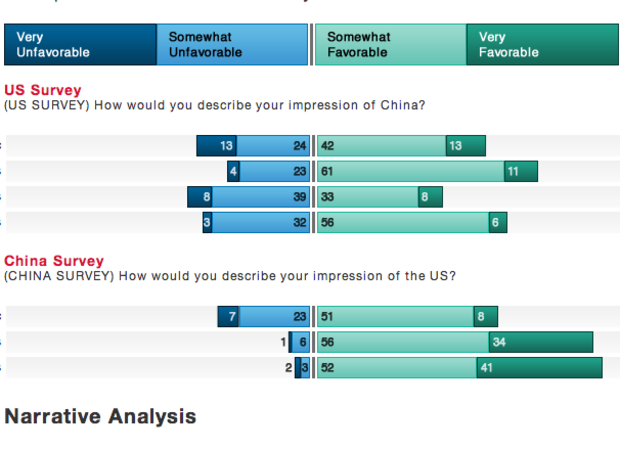
This week on Sinica, Kaiser Kuo is joined by two guests from the Committee of 100, an organization formed over twenty years ago by I.M. Pei and other prominent Chinese-Americans to address issues in the Sino-American relationship. The Committee recently released its fourth in-depth survey, the 2012 US China Public Opinion Perceptions Survey which turns up some surprising findings about changes in how Americans and Chinese perceive each other.

Council on Foreign Relations

Publication Logo Vertical: 
Publication Logo Header: 

From their website:

The Council on Foreign Relations (CFR) is an independent, nonpartisan membership organization, think tank, and publisher. Each of these functions makes CFR an indispensable resource in a complex world.

The Uncertain Future of Beijing's Migrant Schools

As the gap between China’s urban and rural economies continues to expand, the largest rural-urban migration in world history persists. When those from the countryside arrive in the city, the current hukou system blocks their access to the social services that urban residents take for granted. While many join the ranks of China’s “left-behind children” as their parents toil in the city, those who go along often rely on migrant schools for their primary education – while they could attend a public school, the typical fees required far exceed a migrant family’s income. An article from Deutsche-Welle describes the shabby existence and uncertain future of one unlicensed migrant school in Beijing:

China's Coming Economic Transformation

China is grappling with an economic downturn, but there is more than the usual amount of disagreement about how fast it's slowing down. The battle is not between the usual bulls and bears. The most interesting split this time is between those who focus on a "macro," or top-down, picture of an economy, and those who zoom in on a "micro," or bottom-up, picture of companies.

A Confucian Constitution for China: Where's the Popular Sovereignty?

Daniel Bell and Jiang Qing have a short op-ed in today's NYT outlining what a Confucian political system for China might look like. This is a large and complex topic, and the brevity of the piece really cannot do it justice, so any critique must be limited: I'm sure Bell and Jiang have much, much more to say by way of elaboration of this topic. But even in this roughtest of outlines, there seems to be something essential missing, at least to my mind: the notion of popular sovereignty.